 Lightning Tracker
App Store
Maps and data
Handheld lightning detectors: how they work and where they fall short
November 9, 2026 · 6 min read
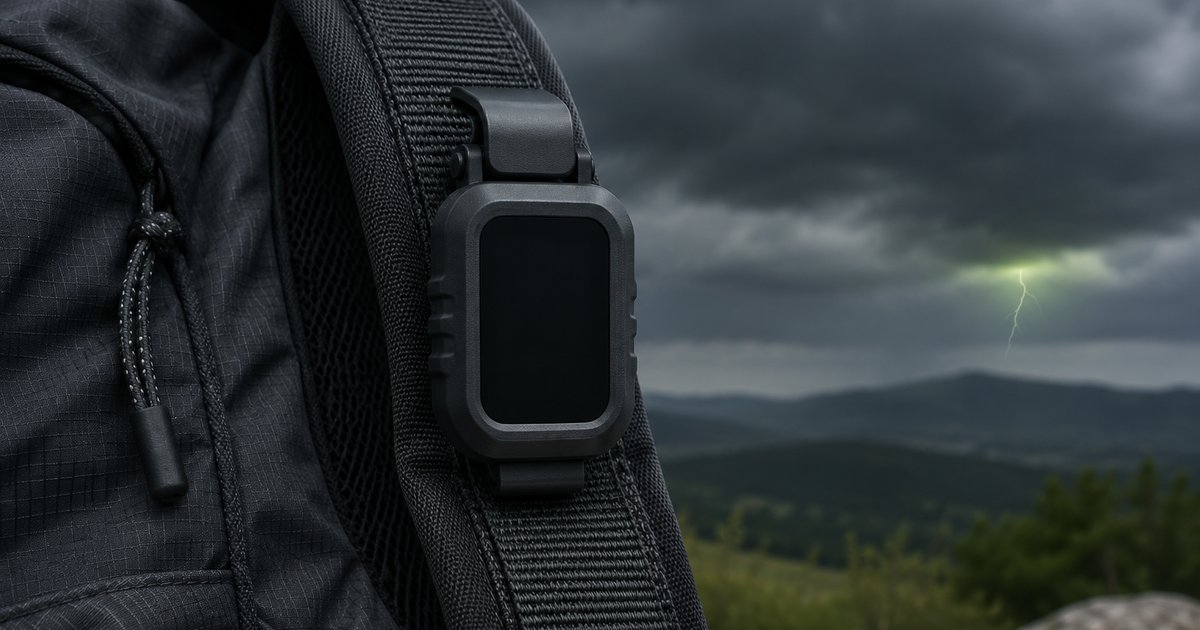
A handheld lightning detector is a small radio receiver: it picks up the electromagnetic pulse of a nearby strike and estimates how far away the strike was. It can add a warning, but as of November 2026 the official guidance does not let it be the only one. NOAA and OSHA say these devices typically miss strikes, cannot give a strike's location and are less accurate than commercial detection services, and a 2013 position statement from athletic trainers said their performance had not been independently verified.
What a handheld detector actually senses
The OSHA and NOAA fact sheet on lightning safety for outdoor workers describes the principle in one sentence: portable and hand-held lightning detectors pick up the electromagnetic signal from a nearby strike and process it to estimate the distance. Makers describe the same idea. SkyScan's manual says its detector listens for the characteristic electromagnetic emissions of individual lightning strokes and applies a patented method to turn them into a distance.
One low-cost sensor chip shows what this looks like inside. A 2019 paper in the journal Electronics, which built a city-wide sensor network around the AS3935 chip, reports that the chip receives a narrow band of radio frequencies centered on 500 kHz, about 33 kHz wide. It does not measure a place. It returns what the authors call statistical estimations of distance. The authors also report that the chip's datasheet gives a 40 km maximum range, that its precision is not linear across that range, and that they therefore spaced their sensors no more than 25 km apart. That is one chip; the commercial handhelds discussed below do not say which sensor they use.
The fact sheet adds that these devices cannot provide the location of a strike. A single receiver explains why: it hears a pulse from somewhere, so it can offer a distance band but not a point on a map. Detection networks find the point by comparing when the same pulse reaches several sensors, a method laid out in how lightning is detected.
What the makers say their detectors do
The table lists five handheld or portable models as their makers describe them, taken from each maker's manual or product page as of November 2026. It is not a ranking, and none of the numbers comes from an independent test.
| Model | Stated detection range | Lightning types the maker names | How distance is shown |
|---|---|---|---|
| AcuRite 02020 | 1 to 25 miles (1.6 to 40 km) | Cloud-to-ground, cloud-to-cloud and in-cloud | Estimated distance to the storm front, updated with each strike |
| SkyScan P5-3 | Up to 40 miles | Built for cloud-to-ground; may miss some cloud-to-cloud | Four bands: 0-3, 3-8, 8-20 and 20-40 miles |
| StrikeAlert HD | 0 to 40 miles | Not stated on the product page | Four bands: within 6, 6-12, 12-24 and 24-40 miles |
| TALOS | Up to 25 miles | Cloud-to-ground and cloud-to-cloud | Three colors: 25, 16 and 6 miles |
| Thunderbolt U1 | Detects to 130 miles; warns within 75 | Built for cloud-to-ground; may miss some cloud-to-cloud | Range and speed of the closest storm cell |
Two things stand out. First, the stated ranges differ more than fivefold, from 25 to 130 miles, and each is a claim about the farthest strikes the unit can hear, not about how reliably it hears them. Second, the makers do not agree on which flashes their units hear. AcuRite and TALOS say theirs register cloud-to-cloud lightning as well as cloud-to-ground; SkyScan and Thunderbolt say theirs are built for cloud-to-ground strikes and can miss some of the rest. NOAA's National Severe Storms Laboratory says there are roughly 5 to 10 times as many flashes that stay in the cloud as flashes that reach the ground, with individual storms varying, so two detectors listening to the same storm may report different amounts of activity.
How accurate handheld detectors are
Independent testing of handheld detectors is the missing piece: a search for it turned up no published test, so this page does not name a most accurate model. What exists is a maker's figure and statements from the organizations that write safety guidance. The retailer listing for the SkyScan P5-3 says the unit is accurate to within 1 to 2 miles 97% of the time, without saying how that was measured. The 2013 position statement of the National Athletic Trainers' Association says handheld detectors come from numerous manufacturers but their performance has not been independently verified, and that they should not be the sole source for deciding when to move to shelter. The OSHA and NOAA fact sheet, in its June 2021 edition, says handheld devices are less accurate than commercial detection and notification services.
The athletic trainers' statement dates from 2013, and no newer edition turned up as of November 2026. A test could exist that the search missed, so the fair summary is that independent evidence was not found, not that none can exist.
Where handhelds fall short
Handheld detectors share several limits, set out in the agencies' guidance and in the makers' own manuals.
- The first strike. The fact sheet says no system can detect the first strike, and that handhelds cannot predict it. SkyScan's manual warns that storms can form directly overhead with little or no warning even when a SkyScan is in use. Thunderbolt's manual says its unit can only display information based on strikes it has already seen.
- Missed strikes. According to the fact sheet, these devices typically do not detect all strikes. The SkyScan and Thunderbolt manuals add that some cloud-to-cloud strokes may go undetected.
- Interference and false alarms. AcuRite's manual says that in rare cases its detector may register lightning that is really interference, and tells users to keep it at least 3 feet from sources such as electric motors, fluorescent lights, microwave ovens, computers and phones; the list includes the motors in a car. SkyScan's manual names TVs, computer displays, motors, gasoline engines and radio transmitters, and says its false-trigger warning takes about 60 seconds to start, during which false strikes may keep appearing.
- Warm-up. Thunderbolt's manual tells users to treat any detected storm cell as local until the unit has gathered at least 15 minutes of data.
- Rain. AcuRite's manual says its detector is weather resistant but not intended for direct exposure to rainfall, and SkyScan's manual calls its unit weather-resistant but not waterproof.
A distance band also says where the latest strike was heard, not how far the next one can land. The National Weather Service says that if you hear thunder, you are likely within striking distance of the storm, and that “bolts from the blue” can strike 10-15 miles from the thunderstorm; lightning myths covers both. Makers' own danger thresholds are not the same either: SkyScan's manual treats detected activity within 8-10 miles as immediate danger, and TALOS's red level is 6 miles.
Using a detector without leaning on it
Detector makers tell buyers not to rely on the unit alone. AcuRite's manual says to take shelter immediately when lightning is present whether or not the detector has registered it, and not to treat the detector as the only source of warnings. The fact sheet says NOAA recommends relying first on NOAA weather reports, and that in some cases simply listening for thunder or watching the sky may be a better indication of a developing or nearby storm than a handheld detector. A lightning plan for outdoor work shows where detection sits in a written plan.
The 30-minute wait needs the same care. AcuRite's detector keeps alerting until it has registered no strikes for 30 minutes, then returns to its listening state. The National Weather Service counts its 30 minutes from the last lightning or thunder, so thunder you hear restarts the wait even if the detector heard nothing. Why the wait restarts explains the rule, and flash to bang shows how counting seconds fits in.
Handheld detector or phone app
A handheld and a phone app approach the same problem from opposite ends. A handheld listens for itself, so it does not depend on a cell signal or a data feed, and it hears only what reaches its own antenna within the range and flash types its maker states. Lightning Tracker, an iPhone app, shows recently detected strikes on a live map, with the distance and direction to the nearest one and how many minutes ago it was detected. It alerts you when a strike is detected inside a radius you set for each place, 10 miles (16 km) by default, and starts a 30-minute wait after the last detected strike inside that radius that restarts with every new one. When the wait ends, the app reports what it observed and asks you to judge conditions yourself; it does not announce that the storm is over.
The app has limits of its own. Detection networks miss some strikes, especially weak ones; data can arrive late, which the app marks as a delay or gap instead of counting it as quiet; and iOS decides when a closed app can check for new data. Like a handheld, it does not replace official warnings and local procedures. How to choose an alert radius shows how to set the distance for a place.
Not a substitute for official weather warnings.
If you hear thunder, seek shelter even if the app shows no nearby strike.
Sources
- OSHA and NOAA, Fact Sheet: Lightning Safety When Working Outdoors (OSHA FS-3863, June 2021, PDF)
- National Athletic Trainers' Association, Walsh et al., Position Statement: Lightning Safety for Athletics and Recreation, Journal of Athletic Training, March-April 2013
- Chaney Instrument Co. (AcuRite), Lightning Detector model 02020CA instruction manual (PDF)
- SkyScan (Xtreme Research Corporation), SkyScan Lightning Detector/Storm Detector manual (PDF, copy hosted by a retailer, cover dated 2002)
- Scientific Sales, SkyScan P5-3 Handheld Lightning Detector, retailer product page, read November 6, 2026
- Forestry Suppliers, StrikeAlert HD Personal Lightning Detector, retailer product page, read November 6, 2026
- TALOS, TALOS Lightning Detectors, maker product page, read November 6, 2026
- Lightning Detection Solutions, Thunderbolt U1 instruction manual (PDF, 2022)
- Mialdea-Flor et al., Development of a Low-Cost IoT System for Lightning Strike Detection and Location, Electronics 8(12), 1512, December 2019 (PDF)
- NOAA National Severe Storms Laboratory, Severe Weather 101: Lightning Types
- National Weather Service, Overview: Lightning Safety
- National Weather Service, Lightning Myths