 Lightning Tracker
App Store
Places and activities
Half Dome and lightning: the summit, the cables and the afternoon storms
November 18, 2026 · 8 min read
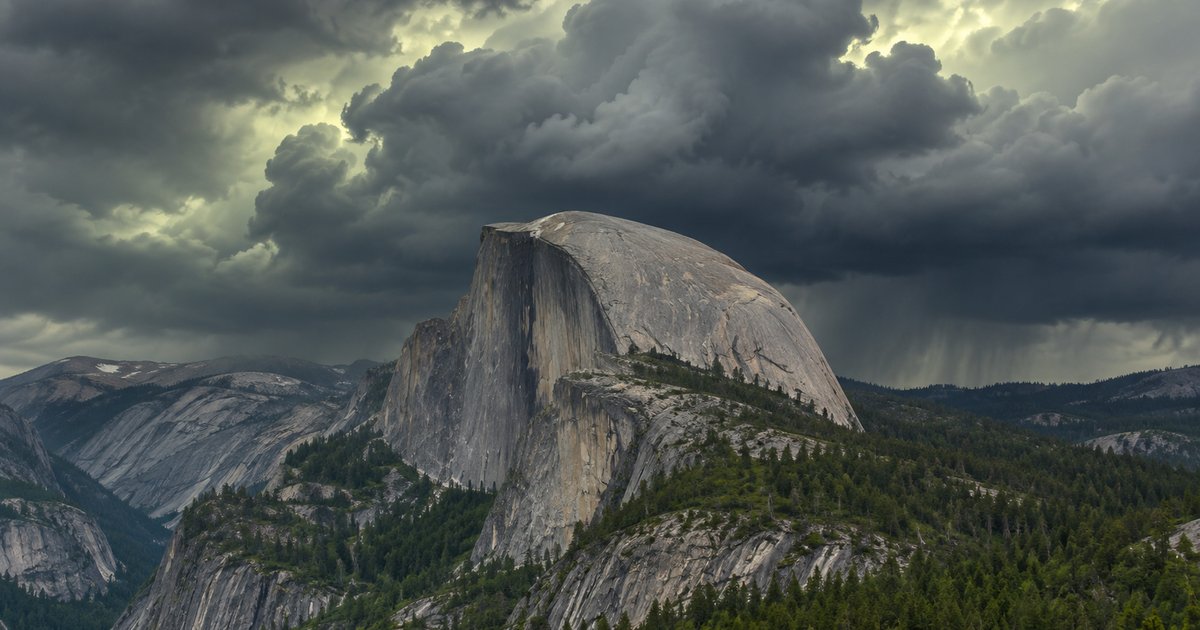
Half Dome is dangerous in a thunderstorm because its summit is a high, exposed place that Yosemite names as one to avoid in a storm, and because the way down is a 400-foot (120-meter) cable route where nearly all fatal falls have happened on wet rock. The National Park Service’s rule is to decide early: do not start the ascent when storm clouds are in the area, and leave the summit if a storm appears nearby.
Yosemite names Half Dome as a place to avoid during a storm
The National Park Service’s Yosemite wilderness safety page, last updated September 4, 2026, says that during a storm hikers should stay away from peaks, particularly Half Dome, and from ridges, caves, water and open areas. The park’s Half Dome day-hike page, last updated September 22, 2025, calls the summit a dangerous place during a lightning storm.
Height explains part of that. The same page puts Half Dome nearly 5,000 feet (1,500 meters) above Yosemite Valley and 8,800 feet (2,700 meters) above sea level. The park’s lightning page, last updated January 21, 2025, says lightning often strikes the tallest object in an area and tells hikers to avoid viewpoints, while the Half Dome page counts the panoramic views from the shoulder and summit among the rewards of the hike.
The cables add a second hazard, wet rock, to the last 400 feet
The Half Dome cables are two metal cables that let hikers climb the last 400 feet (120 meters) to the summit without rock climbing equipment, according to the Half Dome day-hike page. The page says nearly all fatal falls from the cables have happened when the rock was wet, and it names being on the cables when the rock or the cables are wet as the leading cause of those falls.
That puts two hazards on one stretch of rock. The park’s instruction is to make the decision before the cables: do not attempt the ascent if storm clouds are in the area or the ground is wet. For a hiker already in the summit area when a storm appears nearby, the page says to leave the area while still using caution on the cables and steps. The page gives no separate instruction for a hiker who is already partway up the cables.
Crowding is part of the picture. The park’s permit page, last updated June 3, 2025, allows up to 300 hikers a day beyond the base of the subdome, about 225 day hikers and 75 backpackers, and a 2023 news account below describes congested cables when a storm arrived.
The cable season covers the months when Sierra thunderstorms are most common
The park’s Half Dome pages say the cables normally go up the Friday before Memorial Day and come down the day after the second Monday in October, with dates subject to change, and that a permit is required while they are up. Check the park’s Half Dome page before you go for the season and permit status. The park’s lightning page says thunderstorms are most common from June through September but can happen in any month, and that from July through September the North American monsoon pattern can carry moisture from the Gulf of California into the Sierra Nevada. That whole stretch falls inside the usual cable season.
The park’s seasons page, last updated October 31, 2024, describes the pattern: Yosemite gets less than 5 percent of its annual precipitation in summer, mostly from thunderstorms, and storms can be a daily occurrence on summer afternoons. They usually form at higher elevations and come on suddenly, with brief downpours, lightning, thunder, hail and gusty wind, and the sky typically clears again by nightfall. On the park’s account, storms build in the afternoon as the sun heats the air near the ground and ridges and peaks add updrafts.
| Source | What it says |
|---|---|
| Yosemite lightning page (January 2025) | Thunderstorms are most common in the afternoon |
| Yosemite wilderness safety page (September 2026) | Strikes come particularly in mid to late afternoon, but can occur at any time |
| Yosemite seasons page (October 2024) | Daily occurrence on summer afternoons; skies typically clear by nightfall |
| NWS Hanford, July 2018 summary | For July 17 to 24, 2018: afternoon and early evening thunderstorms mainly over the Sierra Nevada crest |
The National Weather Service’s Sacramento office wrote in a 2001 technical attachment that thunderstorms are rather common over the Sierra Nevada in summer, as monsoon moisture moves in. It described them as usually moderately high-topped, short-lived pulse storms that produce heavy rain and hail but seldom reach severe limits. The Hanford entry describes one eight-day spell in one July, so it shows the timing during that spell, not how many days a year bring storms. No source gives a count of storm days at Half Dome.
The park’s clock for a Half Dome day is an early start and a fixed turn-around time, and its lightning page adds a summit before noon
The Half Dome page describes a 14- to 16-mile (23- to 26-kilometer) round trip with about 4,800 feet (1,460 meters) of climbing, and says most hikers take 10 to 12 hours. It advises leaving around sunrise or earlier and setting a non-negotiable turn-around time, with 3:30 p.m. as its example for a hiker who has not reached the top. The park’s lightning page gives a different figure for storms: in the wilderness, it says, plan to summit peaks before noon. On Half Dome the two figures differ, and a hiker who treats 3:30 p.m. as the cutoff would still be climbing in the afternoon hours the park names as the common time for storms.
The cues the park lists are ordinary ones: afternoon build-up of cumulus clouds, towering cumulus, darkening skies, increased wind, thunder and lightning. At the first sign of an impending storm, it says, get to lower elevations. Thunder means a storm within 10 miles (16 km), and the park tells hikers not to wait. It also says that even if a storm approaches from a long distance, you should descend as far and fast as you can. The park’s rough distance method is to divide the seconds between flash and thunder by five for miles. After a storm, it says to stay alert until 30 minutes after the last thunder.
Caves and overhanging rock are on the park’s list of places to avoid
Yosemite’s wilderness safety page lists caves among the places hikers should stay away from during a storm, and a 2020 post by Yosemite Search and Rescue says not to take shelter under, or sit against, exposed overhanging rock. The park’s lightning page says there is no shelter outside during a thunderstorm and names only a substantial building or a hard-topped vehicle as protection.
Reports of two summit strikes, in 1985 and 2023, place the groups in a cave
The park’s lightning page says that in July 1985 lightning at Half Dome killed two people and injured three, two of them critically. A Los Angeles Times wire report dated July 29, 1985, quoted park officials saying five people were sitting in a cavern on top of the monolith at about 6:30 p.m. on Saturday when a series of flashes started a few small fires and struck them. That Saturday was July 27, 1985. The report said one victim was struck on the head and fell 4,000 feet (1,200 meters) to his death. Other hikers reached the valley floor at about 9 p.m. and a helicopter flew to the summit at about midnight to take the remaining four people away. The strike came in the early evening, later than the afternoon peak the park describes, which fits the park’s statement that storms can occur at any time.
The San Francisco Chronicle, in a story published September 26, 2023 and updated the next day, reported that hikers on the summit on Thursday, September 21 sheltered from a storm in a rock cave and that lightning struck the rocks around them. The hikers who spoke to the newspaper said at least two people in the cave were struck, one of them unconscious for about a minute and another left dazed. The Chronicle also reported that the morning forecast had shown a low chance of rain, that the weather went from overcast to rain and sleet within about 15 minutes, and that the cables were so congested there was not much movement. A photo caption in the article said a few people fell from the cables that day. The Chronicle added that Yosemite and the California Highway Patrol had no further information about the rescue when it contacted them. These are the hikers’ accounts as reported, not findings by the park.
Lightning is one hazard among several on this route. A 2018 paper in Wilderness & Environmental Medicine counted 29 confirmed deaths on Half Dome, plus 2 likely ones, over 85 years, and found that of the deaths tied to the cable handrails, only 2 were due to weather. The abstract does not separate lightning from wet rock. The Half Dome page says park rangers assist hundreds of people on the trail every summer, and that most of those emergencies could have been prevented. A 2020 Yosemite Search and Rescue post says lightning-related rescues are less common in the park than swiftwater incidents or rattlesnake bites.
Signal and help on the trail are limited, so the decision comes before the cables
The park’s Half Dome page says some cell phones get coverage from Half Dome and from some places on the trail, that the Little Yosemite Valley ranger station is staffed in summer but not always, and that a group may need to send someone to Yosemite Valley for help. Backpackers with a permit can spend the night in Little Yosemite Valley; the park’s wilderness advice for them is to set up camp before lightning begins.
Lightning Tracker is an iPhone app that alerts you when a strike is detected inside a radius you set for each place, 10 miles (16 km) by default. The free version covers your current location; Premium adds up to five saved places, such as a trailhead and a campsite, each with its own radius. With the patchy coverage the park describes, the app can inform a turn-around decision but cannot make it: detection networks miss some strikes, data can arrive late, and iOS decides when a closed app checks for data. The park’s rule rests on what you can see and hear, so a quiet map is not a reason to start the ascent when storm clouds are in the area. After a storm, the app’s 30-minute wait starts after the last detected strike inside your radius and restarts with each new one; when it ends, the app tells you what it observed and asks you to judge conditions yourself. It does not replace official warnings or ranger instructions.
Not a substitute for official weather warnings.
If you hear thunder, seek shelter even if the app shows no nearby strike.
Sources
- National Park Service, Yosemite, Half Dome Day Hike
- National Park Service, Yosemite, Half Dome Permits for Day Hikers
- National Park Service, Yosemite, Lightning Safety
- National Park Service, Yosemite, Wilderness Safety
- National Park Service, Yosemite, Seasons
- National Park Service, Yosemite Search and Rescue, Lucky Encounters with Lightning, August 25, 2020
- Los Angeles Times, Lightning at Yosemite’s Half Dome Kills 2 Climbers; 3 Hurt, July 29, 1985
- San Francisco Chronicle, These hikers were struck by lightning on Yosemite’s Half Dome, September 26, 2023, updated September 27
- Richardson and Spano, Death on the Dome: Epidemiology of Recreational Deaths on Half Dome in Yosemite National Park, Wilderness & Environmental Medicine, September 2018
- National Weather Service San Joaquin Valley-Hanford, July 2018 Weather Summary for the Central California Interior
- National Weather Service Western Region, Technical Attachment 01-05: Forecasting severe thunderstorms in the Sierra Nevada, May 2001