 Lightning Tracker
App Store
Storm basics
The 1977 New York blackout: how lightning set it off, and what failed next
November 19, 2026 · 11 min read
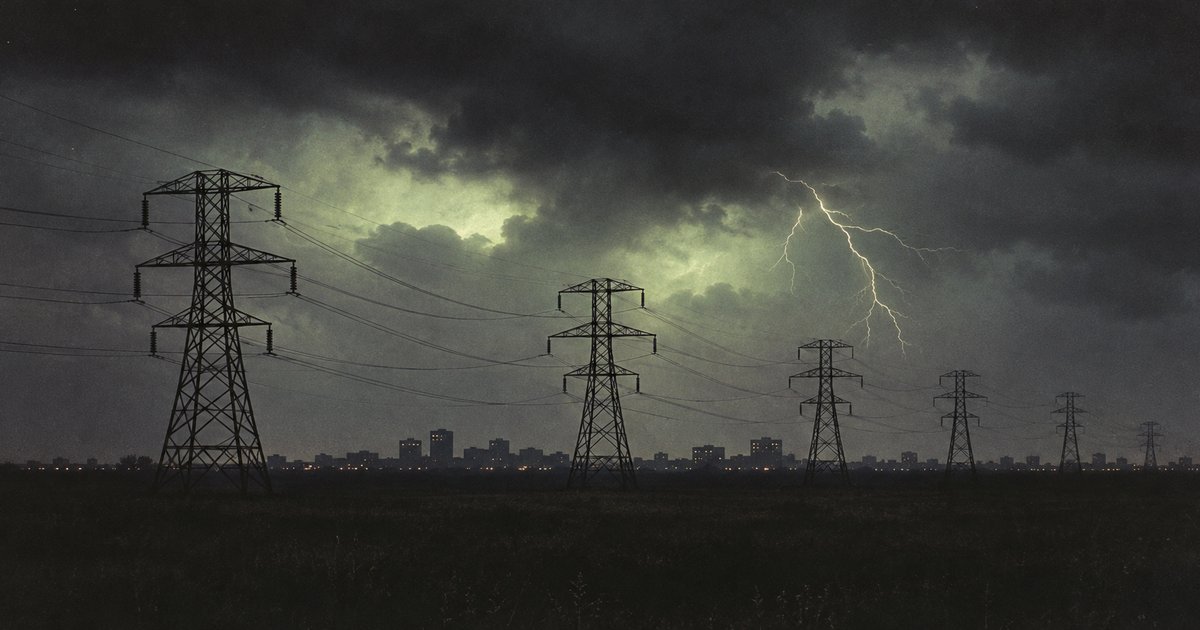
Lightning started the New York City blackout of July 13–14, 1977, but it did not finish it. Two severe strokes 18 minutes apart faulted four of Con Edison’s major transmission lines, three of which stayed open, and a relay design error, faulty equipment and slow operator decisions let that loss grow until the whole system shut down at 9:36 p.m. Federal investigators wrote that the shutdown could and should have been prevented.
The federal investigation traced the blackout to two lightning strokes and four line faults
The final staff report of the Federal Energy Regulatory Commission (FERC), dated June 1978, says President Carter directed the Federal Power Commission to investigate the failure the day after it happened. The report concludes that the collapse resulted from a combination of natural events, equipment malfunctions, questionable system design features and operating errors. Its list of immediate causes begins with two severe lightning strokes about 18 minutes apart, each causing simultaneous flashovers of a pair of major transmission circuits, for four line faults in all.
The first stroke came at 8:37:17 p.m. on July 13. The FERC staff report says it gave both 345-kilovolt (kV) circuits between the Buchanan South and Millwood West substations, lines W97 and W98, a phase B fault to ground. Con Edison’s own Board of Review, which gave the first disturbance as 20:37, places those lines in northern Westchester County and describes them as the outside circuits of a four-circuit tower whose two inner circuits carry 138 kV.
The second stroke came at 8:55:53 p.m., about 18 minutes later. It tripped line W93/W79, which connects the Buchanan North substation to the Sprain Brook substation, and line W99/W64, which connects Millwood West to Sprain Brook. The FERC staff report notes that although these are distinct circuits, they are carried on the same towers from Millwood West to Sprain Brook. All the clock times on this page come from the FERC staff report; the Board of Review’s 20:37 and 21:36 agree with them.
The first stroke removed an Indian Point generator and a major tie line within seconds
Just before the first stroke, the FERC staff report says, the system carried 6,091 megawatts (MW) of load, and about 2,200 MW of it was being imported over interconnections with neighboring systems. Three generating units (Indian Point No. 2, Bowline Point No. 2 and Astoria No. 6) and a transmission line to a New Jersey utility were already out of service for maintenance or repair.
At Buchanan South, the faults on W97 and W98 tripped all four circuit breakers of the substation’s ring bus. The report says that isolated the Indian Point No. 3 nuclear generating unit from any load, and the unit tripped off the line, a loss of 883 MW. The 345-kV tie to the Ladentown substation (line Y88), which had been importing 427 MW, was isolated as well, so the system lost 1,310 MW at once. The other interconnections replaced 1,265 MW of that, and the remaining 45 MW came from slight generator increases and a small drop in load that followed the frequency decline. The report calls conditions stable after this first incident.
Faults in the protective system kept lines out that normal operation would have returned to service. At Buchanan South, a backup relay circuit meant to open the Ladentown breakers if a Buchanan South breaker failed to clear a fault carried too large a time-constant delay. The report says the Ladentown breakers for line Y88 therefore tripped and locked out even though the Buchanan South breakers had operated properly, and that a normal relay response would have restored Y88 and the W97 and W98 lines in less than 2 seconds. At Millwood West, neither breaker on the W98 line reclosed as designed. A loose locking nut on a control-valve linkage had let the valve adjustment change on one breaker, and its operating air pressure fell below the 550 psig (pounds per square inch gauge) low-pressure lockout when it operated.
The second stroke cut the last tie to the northwest, and a bent relay contact tripped another line
After the second stroke, the breakers on W99/W64 reclosed and restored that line in about 2 seconds. On W93/W79, the breaker at Buchanan North did not: the FERC report says it was designed not to reclose if the phase angle across it exceeded 20 degrees, a provision that protected the Indian Point No. 2 unit from power surges. With that breaker open, the Y94 interconnection to the Ramapo substation, which had been carrying about 1,044 MW, was cut off from Con Edison.
Power then surged in from the north and tripped line W81 between Pleasant Valley and Millwood West. Normally W81 would not have tripped for that condition; Con Edison staff later found a bent contact on a protective relay at Millwood West, and the FERC report calls the relay’s action improper. After this second incident the report says Con Edison was in a very serious emergency. For about 23 minutes the system looked stable, but the two vital interconnections still in service were seriously overloaded: line 80 from Pleasant Valley carried 1,356 MW against a normal rating of 825 MW and a short-time emergency rating of 1,016 MW, and the Linden/Goethals tie to New Jersey carried 907 MW against ratings of 505 MW and 717 MW. Con Edison’s procedure required overloads above the emergency rating to be cut within 5 minutes to avoid damage.
The investigators say the operators did not use the generation and load shedding at hand
The FERC report says a complete shutdown could and should have been prevented by a timely increase in Con Edison’s in-city generation or by manual load shedding. Its list of operator failures includes not recognizing that the Y94 interconnection to the west was effectively unavailable, and not shedding load promptly despite repeated advice from the senior dispatcher of the New York Power Pool, a group formed to coordinate planning and operation among the state’s utilities.
Con Edison had no generation under automatic generation control, so nothing responded automatically to the loss of Indian Point No. 3, and the manual request for more reserve generation came 8 minutes after that loss. Combustion turbines at Astoria were slow to respond because maintenance crews were inspecting them and had not reported them as unavailable for 10-minute reserve.
Faulty communication between the control room and the pool dispatcher also contributed, FERC says. From the taped conversations, it suggests the Con Edison operator assumed the Ramapo/Buchanan tie was closed but carrying no load, while the pool dispatcher was aware it was open and assumed the operator knew; neither clearly stated his understanding. The report adds that the operator handed decision-making to a supervisor who was at home and had limited knowledge of the conditions, and that no load shedding took place in the more than 23 minutes after the second stroke. Con Edison’s Board of Review dates its voltage cuts, 5 percent and then 8 percent, between 21:13 and 21:22.
Con Edison lost every remaining tie in about ten minutes after 9:19 p.m.
The collapse after the two strokes was a run of overloads and trips. The FERC staff report lists seven incidents from the first stroke to the loss of the last outside connection, and only the first two were lightning faults.
| Time (p.m.) | Event | Result |
|---|---|---|
| 8:37:17 | Lightning faults W97 and W98 (Buchanan South to Millwood West) | Indian Point No. 3 trips; Y88 tie locks out; 1,310 MW lost |
| 8:55:53 | Lightning faults W93/W79 and W99/W64 (to Sprain Brook) | Y94 tie (1,044 MW) isolated; W81 trips on a faulty relay |
| 9:19:11 | Line 92 from Leeds to Pleasant Valley opens, probably after sagging into a tree | Line was carrying about 1,202 MW; other lines overload further |
| 9:19:53 | A Pleasant Valley transformer trips on overload | 415 MW lost |
| About 9:22 | A Long Island utility operator opens the Jamaica to Valley Stream tie by hand | 520 MW lost |
| 9:22:47 | An attempt to restore W81 draws too heavy a surge | Breaker at Pleasant Valley trips; no net change |
| 9:29:41 | The 230-kV Goethals to Linden tie opens after a transformer failure | About 1,150 MW lost; last 138-kV feeders trip; system isolated |
Once isolated, the report says, Con Edison had a net load of 5,981 MW against net generation of 4,282 MW, a 28.4 percent generation deficiency, and frequency began to fall. Automatic underfrequency load shedding removed an estimated 1,440 to 2,200 MW in the first 10 seconds, but voltage transients tripped Ravenswood No. 3, carrying 844 MW. The other units followed as low frequency degraded their auxiliary equipment, and by 9:36 p.m. the Con Edison system was completely shut down.
The lines were designed for a loss that the two strokes exceeded
The FERC staff report says the losses from the strokes and the directly related equipment malfunction substantially exceeded the contingencies considered credible and designed for without loss of load. The multiple outages from the first two incidents would be considered a highly improbable event under accepted industry criteria. It also calls the judgment to treat the simultaneous outage of W97 and W98 as a low-probability double contingency, one the system would not be designed to fully withstand, “at least questionable” given the city’s sensitivity to power failure. Criteria suited to typical Northeast systems, it says, may be inadequate for Con Edison.
FERC’s lightning appendix describes two ways a stroke can fault a line. In a shielding failure, the stroke bypasses the overhead ground wire and ends on a conductor. In a back flashover, a lightning stroke hits a part of the structure that is normally at ground or lesser potential and the insulation flashes over. The staff calls the first fault of July 13 a lightning-induced back flash, and says the greater portion of the calculated outage rate for these lines comes from shielding failures. The appendix cites a 1967 IEEE report on 345- to 360-kV lines for 1950 through 1964, which found 64.4 percent of line outages associated with lightning phenomena, and says it does not appear possible to design a lightning-proof line.
To test how often such lines should flash over, the appendix used a National Weather Service statistic: New York City’s 68 years of records give 31 thunderstorm days a year, counting days on which thunder is heard. Its calculated outage rates approach the rates Con Edison actually experienced for higher values of average footing resistance at the tower bases, and doubling the average resistance roughly doubles the calculated rate. Con Edison designs its towers for 10 ohms or less. The report says higher values can arise through damage or theft of the grounding material, so it recommends examining the footing resistances on existing 345-kV lines.
Lightning hit the system again on September 26, 1977, when, Con Edison’s Board of Review reports, eight transmission lines were disconnected by lightning. The Board, in its December 1977 report, found lightning the most probable cause of multiple line outages and noted that no line disconnections in Westchester County had ever come from tornadoes, earthquakes or hurricanes.
Restoration took about 25 hours because cables lost oil pressure and backup generators failed to start
The FERC staff report says electric service to more than 8 million people was interrupted for periods from 5 to 25 hours. Con Edison’s Board of Review says service returned over periods of about 21 to 25 hours after the shutdown, and a Department of Energy impact assessment from July 1978 describes a 25-hour failure affecting 9 million people on a night when the city was already suffering a heat wave. The studies give different figures for the people affected and the hours without power.
FERC lists the causes of delay. An early attempt at rapid restoration with limited sectionalizing was unsuccessful and damaged some transformers and other equipment. The insulating oil pressure in the extra-high-voltage underground cables dropped unexpectedly below the level the cables need, and certain generators designed to start without an outside power source could not be started. The first significant customer load, 74,000 customers, returned shortly before 2 a.m. on July 14; by 3 p.m. about half of Con Edison’s customers were reconnected, and restoration was complete 25 hours 46 minutes after shutdown, shortly after 11 p.m.
The FERC report says the economic losses were very large, in part because of extensive looting and malicious property damage. The Department of Energy’s impact assessment counts 1,037 fires in sections of Queens, Brooklyn, Manhattan and the Bronx, though it notes that much of its account of the city during the blackout is taken from media reports.
The five investigations agreed on the technical chain and differed on blame
FERC lists four other investigations besides its own: a New York Public Service Commission staff task force (reports in August and September 1977), a New York City Special Commission of Inquiry (early December 1977), Con Edison’s Board of Review (its third phase report is dated December 28, 1977) and the State of New York (late January 1978). The report says agreement is strongest on the specific technical factors in the collapse and slow restoration, and that there is general agreement the shutdown could have been prevented if all protective equipment had worked or the operators had acted in time.
The disagreement was about responsibility. The city commission faulted Con Edison for failing “to use available technology” or voluntarily adopt recommended improvements, and found that the company’s management and the regulators must share responsibility. Con Edison’s own report admitted that its reliance on automatic load shedding as a last line of defense was misplaced. FERC says its own staff puts relatively more emphasis on operating inadequacies and less on unavailability of facilities than the Federal Power Commission’s August 1977 report did, and that Con Edison’s management must bear responsibility for the failure to withstand the emergency. The staff also compares the 1965 Northeast blackout with 1977: in both, a low-probability event created an emergency and equipment malfunctions and incorrect operator actions let it grow.
The recommendations targeted storm operations, relays, breakers, operators and restoration
Con Edison began a Storm Watch Procedure on July 16, 1977: as soon as a storm may threaten a major installation, the company operates as though a first contingency already exists, with more in-city generation and fewer imports. When a thunderstorm is forecast, the Board of Review says, the system is run to withstand the loss of three transmission lines; the procedure ran on 25 days, including September 26, 1977. FERC recommended making it permanent. Its other principal recommendations were:
- critically examine all relay schemes on the bulk power system for validity against possible contingencies;
- reconsider breaker arrangements at critical substations for more independent protection of individual circuits;
- correct tie-line loadings above short-time emergency ratings rapidly, including automatic backup load shedding;
- consider federal licensing of operators of major power systems operating in interstate commerce;
- write a new restoration plan that returns service to critical city areas in no more than a few hours.
The Federal Power Commission staff’s preliminary report asked every major utility and power pool in the country to examine itself so that Con Edison’s experience would not be repeated. The Department of Energy’s impact assessment says Con Edison planned to invest $65 million in permanent capital improvements after the blackout, including a new 345-kV circuit between Buchanan and Millwood.
For a storm you are experiencing now, Lightning Tracker, an iPhone app, maps recent detected lightning strikes and shows the distance and direction to the nearest one.
Not a substitute for official weather warnings.
If you hear thunder, seek shelter even if the app shows no nearby strike.
Sources
- U.S. Department of Energy, Federal Energy Regulatory Commission staff, The Con Edison Power Failure of July 13 and 14, 1977: Final Staff Report (DOE/FERC-0012, June 1978)
- Consolidated Edison Company of New York, Board of Review, Third Phase Report: System Blackout and System Restoration, July 13–14, 1977, Volume I (summary), December 28, 1977
- U.S. Department of Energy, Impact Assessment of the 1977 New York City Blackout, July 1978