 Lightning Tracker
App Store
Places and activities
WBGT calculator: wet-bulb globe temperature from three readings
November 19, 2026 · 5 min read
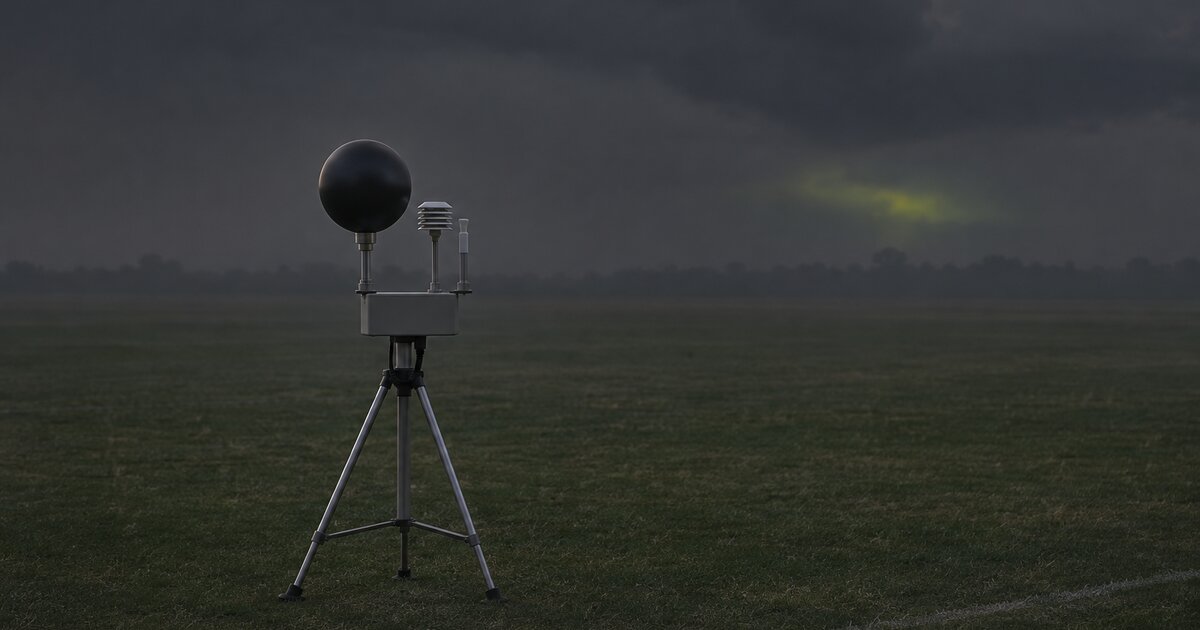
Wet-bulb globe temperature (WBGT) is a weighted result from measured natural wet-bulb, black-globe and dry-bulb temperatures, using one formula in sun and another with no solar load, according to Oregon OSHA’s technical manual. Enter all three thermometer readings below to calculate it for one location and time. This page calculates WBGT from thermometer readings only; without the instruments, use OSHA’s outdoor WBGT calculator, which estimates WBGT from standard meteorological inputs, or the weather-based calculator on the NWS Wichita WBGT page.
WBGT combines three measured thermometers with the weights Oregon OSHA publishes: 0.7 natural wet-bulb, 0.2 black globe and 0.1 dry-bulb outdoors in the sun, or 0.7 and 0.3 without a solar load.
Air temperature plus humidity alone cannot produce measured WBGT; sun, wind, radiant heat, workload, clothing and acclimatization matter.
What the number means
Wet-bulb globe temperature (WBGT) is an index of environmental heat, not an air-temperature reading. Federal OSHA’s heat-hazard guidance, read in November 2026, says a WBGT instrument combines air temperature, humidity, radiant heat and air movement. Its three sensors are a dry-bulb thermometer for air, a natural wet-bulb thermometer for evaporation, and a black globe thermometer for radiant heat. This tool combines readings from those sensors at one place and time. It does not retrieve observations, forecast later conditions, diagnose anyone’s heat strain, or decide whether activity can continue.
Federal OSHA also considers physical workload, clothing and acclimatization when assessing workers’ total heat stress. A WBGT result alone cannot set a work/rest schedule. A school or league’s heat policy may use its own local thresholds; a number on this page does not replace that policy. During a storm, lightning delays in youth and school sports follow their own stop and return rules, regardless of WBGT. The National Weather Service (NWS) tells organizers to have a lightning plan and wait at least 30 minutes after the last thunder before resuming outdoor activity.
Get three readings from the same conditions
Oregon OSHA’s technical manual specifies three instruments for measured WBGT: a natural (static) wet-bulb, a black globe and a dry-bulb thermometer. Take the readings for the same location and time, in the same unit. Federal OSHA says to put the instrument close to the work location: a sunlit work area calls for measurement in that sunlight. A shaded weather-station reading may miss conditions on a field or worksite.
Instrument setup matters before entering numbers. Oregon OSHA specifies a dry-bulb sensor shielded from sunlight and other radiant surfaces without blocking airflow. Its natural wet-bulb wick must be clean and wetted directly with distilled water before the reading; the manual calls for at least half an hour of wetting. Its black globe is a matte, 6-inch (15 cm) sphere, or equivalent, exposed for at least 25 minutes. The stated thermometer accuracy is about ±0.9°F (±0.5°C). This calculator checks typed numbers, but cannot check the wick, shield, globe or sensor placement.
The widget accepts natural wet-bulb and dry-bulb readings of 23–122°F (−5 to 50°C), and black-globe readings of 23–212°F (−5 to 100°C), matching Oregon OSHA’s instrument ranges. It requires all three fields even though the no-solar-load equation does not use dry-bulb in its arithmetic. A blank field keeps the input prompt on screen; when all three fields are filled but one is nonnumeric or out of range, the widget lists the accepted ranges. If natural wet-bulb exceeds dry-bulb, the result asks you to check the readings. That last check is a measurement-consistency rule in the tool, not a range Oregon OSHA states. A black-globe reading below dry-bulb is accepted.
Choose the solar-load equation
Oregon OSHA publishes two measured-input equations. Outdoors with solar load, WBGT equals 0.7 times natural wet-bulb plus 0.2 times black globe plus 0.1 times dry-bulb. Indoors or outdoors with no solar load, WBGT equals 0.7 times natural wet-bulb plus 0.3 times black globe. The coefficients add to one in either case. The natural wet-bulb has the largest weight, but the globe records radiant conditions that plain air temperature and humidity cannot capture.
| Conditions | Measured-input formula | Dry-bulb role |
|---|---|---|
| Outdoors with solar load | 0.7 × natural wet-bulb + 0.2 × globe + 0.1 × dry-bulb | 10% of result |
| Indoors or outdoors with no solar load | 0.7 × natural wet-bulb + 0.3 × globe | Required input; not in result |
The formula is a weighted temperature calculation. It does not calculate natural wet-bulb from humidity, and does not infer globe temperature from sun or wind. OSHA’s separate outdoor WBGT calculator estimates conditions from weather data, location, date and solar assumptions. The daytime heating behind many afternoon thunderstorms may affect an outdoor schedule, but neither this number nor a heat-index reading predicts lightning.
Worked readings: sun and no sun
For a measured natural wet-bulb of 68°F (20°C), globe of 86°F (30°C), and dry-bulb of 82.4°F (28°C), the sunny equation is 0.7 × 20 + 0.2 × 30 + 0.1 × 28 = 22.8°C, displayed as about 73.0°F (22.8°C). The no-solar-load equation uses the same first two readings but changes the globe weight: 0.7 × 20 + 0.3 × 30 = 23.0°C, displayed as about 73.4°F (23.0°C). Those are substitutions into Oregon OSHA’s equations, checked against the page’s JavaScript module on November 12, 2026; they are not observed heat conditions or activity thresholds.
For a second set, natural wet-bulb 77°F (25°C), globe 104°F (40°C), and dry-bulb 95°F (35°C), the sunny mode gives 0.7 × 25 + 0.2 × 40 + 0.1 × 35 = 29.0°C, displayed as about 84.2°F (29.0°C). The no-solar mode gives 0.7 × 25 + 0.3 × 40 = 29.5°C, displayed as about 85.1°F (29.5°C). The tool converts Fahrenheit entries to Celsius, calculates without intermediate rounding and shows one decimal in both units. The difference between modes comes from the published weights, not a claim that moving the instrument into shade would produce those same three readings.
Keep heat and lightning decisions separate
The NWS Wichita office says athletic departments and OSHA use WBGT as a guide for strenuous activity. Federal OSHA pairs the environmental measure with workload, clothing and acclimatization, while the NWS sports guidance asks organizers to make a separate lightning plan. Outdoor crews therefore need a heat assessment and a lightning plan for outdoor work. When thunder is heard, follow the lightning plan and move to shelter; a lower WBGT reading does not change the storm rule.
Lightning Tracker is an iPhone app that shows recent detected strikes on a live map and the distance and direction to the nearest detected strike.
Not a substitute for official weather warnings.
If you hear thunder, seek shelter even if the app shows no nearby strike.
Sources
- Oregon OSHA, Technical Manual, Appendix III:4-2
- Occupational Safety and Health Administration, Heat Hazard Recognition
- Occupational Safety and Health Administration, OSHA Outdoor WBGT Calculator
- Occupational Safety and Health Administration, OSHA Technical Manual, Section III: Chapter 4
- National Weather Service, Wet Bulb Globe Temperature vs Heat Index
- National Weather Service, Lightning Safety and Outdoor Sports Activities