 Lightning Tracker
App Store
Places and activities
Does OSHA require a lightning shutdown distance?
November 16, 2026 · 4 min read
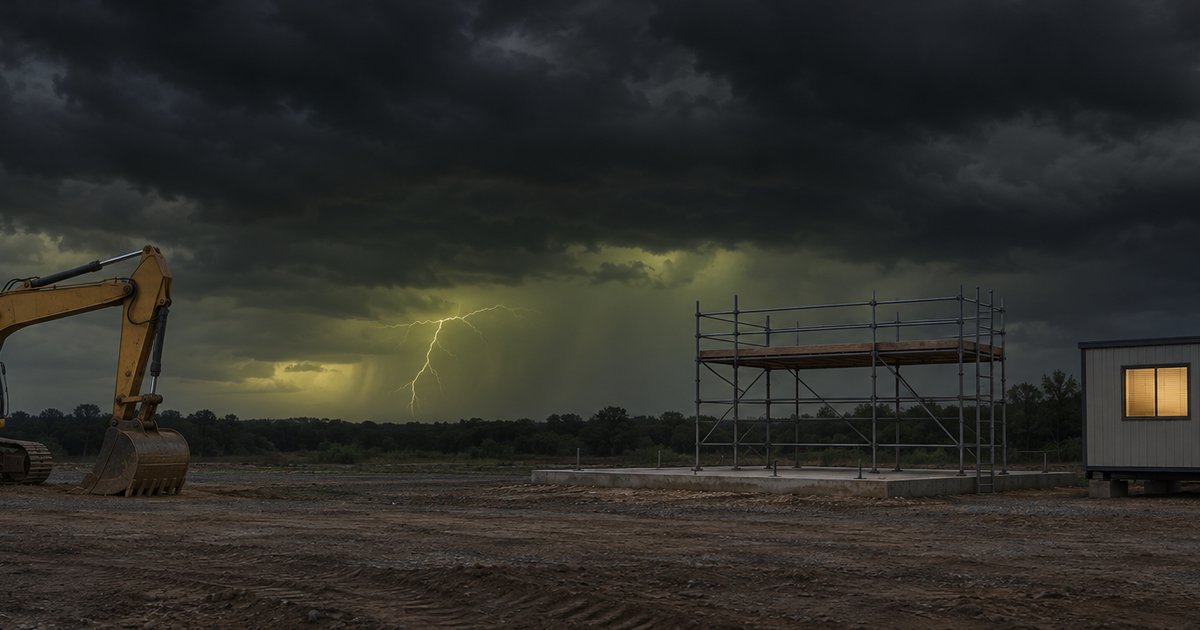
As of November 2026, federal OSHA does not set one lightning shutdown distance for every outdoor workplace. Its General Duty Clause covers recognized serious hazards, and particular construction rules restrict work during storms; OSHA and NOAA separately recommend thunder-triggered shelter and a site-specific plan. The OSHA/NOAA fact sheet’s ten-mile figure describes how far lightning may reach from rainfall, not a required stop-work radius.
What the law says
The Occupational Safety and Health Act’s Section 5(a)(1), as posted by OSHA, requires employers to provide a workplace free from recognized hazards likely to cause death or serious physical harm. OSHA’s June 2021 lightning fact sheet says this includes lightning hazards. The statute does not name a strike radius or a uniform point at which every outdoor job must stop. OSHA’s Field Operations Manual also says the General Duty Clause is used where no standard covers the particular hazard; a citation depends on the facts of a workplace, including recognition and feasible abatement.
That distinction matters to a supervisor: the legal duty concerns the hazard, while the site procedure translates it into actions workers can follow. A ten-mile radius may be an employer’s trigger, but calling it “the OSHA ten-mile rule” misstates the text. The fact sheet’s ten miles describes how far lightning may strike from rainfall, not a mandatory shutdown line. The National Weather Service says thunder can usually be heard around ten miles away when background noise does not mask it, and tells outdoor workers to stop and seek a substantial building or hard-topped metal vehicle when they hear thunder.
Some jobs do have storm-specific rules
OSHA’s construction standards use different conditions for different tasks. They do not create one distance for all outdoor work:
| Work | What the OSHA text says | Scope |
|---|---|---|
| Electric blasting caps | 29 CFR 1926.900(k)(2) requires suspending all blasting and removing people from the blasting area during the approach and progress of an electric storm. | Construction blasting with electric blasting caps. |
| Scaffolds | 29 CFR 1926.451(f)(12) prohibits work on or from scaffolds during storms or high winds unless a competent person determines workers can be there and specified protection is provided. | Scaffold work; the exception has conditions. |
| Crane personnel hoists | 29 CFR 1926.1431(k)(8)(ii) requires a qualified person to judge indications of dangerous weather and bars starting or continuing a personnel lift if that person finds it unsafe. | Hoisting employees, rather than every crane lift. |
| Demolition walls | 29 CFR 1926.854(c) bars work on top of a wall when weather conditions constitute a hazard. | Employees on top of walls in demolition. |
| Power-line work | 29 CFR 1926.964(c)(5) bars live-line barehand work when adverse weather remains hazardous despite required practices; its note names nearby thunderstorms. Paragraph (d)(4) addresses work on towers and structures, with an emergency-restoration exception. | Specified electric-power construction tasks. |
These provisions illustrate why the job type matters. The blasting rule actually says to suspend work during an approaching electric storm. The personnel-hoist rule calls for a qualified person’s determination about dangerous weather. Neither uses a lightning distance in miles. Each rule carries its own qualifications and a narrower scope than a one-line summary can show.
What OSHA and NOAA recommend
The June 2021 OSHA/NOAA fact sheet calls itself “lightning safety recommendations.” It recommends checking weather reports before outdoor work, monitoring conditions during the shift, and considering rescheduling jobs that would expose workers to hazardous weather. It says workers should not begin a task they cannot quickly stop when signs of a storm appear. For workers who hear thunder or see lightning, the sheet points to an enclosed building with wiring and plumbing, or a hard-topped metal vehicle with windows up. Its advice is to remain sheltered at least 30 minutes after the last thunder. Those are agency recommendations in a fact sheet, not a federal mileage regulation.
The same sheet says employers should have a written Emergency Action Plan with a lightning protocol: warning methods, places to go, time for workers and the public to reach them, and how to suspend and resume work. The regulatory language needs care here. OSHA’s 29 CFR 1910.38(a) says an employer must have an emergency action plan whenever another standard in that part requires one; 29 CFR 1926.35(a) applies to plans required by a particular construction standard. The fact sheet’s “should” does not, by itself, make a lightning-specific written plan mandatory for every outdoor employer. The published lightning plan for outdoor work addresses how to put the recommendations into a worksite procedure.
Where a distance fits
A worksite can choose a trigger distance as part of its own protocol. The OSHA/NOAA sheet asks employers to account for how long workers need to reach shelter, but it specifies no universal radius. NWS sports guidance describes a significant lightning threat extending roughly six to ten miles from a storm cloud and says organizers must account for evacuation time; it is guidance for activities, not an OSHA standard. A site’s choice of alert radius therefore depends on its shelter travel time and warning method. Hearing thunder remains a reason to act even when a detector reports no strike within the chosen circle.
OSHA and NOAA say no detection system can report the first strike, catch every strike, or predict a strike. The fact sheet says handheld lightning detectors can miss strikes and are less accurate than commercial services. A supervisor can also use the flash-to-bang distance estimate, but the NWS advises anyone who hears thunder to move to shelter rather than wait for a particular count. For the crew, a substantial building or a hard-topped metal vehicle is the place to shelter from lightning named by OSHA and NOAA.
Lightning Tracker can alert an iPhone user when a detected strike enters a radius set for a saved worksite. The radius is a monitoring setting, not an OSHA compliance determination.
Not a substitute for official weather warnings.
If you hear thunder, seek shelter even if the app shows no nearby strike.
Sources
- OSHA and NOAA, Lightning Safety When Working Outdoors
- OSHA, OSH Act Section 5: Duties
- OSHA, Field Operations Manual, Chapter 4
- OSHA, 29 CFR 1926.900: General Provisions
- OSHA, 29 CFR 1926.451: General Requirements
- OSHA, 29 CFR 1926.1431: Hoisting Personnel
- OSHA, 29 CFR 1926.854: Removal of Walls
- OSHA, 29 CFR 1926.964: Overhead Lines and Live-Line Barehand Work
- OSHA, 29 CFR 1910.38: Emergency Action Plans
- OSHA, 29 CFR 1926.35: Employee Emergency Action Plans
- National Weather Service, Lightning Safety on the Job
- National Weather Service, Lightning Safety and Outdoor Sports Activities