 Lightning Tracker
App Store
Behind the data
How often is the CN Tower struck by lightning? Why it is a research site
November 19, 2026 · 4 min read
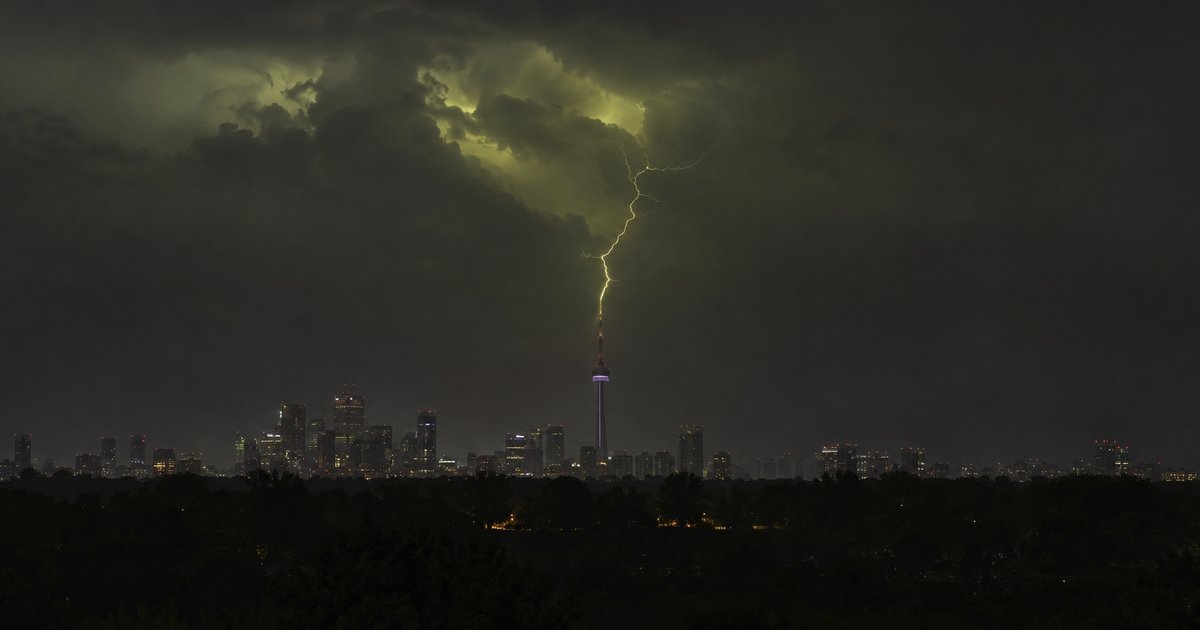
The CN Tower’s own teacher’s guide prints “75 lightning strikes per year,” but published counts depend on method: a 2007 study counted 404 flashes on video from 1991 through 2005, and a 2018 review gives 460 for the same period, so there is no single settled annual number. The tower is also a research site. Toronto Metropolitan University’s 2017 research description says lightning current had been measured there since 1991, because the strike location is known: instruments record what flows through the structure, while cameras and remote sensors document the same flash.
A known strike point makes direct measurement possible
Toronto Metropolitan University’s 2017 project description says that to measure lightning current, researchers need to know exactly where the strike occurred. An instrumented tall tower supplies that location. Unlike a distant image of a flash, a current record comes from a sensor mounted on the structure itself and shows the electrical waveform during a hit.
The CN Tower’s education guide notes say cables run from the antenna to the ground to carry lightning. The National Weather Service’s undated lightning myths page also says tall, pointed, isolated objects can be struck more than once.
The instruments record different parts of one flash
The university’s 2017 project describes two independent current measurement systems operating since 2011. One used a Rogowski coil, a sensor that measures a changing current without placing an ordinary meter in the strike path. A later recording system acquired in 2015 could continuously capture two seconds at four-nanosecond time resolution. The project says this made it possible to record the current of an entire flash at high resolution, including return strokes and current that continues between bright pulses. The instrument specification does not mean every strike yielded a complete usable record.
The same project lists questions researchers can ask of those records: how long a flash lasts, how many return strokes it contains, how long the intervals are, and how fast its current rises. Each quantity describes a different part of the event. A flash can contain more than one stroke, so a count of strokes is not a count of flashes. The project proposed statistical analysis of available and future records; its hoped-for engineering use was better lightning protection for tall structures, including wind turbines.
Camera records add a path the current trace cannot show
A 2007 peer-reviewed paper by Hussein and colleagues describes video images of CN Tower strikes from 1991 through 2005. They studied where the flashes attached and their duration. The paper reports 404 recorded flashes, including 16 that hit below the tip. A 2018 peer-reviewed review by Shindo gives a different series: 460 flashes from 1991 through 2005, of which 23 hit the lower portion. These are differing published tallies for the period. The review notes that camera observations were concentrated near the tower top, which matters when interpreting side-strike counts.
The camera tells researchers where a channel attached; the coil tells them about electrical current at the tower. A remote lightning detection network has a different job: estimating locations from electromagnetic signals. Shindo’s 2018 review says a tower itself contributes to the radiation received by a location network, so a network-inferred peak current may differ from a direct measurement at a tower. The direct record is valuable partly because it can be compared with the remote estimate.
| Record | What it captures | Limit |
|---|---|---|
| Rogowski-coil current system, in operation since 2011 | The current at the tower during a strike | The specification does not mean every strike yielded a complete usable record |
| Recording system acquired in 2015 | Two seconds at four-nanosecond resolution: return strokes and the current between bright pulses | Same: a specification, not a guarantee of a complete record |
| Video images, 1991–2005 | Where flashes attached and how long they lasted: 404 flashes in the 2007 paper, 460 in the 2018 review | Cameras concentrated near the tower top, which matters for side-strike counts |
| Remote lightning detection network | An estimated location from electromagnetic signals | The tower contributes to the radiation received, so a network-inferred peak current may differ from a direct measurement |
Repeated strikes do not produce one timeless annual number
The tower’s undated educational guide prints “75 lightning strikes per year.” The 2007 study’s 404 video-recorded flashes over 15 years is a record of what those cameras captured, not a census of every flash at the tower. The 2018 review’s 460-flash series shows why a single neat average would hide method and coverage.
Upward lightning and other flash types describe how a discharge develops; a “strike” in a public fact sheet need not specify whether its numerator is flashes, strokes, or observations. Shindo’s review says upward initiation at a tower depends on the electric field at its top and the charge in the storm cloud. The tower’s own guide says studies have found changes in strike frequency in the local area, but it does not quantify a universal radius or effect.
The tower is a reference point, not a neighborhood forecast
A direct current trace answers questions about one instrumented structure, not where the next flash will attach nearby. The NWS lightning myths page warns that lightning can strike away from a storm’s rain and that tall objects can be hit repeatedly. For a person outside during a storm, the NWS says to seek a substantial building or hard-topped vehicle immediately when thunder is heard.
Lightning Tracker, an iPhone app, maps recently detected discharges with the nearest detection’s distance, direction and age. Detections can be delayed or missed; seek shelter when thunder is audible even if its map is empty.
Not a substitute for official weather warnings.
If you hear thunder, seek shelter even if the app shows no nearby strike.
Sources
- Toronto Metropolitan University, CN Tower Lightning Flash Characteristics Based on Current Records
- IEEJ Transactions on Electrical and Electronic Engineering, Lightning Striking Characteristics to Tall Structures
- CN Tower, Teacher’s Resource Guide
- National Weather Service, Lightning Myths
- Journal of Electrostatics, Characteristics of Lightning Flashes Striking the CN Tower Below Its Tip