 Lightning Tracker
App Store
Home and everyday
Why do people cover mirrors during a thunderstorm?
November 19, 2026 · 7 min read
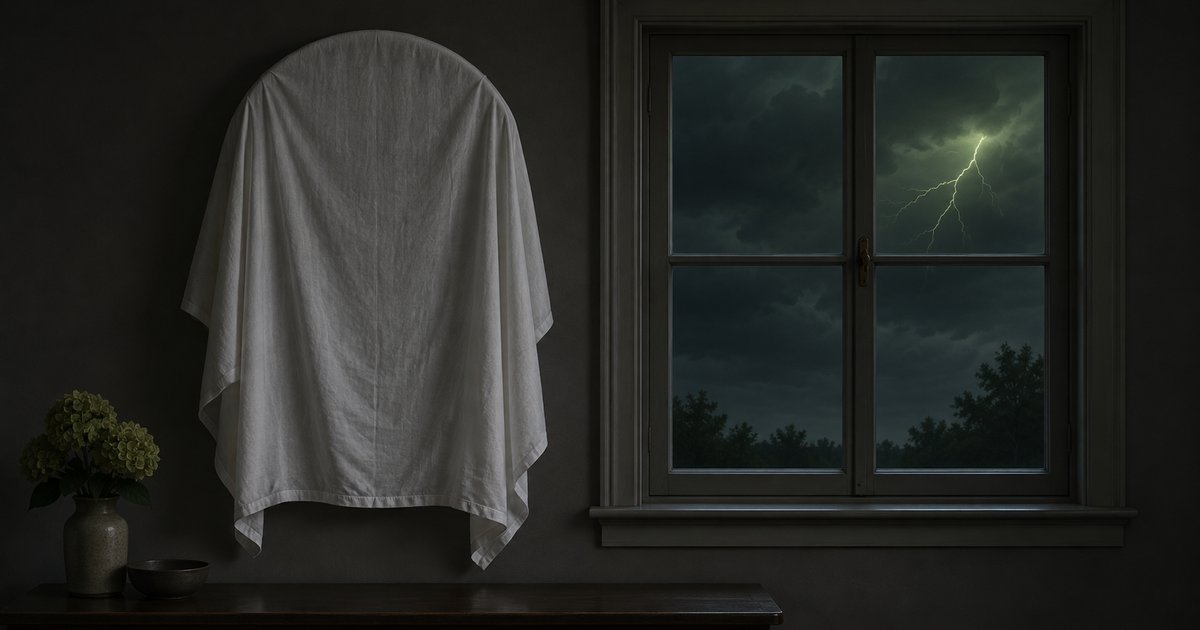
People who cover mirrors during a thunderstorm are following a folk belief, recorded in several archives, that mirrors draw lightning or the storm itself. The National Weather Service says height, a pointy shape and isolation decide where lightning strikes and that metal makes no difference, and it does not list covering mirrors among its indoor steps.
Folklore archives record covered mirrors in storms in the British Isles, Brazil, Michigan and the Cane River region
Five accounts in university and library collections describe covering mirrors during a thunderstorm, and they were dated between 1971 and 2011. They come from different places and families, so the table lists each one on its own terms. Each is a record of what an informant said, not a measurement of anything.
| Archive and date | Place named | What was covered | Reason in the entry |
|---|---|---|---|
| Lore and Language, January 1972 | British Isles | Mirrors, sometimes glass-framed pictures, cutlery and other bright objects | None given for the covering |
| USC Digital Folklore Archives, April 2007 | Brazil | Mirrors | “They attract the storm” |
| Callow Folklore Archive, 1971 | England in the early 1900s, told in Harper Woods, Michigan | Silverware and mirrors | Fear of being struck by lightning |
| Callow Folklore Archive, 1979 | Detroit, Michigan | All mirrors in the house, with sheets | Lightning is attracted to mirrors, in the informant’s explanation |
| NCPTT transcript, posted September 22, 2011 | Cane River region | Mirrors, with a white sheet | Lightning would hit the mirror |
The account with the most detail is in the January 1972 issue of Lore and Language, the journal of the University of Sheffield’s Survey of Language and Folklore. J. D. A. Widdowson, writing about customs of the house, says that until recent times it was common during a thunderstorm to open all the doors of a house “so that the lightning will go through.” In the same passage mirrors and sometimes pictures framed in glass were shrouded, and cutlery and other bright objects were covered. He adds that such customs vary with each family’s beliefs and with the type of house. The examples in his article come from the British Isles, and the passage gives no reason for the covering. It also describes opening every door, whereas the National Weather Service lists exterior doors among the places to stay away from indoors.
The USC Digital Folklore Archives holds an entry titled “Mirrors attract storms and should be covered during a storm,” with a performance date of April 2007 and a posting date of April 18, 2012. The collector interviewed a Brazilian-born woman of Portuguese descent, who described her grandmother, a devout Catholic. In heavy rain with thunder and lightning the grandmother would go around the house covering the mirrors because, in the informant’s words, they attract the storm. The collector wrote of never having heard a superstition quite like this one and judged it “probably either taken directly from native lore or is a hybridization” of Portuguese and native lore. That is the collector’s guess, not a documented origin.
The James T. Callow Computerized Folklore Archive at the University of Detroit Mercy holds two Michigan records on the same custom. One, dated 1971 and tied to Harper Woods, says that during a thunderstorm in England in the early 1900s everyone covered their silverware and mirrors for fear of being struck by lightning. The other, dated 1979 and tied to Detroit, says to cover all mirrors in the house with sheets during a storm to prevent lightning from striking the house. Its submitter notes that the informant explained this by saying lightning is attracted to mirrors.
The National Center for Preservation Technology and Training (NCPTT) posted a video transcript on September 22, 2011, titled “African-American and Creole Traditions Surrounding Death in the Cane River Region.” It has a section headed “Covering Mirrors.” There one speaker says the only time mirrors were covered was during lightning, with a white sheet, and that people said “with that lightning flashing it would hit that mirror.” Another says that whenever there was lightning or thunder, everybody made sure to cover their mirror. Because the NCPTT site did not answer on November 11, 2026, this page cites the Internet Archive’s capture of the transcript from December 8, 2022.
The accounts differ in what was covered and who did it, and none traces an origin
The five accounts agree that mirrors were covered during a storm, and they differ on almost everything else. Widdowson and the 1971 Callow record add cutlery or silverware, while the others name only mirrors. Four entries give a reason, each in the informant’s terms: mirrors attract the storm, people feared being struck by lightning, lightning is attracted to mirrors, or lightning would hit the mirror. The Widdowson passage gives none. The informants range from a Brazilian-born woman recalling her Catholic grandmother, to speakers from the Cane River region, to a Michigan record about England, so the entries show a custom recorded in many places rather than one tradition handed down along one line.
None of the entries dates the custom’s beginning or names an earlier source for it. Their dates are the dates of recording, which say when someone wrote the custom down, not when it began. This page therefore cannot say where the custom comes from, only where and when it was recorded.
The same archives record mirror covering for another occasion, a death in the house, with reasons of its own. A Callow record tied to Birmingham, Michigan, and dated 1968, says the spirit of the dead person could fly into the mirror and its release to heaven would be delayed or impeded. A Romanian-custom record dated 1969 says the mirrors are covered for six weeks, and that the informant thinks it is so the spirit will not come back to see itself. In the NCPTT transcript a third speaker describes the death custom too, covering a mirror in the room where someone died, because, as she recalled, people said the person would be in the mirror. The storm accounts above do not mention any of these reasons, and the archives do not tie the two customs together.
The National Weather Service says height, shape and isolation decide where lightning strikes, and metal makes no difference
The National Weather Service names height, a pointy shape and isolation as the dominant factors controlling where a lightning bolt will strike, and it says the presence of metal makes absolutely no difference to where lightning strikes. Its page of lightning myths lists the belief that structures with metal, or metal on the body such as jewelry, cell phones, MP3 players and watches, attract lightning, and answers it with those facts. The same page points out that trees and mountains, which hold little to no metal, are struck many times a year. It also says metal conducts lightning once it is hit, which is why it advises staying away from metal fences, railings and bleachers.
The National Severe Storms Laboratory (NSSL) gives the mechanism in its lightning FAQ. Lightning usually strikes the tallest object, it says, because the tallest object is the most likely to produce upward streamers that connect with the downward lightning leader.
Neither page names mirrors, glass or shiny surfaces. The nearest statement is the NWS answer on metal, and this page does not stretch it into a test of mirrors. None of the sources used here reports a comparison of covered and uncovered mirrors.
Indoors, the NWS asks people to avoid conducting paths, and its list has no mirrors
The NWS Lightning Indoors page says there are three main ways lightning enters structures: a direct strike, wires or pipes that extend outside the structure, and the ground. Once inside, it adds, lightning can travel through the electrical, phone, plumbing and radio or television reception systems, and through metal wires or bars in concrete walls or floors. Its tips follow from those paths:
- Stay off corded phones; cellular and cordless phones can be used.
- Do not touch electrical equipment such as computers, TVs or cords. Remote controls can be used.
- Avoid plumbing: do not wash your hands, take a shower or wash dishes.
- Stay away from exterior windows and doors, and stay off balconies, porches and out of open garages or carports.
- Do not lie on concrete floors or lean against concrete walls.
The NWS lightning safety overview, also undated, gives the rule that goes with them: if you hear thunder you are likely within striking distance, so get inside a substantial building or a hard-topped vehicle, and wait 30 minutes after the last lightning or thunder before going back outside.
Glass appears in the NWS material only as windows. Its myths page says windows are hazardous for two reasons: wind generated during a thunderstorm can blow objects into a window and shatter it, and in older homes, in rare instances, lightning can come in through cracks at the sides of windows. Neither reason concerns a mirror on a wall. Covering mirrors appears nowhere in the NWS indoor pages used here, so a household that does it is adding a step the NWS does not list.
What the sources leave open
The archives show that people have covered mirrors during storms for reasons they could name and that the custom was recorded on both sides of the Atlantic. The NWS and NSSL pages state what decides where lightning strikes and what to do indoors. Nothing used here connects the two, so the custom stays a recorded belief with no tested effect either way. People who want to see where lightning has been detected nearby can use Lightning Tracker, an iPhone app that shows recently detected strikes on a live map with the distance to the nearest one and how many minutes ago it was detected.
Not a substitute for official weather warnings.
If you hear thunder, seek shelter even if the app shows no nearby strike.
Sources
- Widdowson, J. D. A., “Traditions of the House and Home,” Lore and Language no. 6, University of Sheffield, January 1972 (scan hosted by Memorial University of Newfoundland), PDF
- USC Digital Folklore Archives, Mirrors attract storms and should be covered during a storm
- University of Detroit Mercy Libraries, James T. Callow Computerized Folklore Archive, search results for “mirrors”
- National Center for Preservation Technology and Training (NCPTT), African-American and Creole Traditions Surrounding Death in the Cane River Region (posted September 22, 2011; Internet Archive capture of December 8, 2022)
- National Weather Service, Lightning Myths
- National Weather Service, Lightning Indoors
- National Weather Service, Overview: Lightning Safety
- NOAA National Severe Storms Laboratory, Severe Weather 101: Lightning FAQ