 Lightning Tracker
App Store
Storm basics
Do giraffes get struck by lightning?
November 19, 2026 · 4 min read
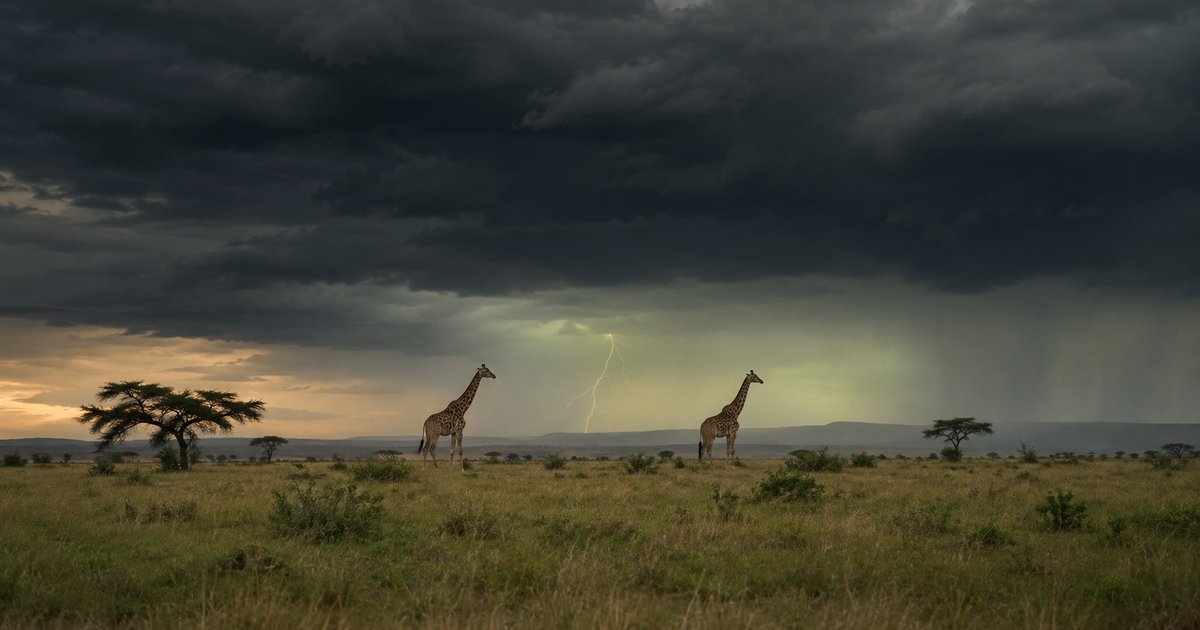
Yes, giraffes can be struck by lightning. A 2020 African Journal of Ecology field report inferred that one giraffe died from a direct strike and a second, found about 23 feet (7 meters) away, probably died from a side flash or ground current after a February 29 storm in South Africa. Those two deaths document a hazard, but they do not measure how often giraffes are struck or prove that giraffes have a higher strike rate than other animals.
What the South African field report observed
Researcher Ciska Scheijen’s 2020 African Journal of Ecology report followed eight giraffes at Rockwood, a private South African reserve. The animals had been monitored nearly every day and were usually seen in one herd. A strong thunderstorm with heavy rain and lightning passed the reserve on February 29, 2020. The report says all eight had been seen before the storm, but their exact locations during it were not recorded. Staff saw only six the next morning and found two dead on March 2.
The two female giraffes lay about 23 feet (7 meters) apart near a place where the herd had been seen before the storm. The older animal had a fracture at the base of an ossicone, one of the horn-like projections on a giraffe’s head. Scheijen interpreted that injury, together with the open setting and lack of nearby large trees, as evidence of a direct lightning strike to the head. The second animal had no visible injury. The paper concluded that she likely died from either a side flash or step potential, the voltage difference that can drive current through an animal standing across two points on the ground.
Those are forensic inferences, rather than video of the instant of impact. The researchers did not record exactly where each animal stood during the storm or measure the current that passed through either one. The two carcasses and their different physical signs support the paper’s account of more than one possible route for lightning injury; they cannot identify a precise path for the second giraffe.
Other documented giraffe cases exist
A 2014 report by Ryan Blumenthal, preserved in the University of Pretoria repository, describes an adult giraffe killed by lightning on a game farm near Phalaborwa, South Africa, in March of that year. Its abstract focuses on delayed scavenging of the carcass and explicitly says that phenomenon had not been confirmed by formal studies. The case is evidence of another giraffe lightning death, not evidence that scavengers predict a lightning strike or that the pattern is typical.
Wits University described another giraffe skeleton in a May 2023 account of its lightning research. Witnesses had seen the animal struck, according to the university. Researchers examined microscopic fractures in the bone and then reproduced similar patterns using artificial lightning impulses on other bones. The university presents that work as a possible forensic aid when an animal is found dead without a witness.
How a strike can kill an animal without hitting it directly
The National Weather Service explains that a lightning discharge can travel outward in and along the ground after it hits an object. The greater the separation between an animal’s ground contact points, the greater the potential for a harmful voltage difference. Large farm animals have a long span between front and back legs, which makes ground current a serious mechanism for them. The Rockwood author used “step potential” for this pathway and also considered a side flash for the second giraffe: current jumping from an object or animal that received a strike.
A direct strike is a different pathway: the animal is in the main discharge channel. The Rockwood fracture led the author to infer such a strike for the older giraffe. The National Weather Service’s account of the ways lightning reaches people explains these pathways in human terms. The same distinction prevents a mistaken reading of a group death: finding two animals together does not mean both were hit directly by separate bolts. Lightning reaching livestock through the ground is a related concern for people managing large animals, though that page addresses farms rather than giraffes.
Does height make giraffes more likely to be hit?
The National Severe Storms Laboratory says lightning usually strikes the tallest object, but expressly warns against saying it always does. Taller objects are more likely to send an upward channel that connects with a developing flash. The Rockwood paper observed that the giraffes stood in relatively open vegetation below their height and suggested that their height may increase vulnerability to direct strikes. That is a physically plausible explanation for this case, not a measured comparison of giraffes with zebras, cattle or people.
The 2020 report itself says records of wildlife lightning deaths are scarce and often lack detail. A strike-rate comparison would need systematic counts of exposed animals, observation time and confirmed deaths under comparable storm conditions. The Rockwood report supplies detailed evidence about two individuals at one reserve; the 2014 case and the Wits account add examples, not the denominator for a species-wide rate.
Height is also only one part of exposure. Scheijen noted that animals might change behavior in a storm, but the Rockwood observations could not confirm that the giraffes did so during this event. Their positions at the time of the strike were not recorded. A taller body in open country can matter to how lightning attaches; it does not make the next strike predictable. The National Severe Storms Laboratory’s caution about the tallest object applies here just as it does to common lightning myths.
For storms near your own location, Lightning Tracker, an iPhone app, shows recently detected strikes on a live map and the distance to the nearest one.
Not a substitute for official weather warnings.
If you hear thunder, seek shelter even if the app shows no nearby strike.
Sources
- African Journal of Ecology, Inferred giraffe deaths from lightning strikes
- Vulture News, Delayed post mortem predation in lightning strike carcasses
- Wits University, Finding facts in a lightning bolt
- National Weather Service, Ground Current
- NOAA National Severe Storms Laboratory, Lightning FAQ