 Lightning Tracker
App Store
Storm basics
Can animals sense a storm before people do?
November 19, 2026 · 4 min read
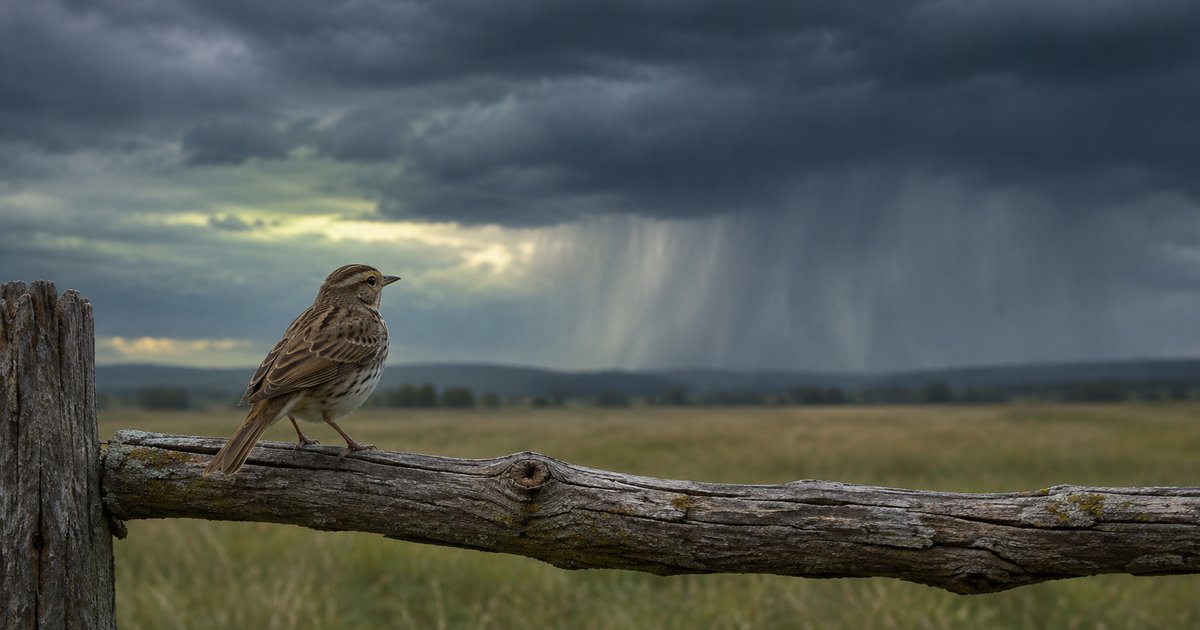
Yes, some animals respond to storm cues before people notice them, but their behavior is not a dependable lightning warning. In a 2013 Journal of Experimental Biology study, air pressure fell 12 to 24 hours before snowstorms, and white-crowned sparrows ate more when researchers lowered pressure in a laboratory. That measured response does not show a bird—or a pet—can forecast where or when lightning will strike.
One controlled bird experiment found a response to falling pressure
In a 2013 Journal of Experimental Biology study, researchers first tracked free-living white-crowned sparrows and weather, then lowered air pressure in a laboratory. Their field data showed pressure falling in the 12 to 24 hours before snowstorms. In the laboratory, birds ate more when pressure declined. The experiment supports the narrower claim that this species can respond to changing pressure.
The same 2013 study found no relationship between pressure and stress physiology in the field, and the laboratory pressure change did not alter metabolic rate or stress physiology. The feeding response therefore did not coincide with a measured rise in those other responses.
A tracked escape before a severe storm suggests another cue
In a 2015 Current Biology report archived by the U.S. Geological Survey, golden-winged warblers carrying light-level geolocators left their Tennessee breeding territories more than 24 hours before a severe tornadic storm and the local atmospheric changes associated with it. The birds made a journey exceeding about 930 miles (1,500 kilometers) over five days to go around the storm. This was an unusual movement outside their regular migration period, captured because the researchers were already tracking the birds.
The authors called infrasound—the very low-frequency sound they proposed a large storm could radiate over long distances—the probable cue. They did not record what the birds heard. A geolocator documents the journey; it does not identify a sense organ. The proposed sound cue remains an inference.
A newer call study found rain and humidity, but not a pressure signal
Gillies and Brown's 2024 study in the Australian Journal of Zoology tested whether sulphur-crested cockatoos give a particular “rain call” in response to weather. Researchers recorded calls and barometric pressure, humidity, rainfall and temperature for four months at four sites around Sydney. Calls were most prominent at dawn and much more common at two of the four sites. They were more likely during high humidity, slightly lower temperatures and rain already falling. The researchers found no evidence that the calls were prompted by the current air pressure.
The authors also say their observation period contained few storms, limiting what the negative pressure result can settle. The study looked at a different species, a specific call and field conditions rather than feeding during an experimental pressure change.
| Study | Species | Signal tested | What it found |
|---|---|---|---|
| Journal of Experimental Biology, 2013 | White-crowned sparrows | Falling air pressure | Pressure fell 12 to 24 hours before snowstorms; in the laboratory, birds ate more when pressure declined |
| Current Biology, 2015 | Golden-winged warblers | Local atmospheric changes before a severe tornadic storm; the authors proposed infrasound | Birds left their Tennessee territories more than 24 hours before the storm; the infrasound cue is an inference |
| Australian Journal of Zoology, 2024 | Sulphur-crested cockatoos | Calls against pressure, humidity, rainfall and temperature | Calls were more likely in high humidity, slightly lower temperatures and rain already falling; no evidence they were prompted by current air pressure |
An animal's early reaction does not tell you when lightning will arrive
Animals can respond to a cue that already exists while a person has not yet noticed it. A weather change can precede rain; distant thunder or lightning from a distant storm means a storm already exists. These are different from forecasting a strike at a particular place. The bird studies establish responses and movements, not a measured hit rate for using pet behavior as an alarm. A pet that hides or a flock that moves also gives no location, distance or time for a possible strike.
The 2013 sparrow experiment investigated pressure before snowstorms, but it did not measure lightning or show that feeding predicts thunder inside a snowstorm. A dependable warning would require knowing how often the behavior occurs on quiet days and how often storms occur without it; the bird studies do not provide those rates for a pet or backyard bird.
Weather information and thunder remain the practical triggers
The National Weather Service's undated lightning overview, read in November 2026, says to plan ahead, watch weather conditions and reach a substantial building or hard-topped vehicle before a storm threatens. If you hear thunder, it says, you are likely within striking distance; if the sky looks threatening or you hear thunder, go inside. Wait 30 minutes after the last lightning or thunder before returning outdoors. An animal's behavior does not replace that rule or an official forecast and warning.
For pets, the National Weather Service's indoor-lightning page says a doghouse is not lightning shelter and dogs chained to trees or metal runners are particularly vulnerable. The building or hard-topped vehicle guidance applies whether the animal acted oddly beforehand or not. Bring a pet in before weather becomes threatening.
If you are watching a storm near your pets, Lightning Tracker, an iPhone app, shows recently detected strikes on a live map and the distance to the nearest one.
Not a substitute for official weather warnings.
If you hear thunder, seek shelter even if the app shows no nearby strike.
Sources
- The Company of Biologists, Environment, behavior and physiology: do birds use barometric pressure to predict storms?
- U.S. Geological Survey, Tornadic storm avoidance behavior in breeding songbirds
- Macquarie University, Do sulphur-crested cockatoos (Cacatua galerita) call the weather?
- National Weather Service, Overview: Lightning Safety
- National Weather Service, Lightning Indoors