 Lightning Tracker
App Store
Home and everyday
Why dogs fear thunderstorms, and what veterinarians advise
November 19, 2026 · 10 min read
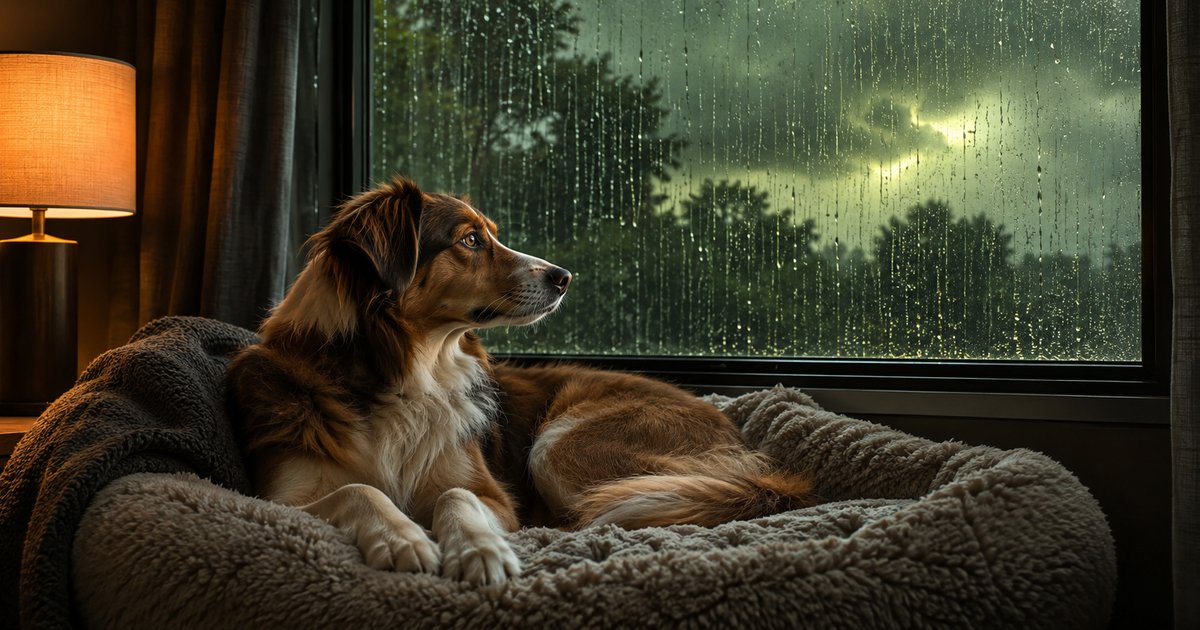
Veterinary sources name the sound of thunder as a trigger of storm fear in dogs, along with what a dog has learned to expect from storms, genetics, early experience and sometimes pain, and they disagree about the role of air pressure and static electricity. Their shared advice is to give the dog a ready retreat, never punish it, and involve a veterinarian when the fear is moderate or severe.
Veterinary sources name several causes of storm fear and do not settle on one
PetMD, whose storm-phobia page was reviewed by a veterinarian and updated September 23, 2025, says the exact cause of storm anxiety in dogs is unknown. It lists three possible contributors: too little exposure to storms early in development, owners unintentionally reinforcing the fear, and a genetic predisposition for emotional reactivity, with the condition appearing more common in herding breeds. Cornell University’s College of Veterinary Medicine (as of November 2026) names a negative experience around a specific noise, lack of early socialization, underlying illness, and anxieties that worsen with age. The ASPCA’s September 14, 2023 article says the trigger for an individual pet is hard to pin down and that there may be more than one.
Sound is the trigger all of these sources name. A July/August 2025 article in Today’s Veterinary Practice, co-written by a board-certified veterinary behaviorist, describes storm phobia as a fear response out of proportion to the danger a storm poses. It says the response occurs in close association with the sound of thunder and may be more intense in dogs because of their superior hearing. The behavior clinic of the University of Pennsylvania School of Veterinary Medicine (Penn Vet) adds, in an undated handout, that wild animals react to storms fearfully because storms can be dangerous, so the fear is not abnormal in itself; the trouble is that pet dogs are mostly shielded from real storm dangers and can create danger through their reactions. Real storm damage, the handout says, usually worsens fears or causes them in dogs that had none.
Breed, age and pain affect which dogs develop storm fear
VCA Animal Hospitals’ fear-of-noises article, written by board-certified veterinary behaviorists (undated), says noise aversions are quite common, with an estimated one-third of dogs affected. A 2001 Tufts University Internet survey of 69 owners, published in the Journal of the American Animal Hospital Association, found that herding dogs and herding crossbreeds made up the majority of cases, and that 17 of 41 dogs with a known age of onset began showing thunderstorm phobia before age 1. A 2023 review by a researcher at the Vetmeduni Vienna says a majority of affected dogs show signs in their first or second year, and that a new onset of noise fear after age six is relatively uncommon.
When fear appears late, the sources point to the body. The 2023 review says a sudden fear of noises at an older age could indicate a pain issue. VCA says dogs 8 years and older that develop a fear of noises should be examined by a veterinarian, since partial hearing loss can change how they perceive sounds.
Pressure, static electricity and light flashes are named as triggers, with different levels of support
| Cue | Named by | What the sources say |
|---|---|---|
| Thunder | Cornell, PetMD, ASPCA, Penn Vet | Fear occurs in close association with the sound of thunder |
| Lightning flashes, darkening skies | PetMD, ASPCA, Penn Vet, VCA | Advice is to block the view; a dog may also learn them as storm predictors |
| Falling barometric pressure | PetMD, ASPCA, Penn Vet, VCA | Listed as a trigger or a clue; the ASPCA says the trigger for one pet is hard to name |
| Static electricity | PetMD, an AKC-quoted trainer, a Tufts theory | Tested by its proponent; Penn Vet rejects the grounding idea |
Today’s Veterinary Practice treats darkening skies, gusts of wind, the scent of ozone, barometric pressure changes and even rain alone as contextual clues a frightened dog learns to associate with a coming storm, which, it says, could explain why some dogs show fear before a storm begins. That is a learning explanation, not a claim that dogs measure pressure. PetMD and Penn Vet list falling barometric pressure among the things dogs react to, and the ASPCA says it may be the trigger for some pets. None of the pages cited here reports a measurement showing that dogs sense a pressure change. An AKC article updated September 30, 2025 quotes a dog trainer who thinks dogs may be sensitive to air pressure and potentially static electricity, and presents that as her view.
Static electricity has the most unusual history. In a fall 2011 Tufts Magazine essay, Nicholas Dodman of Tufts’ Cummings School of Veterinary Medicine described owners whose storm-phobic dogs sat in sinks, bathtubs and shower stalls, places that are electrical grounds, and said this led him to a static electrical theory. Dogs he exposed to a Van de Graaff generator’s charge seemed to feel a hair-raising sensation but did not erupt in full-blown storm phobia. He then reported two studies of a cape with an antistatic lining: in the first, 11 of 14 dogs were distinctly improved by owner reports, and in the second, 14 dogs in the cape and 14 in a placebo cape without the lining both improved, with greater improvement in the treatment group.
Other veterinary sources are less convinced. Penn Vet’s handout says there is no truth to the idea that dogs seek out bathtubs because plumbing grounds them; humid, rainy air conducts electricity and keeps static from building, it says, and dogs are probably drawn to bathrooms because they are often somewhat sound-insulated. A 2024 systematic review of pressure wraps in the journal Animals notes that Cottam and Dodman themselves hypothesized that a placebo effect may have accounted in part for the benefits seen with the cape. Read together, the sources support sound and learned storm cues as triggers. The static idea rests on one research group’s reports, and the pressure idea on lists of cues without a cited test.
Storm fear shows up as pacing, panting, trembling and escape attempts, and can start before the first thunder
Cornell lists trembling, vocalizing, panting, pacing, drooling, hiding, digging at doors and escape attempts, from mild to severe. PetMD adds destructiveness and house soiling. Penn Vet says the signs often begin before the storm arrives, as dogs watch for increasing wind, low barometric pressure and darkening skies, and that some dogs generalize the fear to gentle rain or a clear, windy day. Today’s Veterinary Practice says dogs with storm phobia might keep showing fearful behavior for hours to days after the storm has passed. VCA draws a line between ordinary fear and a phobia: fear that fades after a clap of thunder is normal and adaptive, while a phobia is an exaggerated response, and a dog’s recovery time shows which one it is.
The risk to the dog is often the escape. The ASPCA says pets that bolt could be injured, lost or eat something outside they should not, and Today’s Veterinary Practice reports lacerations to the face and paws and damage to teeth and gums from attempts to hide or escape.
Veterinary sources say a frightened dog can be comforted, and that punishment makes the fear worse
Penn Vet’s handout calls the old advice to ignore a dog during storms simply false: fear is an involuntary emotional response, and ignoring a panicky dog withholds comfort. PetMD agrees that comforting a dog that seeks it does not reinforce fear. VCA says it is fine to pet a frightened dog gently or let it sit close, but to stay calm and not make a fuss, because excessive attention could teach a dog to look for its owner whenever it is worried. Cornell, Penn Vet, PetMD and VCA all say never to punish a fearful dog; Penn Vet adds that punishment does not calm the dog and teaches it to expect punishment when storms come. Penn Vet says some dogs are comforted by being allowed in bed when storms occur at night.
Before a storm, veterinary sources advise a ready retreat, masked sound and a plan for outings
Today’s Veterinary Practice recommends a retreat that is ready in advance when the chance of storms is 40% or higher: a basement, interior room, closet, bathroom or, if the dog tolerates confinement, a crate, with few or no windows and blackout curtains or closed blinds over any that exist. Confinement is a point of caution: VCA says many dogs panic and could seriously injure themselves in a crate, and Penn Vet says forcing a dog behind a closed door, gate or crate can be very dangerous. Penn Vet suggests having someone stay with the dog on days with at least a 50% chance of storms. The retreat belongs inside buildings with electricity and plumbing: the National Weather Service says dog houses are not shelter and that dogs chained to trees or on metal runners are particularly vulnerable to lightning strikes (as of November 2026).
For sound and light, Cornell suggests layering two kinds of sound, such as white noise and music, and offering long-lasting food toys. Penn Vet says a light left on in the room can lessen the impact of lightning flashes, while warning that loud thunder cannot be masked by any ordinary sound.
For outings, Cornell advises exercise and play earlier in the day, with bathroom breaks planned so the dog does not have to go out after a storm starts, a leash even in a fenced yard if going out cannot be avoided, and current ID collar and microchip information. NASA’s Global Precipitation Measurement mission says that over land, thunderstorms are most likely at the warmest, most humid part of the day, usually the afternoon or evening, so a morning walk fits that advice where storms build in the afternoon. When the owner takes the dog out again, the weather service’s rule for people applies: wait 30 minutes after the last lightning or thunder before going back outside.
Lightning Tracker, an iPhone app, sends an alert when a strike is detected inside the radius you set for a place, which can serve as a cue to bring a dog in and settle it in its retreat, though detection networks miss some strikes and the app does not replace official warnings.
Veterinary sources disagree on whether storm recordings can retrain a dog
VCA describes systematic desensitization and counterconditioning: play the storm sound at a barely audible volume while the dog settles and earns treats, raise it slowly, begin when storms are unlikely, and plan on several weeks. VCA also warns that darkening skies, rain, flashes and barometric changes are hard to reproduce, so many dogs still cannot relax in a real storm. Penn Vet’s handout goes further, saying there is no good evidence that dogs can be desensitized to storms, because a recording cannot imitate low pressure, rain, humidity, lightning and the smell of ozone, and that the effort may sensitize the dog further.
A 2003 University of Georgia open clinical trial of 40 dogs combined two prescription drugs with behavior modification, including home desensitization with audio storm sounds; 30 of the 32 dogs that finished improved by their caregivers’ assessment, improvement was greater during true storms than during rain only, and the response to the audio simulation did not change. The 2023 Vienna review says counterconditioning to real-life noises, relaxation training and training with recordings have been shown to improve noise fear. The sources agree a recording cannot reproduce a whole storm, and differ on whether the training helps anyway.
Wraps, supplements and prescriptions have very different levels of support
| Aid | What the sources say | Source |
|---|---|---|
| Pressure wraps | Four studies met the review’s criteria; evidence of benefit is weak and limited. Some dogs seem comforted, others are distressed; watch for overheating | 2024 systematic review; Penn Vet |
| Pheromone products | Some dogs respond, some not at all; study findings are inconsistent | Penn Vet; 2023 review |
| Supplements, herbal products, homeopathy, Bach flowers, essential oils | Unlikely to be sufficient on their own; no good evidence for aromatherapy, Bach flowers or homeopathic preparations for true storm fear | 2023 review; Penn Vet |
| Prescription anti-anxiety medication | Good evidence of efficacy for several; essential for most dogs with moderate or severe storm phobia, says Penn Vet | 2023 review; Penn Vet |
Penn Vet notes that only a veterinarian can legally prescribe medication. Cornell advises raising medication with a veterinarian well in advance and trying any prescribed drug first on a day without noise, and the ASPCA likewise recommends a test run while the regular veterinarian’s office is open. This article gives no drug advice or doses; those are for the dog’s veterinarian.
A veterinarian or behaviorist belongs in the plan once fear is moderate or severe
The ASPCA says storm phobias can worsen with time and that moderate to severe fear calls for a veterinarian or a veterinary behaviorist. PetMD says the veterinarian will need to rule out conditions that can look alike, such as separation anxiety, pain and neurological problems, and Today’s Veterinary Practice notes that noise phobia, storm phobia and separation anxiety often occur together and that treatment must address all of them.
Not a substitute for official weather warnings.
If you hear thunder, seek shelter even if the app shows no nearby strike.
Sources
- PetMD, Thunderstorm Phobias in Dogs: How to Manage Dog Storm Anxiety, updated September 23, 2025
- Cornell University College of Veterinary Medicine, Fear of fireworks and thunderstorms
- ASPCA, Weathering the Storm: How to Help Scared Pets During Storms, September 14, 2023
- Today’s Veterinary Practice, Storm Phobia in Dogs, July/August 2025
- University of Pennsylvania School of Veterinary Medicine, Ryan Veterinary Hospital behavior clinic, Fear of Thunderstorms and Fireworks (undated handout)
- VCA Animal Hospitals, Fear of Noises in Dogs
- VCA Animal Hospitals, Treating Fear of Storms and Fireworks in Dogs
- Tufts Magazine, The Shocking Truth: Calming Fido’s fear of thunderstorms, fall 2011 (Internet Archive copy of October 21, 2021; the original page asks for a login)
- American Kennel Club, Understanding Thunderstorm Anxiety in Dogs, updated September 30, 2025
- McCobb et al., Thunderstorm phobia in dogs: an Internet survey of 69 cases, Journal of the American Animal Hospital Association, July–August 2001
- Crowell-Davis et al., Use of clomipramine, alprazolam, and behavior modification for treatment of storm phobia in dogs, Journal of the American Veterinary Medical Association, March 15, 2003
- Riemer, Therapy and Prevention of Noise Fears in Dogs: A Review of the Current Evidence for Practitioners, Animals, November 2023
- Mathis et al., A Systematic Review of the Efficacy of Compression Wraps as an Anxiolytic in Domesticated Dogs, Animals, November 2024
- National Weather Service, Lightning Indoors
- National Weather Service, Overview: Lightning Safety
- NASA Global Precipitation Measurement mission, Is there a specific time of day that a thunderstorm is most likely to occur?