 Lightning Tracker
App Store
Storm basics
Does lightning make mushrooms grow?
November 19, 2026 · 4 min read
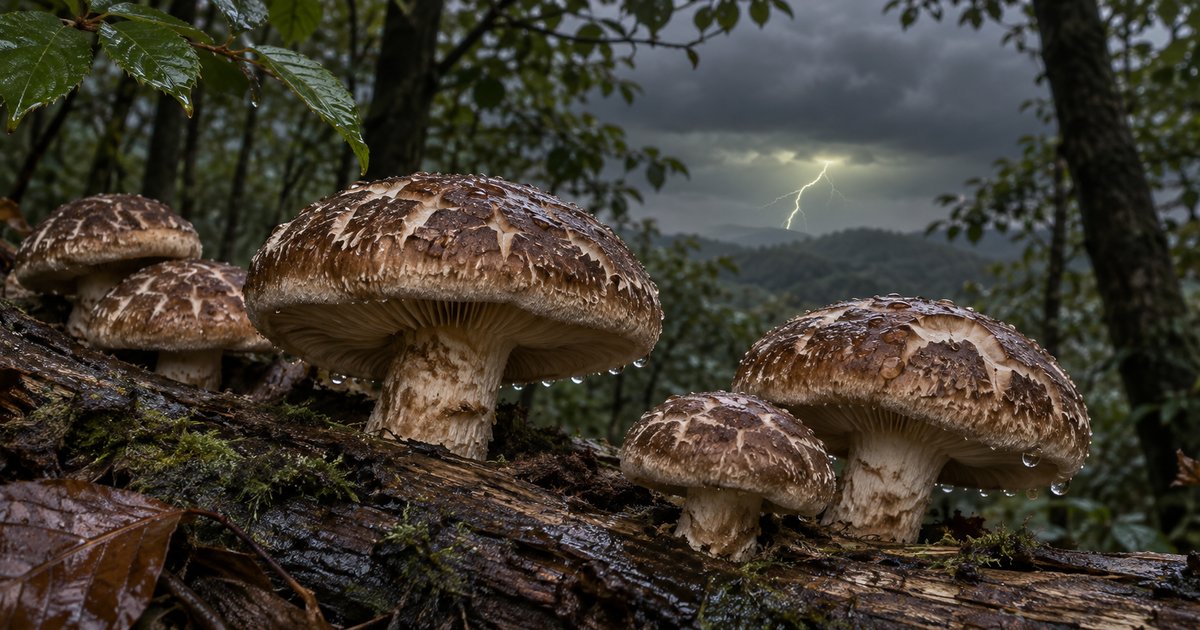
Controlled electrical pulses can increase the harvest from cultivated mushrooms, but that does not prove a natural lightning strike makes wild mushrooms grow. In a 2018 Materials experiment, treated shiitake logs yielded about 1.3 times the control group’s total weight; the paper’s discussion reports about 1.2 times for another cultivated species. The investigators applied pulses with equipment to prepared growing material; the study did not count mushrooms after ordinary thunderstorms.
The measured result came from cultivated material with a control group
Takahashi and colleagues reported in Materials on December 5, 2018 that they cultivated shiitake on logs and Lyophyllum decastes on sawdust blocks. They compared treated groups with untreated controls, measuring harvested fruiting bodies—the visible reproductive structures we call mushrooms. For shiitake, the study followed four fruiting seasons; for the other fungus, two. The abstract rounds both yields to about 1.3 times control weight, while the discussion gives about 1.3 for shiitake and 1.2 for Lyophyllum. That is a yield result for particular cultivated fungi under specified treatments, not a count of mushrooms appearing after natural strikes.
The 2018 team divided 80 shiitake logs into five groups of 16: four receiving different electrical treatments and one control group. They placed electrodes at log ends, used 30- or 50-kilovolt pulses from two kinds of generator, and rearranged the logs to reduce the effect of their position. The logs had already been inoculated with shiitake and incubated for two years. The treatments reached established fungal cultures at a chosen point before a fruiting season.
Three experiments tested different parts of the lightning idea
The 2018 Materials paper and two studies in Mushroom Science and Biotechnology dated 2020 and 2024 delivered different exposures: electrical pulses, a simulated nearby strike and sound.
| Study | Exposure | Measured result |
|---|---|---|
| Takahashi et al., 2018 | High-voltage pulses applied to cultivated shiitake logs and sawdust blocks of another species | About 1.3 times control weight for shiitake and 1.2 times for Lyophyllum in the discussion |
| Shimizu et al., 2020 | Generator discharge to a lightning rod a few meters from cultivated shiitake logs | Twice the number of shiitake fruiting bodies compared with logs without simulated strikes |
| Ogama et al., 2024 | Airborne sound at different pressures and frequency bands delivered during shiitake cultivation | Best onset response at 110 decibels; fruiting-body yield peaked in the tested 1.5–2.5 kilohertz band |
The 2018 paper reports a useful nuance within its own trial: after a stimulated flush, the following third shiitake flush received no fresh pulses and did not keep the same increase over controls as the second flush. The authors describe yield as varying among logs and generally depending on the previous flush. That means even in cultivation, timing and the measure chosen—weight versus number of fruiting bodies—matter. A doubled count in one experiment is not the same as a doubled weight in another.
A simulated nearby strike tested an indirect effect
Shimizu and colleagues' 2020 J-STAGE abstract says natural lightning rarely strikes a mushroom-growing log directly. To better resemble a nearby discharge, their generator sent a spark to a lightning rod while cultivated shiitake logs stood a few meters away. The researchers compared logs exposed to these simulated strikes with logs not exposed and harvested twice as many fruiting bodies in the exposed group.
The 2024 J-STAGE study by Ogama and colleagues isolated another possible part of a thunderstorm: sound. They applied different sound pressures and frequency bands during shiitake cultivation. Their abstract reports the strongest promotion of fruiting onset at 110 decibels and the highest yield when the applied sound was between 1.5 and 2.5 kilohertz. The researchers interpreted the result as support for a sound or vibration effect.
Rain can explain a flush after a thunderstorm
University of Minnesota Extension's page, reviewed in 2024, says mushrooms are fruiting bodies of fungi already living in soil and that lawn mushrooms commonly appear during moist conditions from rain or irrigation. University of Maryland Extension's July 2026 page similarly says mushrooms tend to appear after wet weather, while the main fungus is a network of mycelium beneath the surface. An apparent sudden growth after a storm need not mean a strike created a new organism overnight. The visible structure can emerge from a fungus that was present before the rain.
Rain provides a competing explanation whenever lightning and mushrooms follow the same thunderstorm. To show a natural-strike effect, a field study would have to compare similar places or logs with and without a recorded strike, while accounting for water and other weather conditions. The 2018, 2020 and 2024 cultivation studies tested controlled treatments instead.
A mushroom sighting offers no reason to stay out in lightning
The National Weather Service's undated lightning overview, read in November 2026, says to get inside when skies look threatening or thunder is heard, and to wait 30 minutes after the last lightning or thunder before going back out. Even a storm with little rain can produce a strike, so mushroom hunting should not depend on whether the ground is wet. The NWS identifies a substantial building or hard-topped vehicle as the places to seek shelter from lightning. Lightning inside a snowstorm calls for the same response.
Before you head out after a storm, Lightning Tracker, an iPhone app, shows recently detected strikes on a live map and the distance to the nearest one.
Not a substitute for official weather warnings.
If you hear thunder, seek shelter even if the app shows no nearby strike.
Sources
- MDPI, Development of Compact High-Voltage Power Supply for Stimulation to Promote Fruiting Body Formation in Mushroom Cultivation
- Japanese Society of Mushroom Science and Biotechnology, Effects of lightning strike on the occurrence of shiitake mushrooms
- Japanese Society of Mushroom Science and Biotechnology, Effect of sound and sound frequency associated with lightning strikes on the promotion of fruiting body development in shiitake mushrooms
- University of Minnesota Extension, Mushrooms in lawns
- University of Maryland Extension, Mushrooms and Slime Molds in Lawns
- National Weather Service, Overview: Lightning Safety