 Lightning Tracker
App Store
Storm basics
Is lightning good for plants? What the nitrogen adds
November 19, 2026 · 8 min read
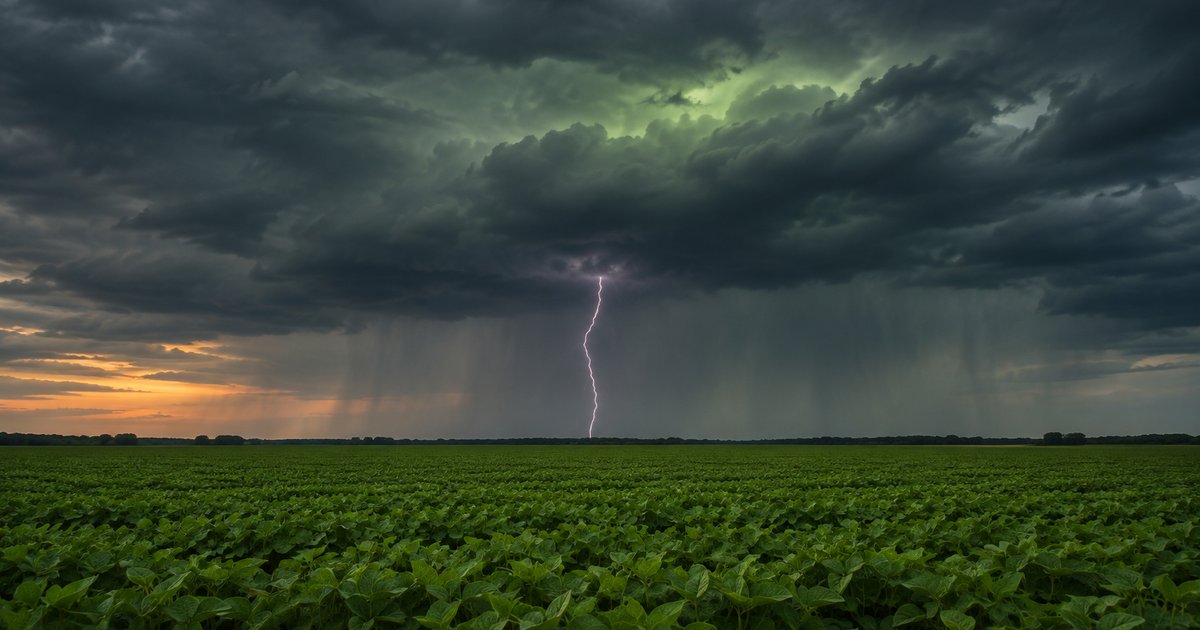
Lightning does add some plant-usable nitrogen, but a small amount: a 2013 review in Philosophical Transactions of the Royal Society B puts it at about 5 million metric tons (5.5 million short tons) a year, 2.4% of natural fixation and far less than biology or fertilizer plants fix. Nitrates do reach soil in rain, yet none of the sources used here reports a lawn turning greener because of a storm’s lightning.
Lightning turns nitrogen from the air into forms that rain can carry to plants
Plants cannot use most of the nitrogen in the air. A NOAA Global Monitoring Laboratory teacher background says that most atmospheric nitrogen is unavailable to organisms because the strong triple bond in the N2 molecule makes it relatively unreactive, so it must first be converted to a form such as ammonium or nitrate. The same document lists lightning as the first step in the nitrogen cycle: lightning breaks nitrogen molecules apart, they combine with oxygen, and the resulting nitrogen oxides dissolve in rain to form nitrates that are carried to the ground. A 1984 NASA Ames and Georgia Tech paper makes the same point about energy: only a few organisms, such as algae and certain bacteria, can “fix” nitrogen, and lightning provides a process without living things for breaking the nitrogen–nitrogen bond.
The energy comes from the flash itself. The National Severe Storms Laboratory (NSSL) says a flash heats the air in its channel to above 50,000 °F in only a few millionths of a second. A 2007 review in Atmospheric Chemistry and Physics, by U. Schumann and H. Huntrieser, concludes that a “typical” thunderstorm flash makes nitrogen oxides containing about about 7.7 pounds (3.5 kilograms) of nitrogen, and that the true amount could be as little as 0.13 times or as much as 2.7 times that figure. The National Atmospheric Deposition Program (NADP) says some nitrogen oxides end up as nitric acid vapor or particulate nitrate, which deposition processes efficiently remove from the air, and that nitrogen falls back to land in wet deposition (rain or snow) or as dry deposition of particles and gases.
Estimates of lightning’s nitrogen output run from 2 to 10 million metric tons a year
Published estimates of the global nitrogen fixed by lightning differ by a factor of several, and each review says so. Schumann and Huntrieser put the source at 5 ± 3 teragrams (Tg) of nitrogen a year; a teragram is one million metric tons, or about 1.1 million short tons. Their figure rests on a global flash rate of 44 flashes a second from satellite data, and they say that getting the estimate to within about 1 Tg a year, or 20%, is still a challenging goal. Our arithmetic is consistent with their figures: 44 flashes a second over a year, at 3.5 kilograms each, comes to about 4.9 million metric tons.
| Source | Estimate | In million short tons |
|---|---|---|
| Borucki and Chameides, NASA Ames and Georgia Tech, published November 1984 | About 2.6 Tg; the authors tie the uncertainty mainly to the energy of a flash | About 2.9 |
| Schumann and Huntrieser, Atmospheric Chemistry and Physics, July 2007 | 5 ± 3 Tg | 5.5, within a range of 2.2 to 8.8 |
| Fowler and colleagues, Philosophical Transactions of the Royal Society B, July 2013 | 2 to 10 Tg across estimates, with recent values closer to 5; the review adopts 5 Tg | 2.2 to 11.0, with 5.5 adopted |
The range is wide enough that no single number should be treated as settled. Fowler and colleagues call the uncertainty in each estimated component of natural fixation very large, reflecting the difficulty of scaling up from the available data.
Biology and industry fix far more nitrogen than lightning does
Fowler and colleagues’ 2013 review ranks lightning as a small part of the nitrogen that enters ecosystems. It puts global natural fixation before the industrial era at 203 Tg of nitrogen a year, with just 2.4% from lightning, and it says the lightning quantity is over an order of magnitude smaller than any of the estimates of biological fixation. Their abstract totals all fixation, natural and human, at 413 Tg a year, half of it from human activity; five of 413 is about 1.2% (our arithmetic).
| Source | Tg of nitrogen a year | In million short tons |
|---|---|---|
| Biological fixation in the oceans | 140 | 154 |
| Biological fixation in natural land ecosystems, before the industrial era | 58 | 64 |
| Industrial production, mostly fertilizer (fertilizer 100, chemical industry 20) | 120 | 132 |
| Fixation by agricultural crops | 60 | 66 |
| Combustion, as nitrogen oxides | 40 | 44 |
| Lightning | 5 | 5.5 |
The review’s natural figures describe the time before the industrial revolution, and its overview of human sources is for 2010. On a field the contrast is plainer. The NOAA teacher background says that bacteria in the soil and attached to the roots of legumes, such as peas, beans, peanuts and soybeans, change atmospheric nitrogen into a form plants can take up. University of Nebraska–Lincoln extension specialists (December 2016) report that well-established red and white clover has been reported to provide 75 to 200 pounds of fixed nitrogen per acre, and alfalfa 150 to 200 pounds.
Spread over the whole Earth, lightning’s nitrogen comes to under a tenth of a pound per acre a year
A planet-wide average shows the scale, though not what any one yard receives. NASA’s Earth fact sheet gives a volumetric mean radius of 6,371 kilometers, which makes the surface about 510 million square kilometers (our arithmetic). Spread evenly over it, 5 Tg of nitrogen is about 0.0098 gram per square meter a year, or roughly 0.09 pound per acre (0.1 kilogram per hectare); the 2 to 10 Tg range gives 0.035 to 0.17 pound per acre. Wisconsin’s Division of Extension (September 2022, last validated 2024) advises no more than 1 pound of actual nitrogen per 1,000 square feet per application, which is about 43.6 pounds per acre. One such lawn application is therefore about 500 times what lightning adds in a year at the Earth-wide average for 5 Tg, and 250 to 1,250 times across the range; a year of alfalfa fixation is roughly 1,700 to 2,300 times (our arithmetic).
The average hides large differences. Schumann and Huntrieser point to tropical continents as where most lightning occurs, and within the United States a Vaisala datasheet hosted by the National Weather Service shows lightning per square mile by state: 244.1 total lightning counts a year in Florida against 2.1 in Washington, averaged over 2015–2019, a gap of more than 100 times (our arithmetic). Kang and colleagues, in a 2022 paper in Atmosphere, modeled lightning’s effect on the contiguous United States and found that in certain grid cells in remote areas with low human nitrogen oxide emissions, lightning more than doubled wet deposition of oxidized nitrogen. A given storm can add more or less than the average, and the sources used here do not give a measured per-storm amount for a yard.
Rain already carries nitrogen to US soil, and lightning is one modeled source of it
The NADP’s 2016 brochure describes parts of eight states, from eastern Nebraska to western Ohio, that received 4.4 pounds of inorganic nitrogen per acre (5 kilograms per hectare) or more in a year from precipitation. It says precipitation over the Midwest contributes 3.6 to 6.2 pounds per acre (4 to 7 kilograms per hectare) of inorganic nitrogen to the soil each year, less than 5% of the inorganic nitrogen needs of corn and up to 15% of those of wheat. Those totals are not lightning’s alone. The same brochure says human activities account for more than 80% of US nitrogen oxide emissions (2014 inventory), that nitrate concentrations in precipitation tend to be highest where the air is most polluted with nitrogen oxides, and that 60% to 75% of the wet inorganic nitrogen in that Midwest area is ammonium, while the model described next covers oxidized nitrogen only.
Kang and colleagues isolated lightning with a regional air-quality model. For July 2016, they estimate that lightning nitrogen oxides contributed about 24% of wet oxidized nitrogen deposition and about 5% of dry oxidized nitrogen deposition, averaged over the model domain. They also report that without lightning emissions the model underestimated summer wet deposition by up to 30%. This is a modeled estimate for one month and for oxidized nitrogen only, not a measured share of the nitrogen in a rainstorm or a yearly figure.
A greener lawn after a storm has several possible causes, and the sources do not separate them
Nitrate from rain is one explanation for a greener lawn, but the sources used here do not isolate it from the others. The mechanism is documented: nitrates reach the ground in rain. The amounts, though, are small next to a fertilizer application, and the NADP brochure shows that rain also carries nitrate from human-made nitrogen oxides, which are more than 80% of US emissions, so rain delivers some nitrate with or without lightning.
Water is a second explanation. Ohio State University turfgrass specialists (September 2024) say that a lawn gone brown in drought may be dormant, not dead, and should begin recovering after receiving rainfall or irrigation. A third is in the soil: a 2009 review of drying and wetting in Global Change Biology finds that the pulse in net nitrogen mineralization after dry soil is wetted is short-lived and often exceeds the rate in a moist control soil. The same review adds that cumulative mineralization over a whole drying-and-wetting period is mostly smaller than in soil kept at optimum moisture, so wetting pulses cannot make up for slow mineralization during drought.
None of the sources used for this page reports lawn or plant color measured before and after a storm, so none ties a greener yard to a particular storm’s lightning. Read together, they document that lightning adds some nitrate to rain, that its share of the world’s fixed nitrogen is small, and that nothing in these sources puts a storm’s contribution near the size of a fertilizer application.
Lightning also damages the plants it hits and can start fires
A struck tree shows the other side of the same energy. NSSL says lightning running down a tree turns water to steam, the rapidly expanding steam can blast bark and branches off, and the wood along the path is often killed. At landscape scale, the National Interagency Fire Center’s table for 2025 lists 8,294 lightning-caused wildland fires and 2,857,141 acres burned by them.
Gardeners checking plants after a storm follow the same 30-minute rule as everyone else
The National Weather Service tells everyone to wait 30 minutes after the last lightning or thunder before going back outside, and a gardener going out to look at the lawn is going back outside.
Lightning Tracker, an iPhone app on the App Store, shows recently detected strikes on a live map, with the distance to the nearest one and how many minutes ago it was detected, and it does not replace official warnings.
Not a substitute for official weather warnings.
If you hear thunder, seek shelter even if the app shows no nearby strike.
Sources
- NOAA Global Monitoring Laboratory, Teacher Background: Nitrogen and Climate Change
- NASA Technical Reports Server, Borucki and Chameides, Lightning: Estimates of the rates of energy dissipation and nitrogen fixation, Reviews of Geophysics and Space Physics, November 1984
- Schumann and Huntrieser, The global lightning-induced nitrogen oxides source, Atmospheric Chemistry and Physics, July 2007
- Fowler et al., The global nitrogen cycle in the twenty-first century, Philosophical Transactions of the Royal Society B, July 2013
- National Atmospheric Deposition Program, Nitrogen from the Atmosphere, October 2016
- Kang et al., Assessing the Impact of Lightning NOx Emissions in CMAQ Using Lightning Flash Data from WWLLN over the Contiguous United States, Atmosphere, August 2022
- NASA, Earth Fact Sheet
- University of Nebraska–Lincoln Extension, Is Nitrogen Fixation Oversold with Legume Cover Crops?, CropWatch, December 2016
- University of Wisconsin–Madison Division of Extension, Now’s a great time to fertilize your lawn, September 2022
- Ohio State University Turfgrass Science, Managing Lawns During a Drought, September 2024
- Borken and Matzner, Reappraisal of drying and wetting effects on C and N mineralization and fluxes in soils, Global Change Biology, April 2009
- Vaisala, hosted by the National Weather Service, Total Lightning Counts by State from 2015 to 2019
- NOAA National Severe Storms Laboratory, Severe Weather 101: Lightning FAQ
- National Weather Service, Overview: Lightning Safety
- National Interagency Fire Center, Lightning-caused wildfires
- NIST Office of Weights and Measures, Metric (SI) Prefixes