 Lightning Tracker
App Store
Storm basics
Is lightning good for trees? One rainforest tree that gains from strikes
November 19, 2026 · 6 min read
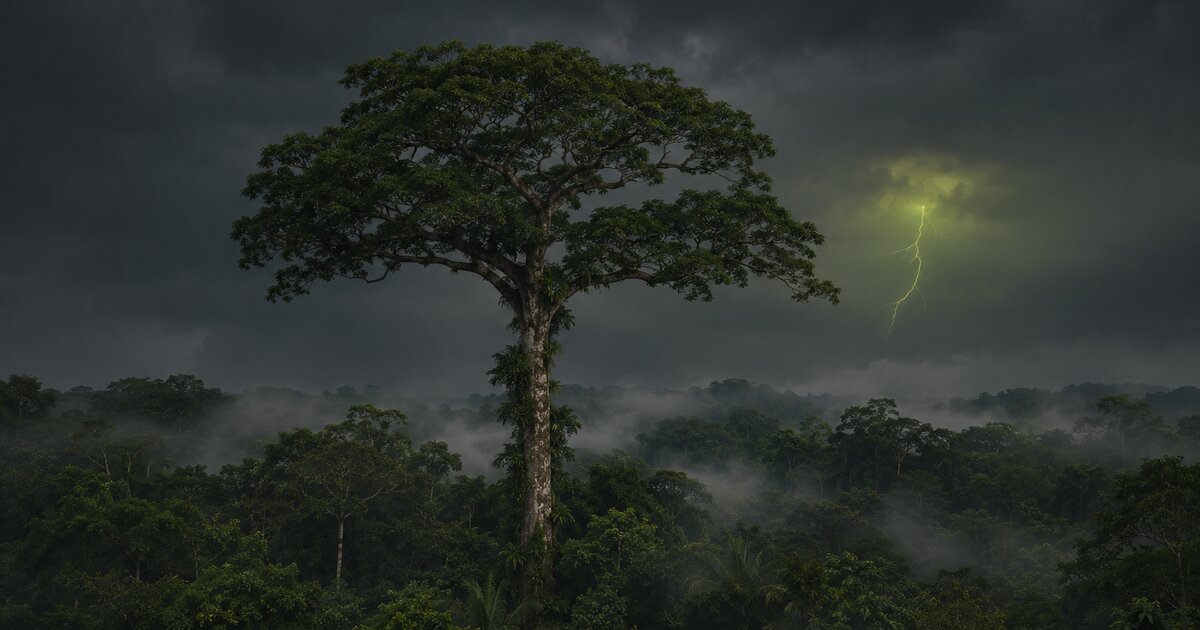
For most trees, no: in a 2025 New Phytologist study in Panama, lightning killed 56% of 93 directly struck trees. But one species gains. Nine Dipteryx oleifera trees survived 10 direct strikes with little visible harm, while vines on their crowns and neighboring competitors declined. The benefit is a competitive opening for a lightning-tolerant tree, not a general benefit for trees or a reason to stand near one in a storm.
What the researchers actually watched
Gora and colleagues' 2025 New Phytologist study was conducted in a lowland tropical forest in central Panama. A local lightning-location system identified the trees hit directly; the team then followed tree survival, crown and trunk condition, vines and neighboring trees for two to six years. That design matters because damage can develop after the flash, and a tree that still stands immediately afterward has not necessarily survived the longer aftermath.
The study recorded 94 direct strikes to 93 trees. Nine Dipteryx oleifera individuals received 10 of those strikes because one tree was hit twice. All nine individuals survived. Of the 83 directly struck trees of other species, 64% died within two years. The authors also compared struck Dipteryx with unstruck trees of the same species: crown dieback was similarly low in the two groups. This is an observed difference in this forest, not a claim that every Dipteryx tree survives every conceivable strike.
The advantage came from less competition
The 2025 study found that the strike often harmed plants sharing a Dipteryx tree's space. Woody climbing vines called lianas use a host tree for support and compete for light. On the six Dipteryx strike observations with lianas before the strike, vine abundance fell. Across the 10 strike observations, the average count dropped from 4.1 to 0.9, a 78% decline between the initial and final post-strike surveys. Four strike observations had no lianas at either survey. The result is a measured reduction in a competitor, not evidence that electricity directly nourished the tree.
The same paper reports that a strike to Dipteryx killed 9.2 neighboring trees on average, with 2.1 metric tons (about 2.3 short tons) of neighboring tree biomass dying. The researchers found neighboring trees died at similar rates around lightning-tolerant trees and other struck trees; the key difference was that the tolerant focal tree remained alive to occupy the newly opened space. In historical plot records from 1982 to 2015, trees growing near large, living Dipteryx were 48% more likely to die than trees near other large, living canopy trees. That association is consistent with repeated lightning effects, but the historical record alone does not identify lightning as the cause of every neighbor's death.
The 14-fold figure is a model, not a counted harvest
The study's striking seed-production figure comes from a demographic simulation. Gora and colleagues compared observed growth, death and seed production with a hypothetical Dipteryx population that suffered average lightning mortality and did not receive the reductions in vines and neighboring competition. In that comparison, estimated lifetime seed production was 14.1 times higher with lightning tolerance. The researchers attributed much of the modeled increase to the removal of vines and neighboring trees. No one followed one tree for its entire lifetime and counted fourteen times as many seeds after a flash.
The team's estimate of about five direct strikes over the life of a large Dipteryx is also modeled. It combines strike probability in the study's mapped forest with the estimated time a tree spends above a trunk diameter of 60 centimeters (about 24 inches). The paper gives a 95% confidence interval of 3.1 to 12.3 strikes. That is a long-term expectation for large trees at this site, not an annual risk for a tree in a yard.
| Result | What it rests on | Kind of evidence |
|---|---|---|
| All 9 Dipteryx trees survived 10 strikes; 64% of 83 other struck trees died within two years | Field resurveys of struck trees | Counted |
| Liana count fell from 4.1 to 0.9 per tree on average (78%) | 10 strike observations, first and final surveys | Counted |
| 9.2 neighboring trees and 2.1 metric tons of neighbor biomass killed per strike | Field surveys around each strike | Counted |
| About 5 direct strikes over a large tree’s life (95% interval 3.1 to 12.3) | Mapped strike probability and time spent above 60 cm trunk diameter | Modeled |
| Lifetime seed production 14.1 times higher than with no benefit | Demographic simulation | Modeled |
| Trees near large living Dipteryx 48% more likely to die, 1982 to 2015 | Historical plot records | Association, not proof of cause |
Tall crowns change the odds, but the tree makes no choice
The 2025 researchers modeled strike probability from crown area and canopy exposure. Dipteryx oleifera trees were taller and had wider crowns than other trees of the same trunk diameter. Their modeled probability of a direct strike was 49% to 68% higher than it would be if their shape followed the forest's average relationship between trunk diameter, height and crown size. A large exposed crown can be more likely to intercept a strike; the study does not show a tree deliberately drawing lightning or changing its growth to call a flash.
Counting the other long-lived, large-statured species that survived every observed strike, the paper has 18 individuals from seven species, nine of them Dipteryx. The authors saw similar apparent benefits in the other nine but said those sample sizes were too small for a species-level conclusion. The clearest evidence concerns Dipteryx in this Panamanian forest. Lightning's nitrogen contribution to ordinary plant growth is a separate process; this study measured survival and competition after direct strikes.
Across the whole forest, one flash kills several trees on average
The Dipteryx result is an exception inside a forest where lightning is a major cause of death. In a 2020 New Phytologist study of the same island forest in Panama, Yanoviak and colleagues located 32 strikes with a camera system and surveyed each site repeatedly over 11 to 25 months. They counted a tree as killed by lightning if it was visibly damaged by the strike, showed no wind damage and died standing within 13 months. On average each strike killed 3.5 trees more than 4 inches (10 cm) across, with a range from none to 12, and damaged 11.4 more; five of the 32 strikes killed no tree in the first year. The 2025 paper summarizes a later, larger survey of the forest, in which a single strike on average damages 23.6 trees and kills 5.3 of them.
The 2020 study also scaled the counts to the whole forest. It estimated that lightning directly causes 40.5% of deaths of trees more than about 24 inches (60 cm) across, and 4.5% of deaths of all trees more than 4 inches (10 cm) across. These are estimates for one site, which the 2020 paper puts at about 12.7 cloud-to-ground strikes per square kilometer a year (about 33 per square mile), not a worldwide rate for forests or a rate for any tree in a yard. The 2020 authors suggest that current jumps between neighboring crowns, a process they call flashover, is why large trees are killed or damaged at higher rates than small ones.
A surviving forest tree is still no shelter
The 2025 paper does not turn a struck tree into a place for people to wait out a storm. The National Weather Service's undated lightning guidance says never to shelter under an isolated tree. The usual damage to a struck tree may also appear well after the event. When thunder is heard, the NWS directs people to shelter in a substantial building or enclosed metal-topped vehicle and wait at least 30 minutes after the last thunder.
If you are watching a storm near trees, Lightning Tracker, an iPhone app, maps recent detected lightning strikes and shows the distance and direction to the nearest one.
Not a substitute for official weather warnings.
If you hear thunder, seek shelter even if the app shows no nearby strike.
Sources
- New Phytologist, How some tropical trees benefit from being struck by lightning
- New Phytologist, Lightning is a major cause of large tree mortality in a lowland neotropical forest
- National Weather Service, Lightning Tips