 Lightning Tracker
App Store
Lightning safety
Thunderstorm warnings in Ireland: Met Éireann colors and what to do
November 19, 2026 · 6 min read
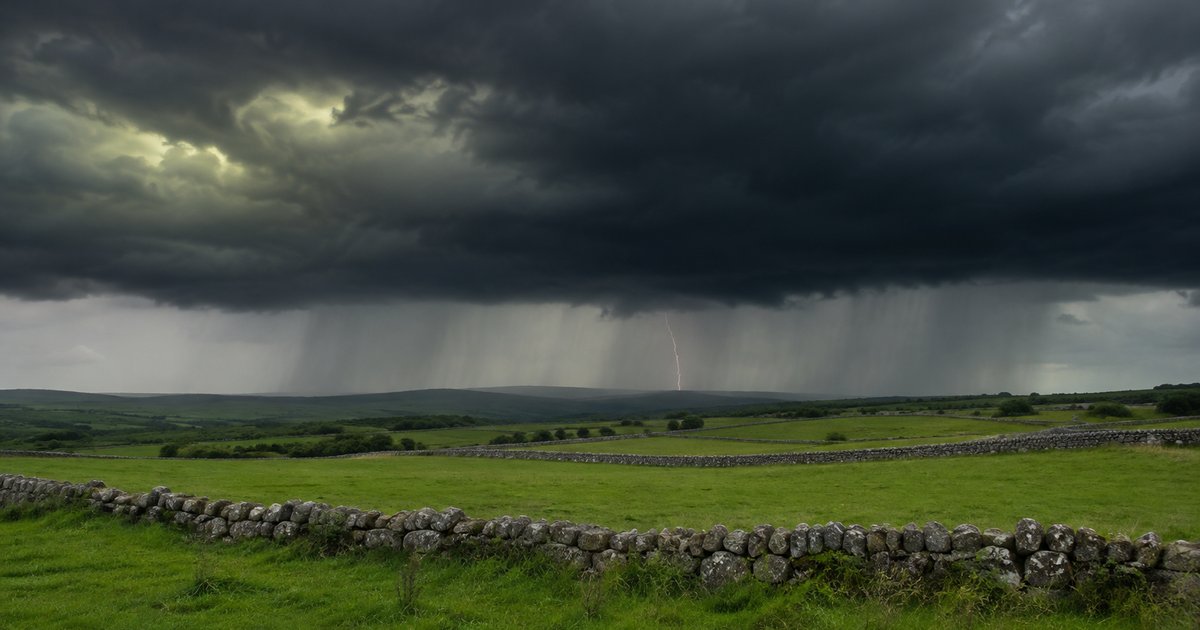
Met Éireann issues thunderstorm warnings for the Republic of Ireland in three colors, Yellow, Orange and Red; the UK Met Office issues them for Northern Ireland. In Ireland, thunder means it is time to leave exposed ground and reach an enclosed building or hard-topped car, whether or not a warning is posted. A May 2026 study found 113 lightning deaths in 94 newspaper-recorded events across the island from 1900–2024, a historical count that does not measure today’s individual risk.
Where and when thunderstorms occur
Met Éireann’s account of Ireland’s climate says warm, humid air and daytime heating can bring thunderstorms in mid to late summer. A 2026 study of fatal lightning incidents on the island found deaths in every season, with June and July accounting for the majority. Those are counts of people killed, not a measure of every flash: the timing also reflects when people were outside. A summer plan for a walk, farm job or outdoor gathering should therefore include a building or enclosed vehicle you can reach before thunder begins.
The 2026 study located fatal incidents in almost every county, with concentrations in the west and south, especially Kerry, Galway and Cork. That pattern describes archived deaths, not a ranking of the chance of a strike on a particular day. Met Éireann’s climate discussion also notes that the sequence of Irish weather varies considerably from year to year. A county with fewer recorded fatalities still needs the same response to an approaching thunderstorm.
What the Irish death record counts
Moore, Murphy and Fealy’s May 2026 paper found 113 deaths in 94 fatal lightning events on the island of Ireland from 1900 through 2024. The researchers searched digitized Irish Newspaper Archive titles year by year, checked accounts to avoid double counting, and recorded the place, date and activity where reporting allowed. Their series includes Northern Ireland. It is a historical newspaper-based chronology, not a hospital injury register or a count of all lightning flashes.
The paper identifies two deaths in the twenty-first century, one in 2006 and one in 2008; 2008 is the most recent fatal event in that archive series. It also records 65 deaths during activities such as farming and bog work. Earlier decades contributed far more deaths than recent ones, so dividing 113 by 125 years would conceal a large change over time. The paper does not establish a corresponding national total of nonfatal lightning injuries; do not use its death count as though it measured everyone harmed.
Read a Met Éireann thunderstorm warning
Met Éireann’s warning-system explanation, read in November 2026, lists thunderstorm criteria at Yellow, Orange and Red. Yellow covers thunderstorms with lightning activity, heavy rainfall or hail. Orange covers widespread thunderstorms, severe lightning activity, heavy rain or large damaging hail; Red is reserved for exceptional conditions. These are weather and impact warnings, not a count of bolts or an estimate of where the next flash will land.
| Color | Thunderstorm criteria | How the agency describes it |
|---|---|---|
| Yellow | Thunderstorms with lightning activity, heavy rainfall or hail | Localized danger for people whose activity or location exposes them |
| Orange | Widespread thunderstorms, severe lightning activity, heavy rain or large damaging hail | Dangerous conditions that may threaten life and property |
| Red | Exceptional conditions | Rare, very dangerous conditions requiring action |
The agency describes Yellow as localized danger for people whose activity or location exposes them, Orange as dangerous conditions that may threaten life and property, and Red as rare, very dangerous conditions requiring action. Its forecasters consider expected impacts as well as weather thresholds, and it cautions that places within one warning area may experience different conditions. Read the place, valid time, type and wording of the individual warning on Met Éireann’s weather warnings page before an outdoor plan, then respond to thunder where you actually are even if no warning covers you.
Met Éireann issues warnings for the Republic of Ireland, while the UK Met Office issues those for Northern Ireland. Met Éireann displays the Northern Ireland warnings on its all-island page but does not issue them. Its explanation notes that the UK service uses Amber where the Republic uses Orange. People crossing the border should check which service issued the warning rather than treating the two color labels as separate storms.
Is there a lightning map for Ireland?
Met Éireann’s lightning page, opened on November 19, 2026, shows each located strike as a cross that starts red, turns orange and then yellow, and disappears after a period. The page links the worldwide Blitzortung map and archive maps that color strikes by the hour. Met Éireann says its detection system is optimized for cloud-to-ground flashes, which it puts at roughly 10 to 20 percent of all lightning over Ireland. A strike map shows detections; it is not a thunderstorm warning.
What to do when thunder reaches you
At the first thunder, end the exposed activity and go to a substantial enclosed building or a hard-topped metal vehicle with the windows closed. A building or enclosed car is a more useful destination than a tree, umbrella, open shelter or tent. Met Éireann specifically warns against sheltering beneath a tree or umbrella and says being on open water during lightning is dangerous. Leave a lake, river or coastal outing early enough to reach the destination; do not wait to see a strike land nearby.
Met Éireann also warns about landline phones and metal connected to the ground during thunderstorms. Once inside, avoid those connections during the storm. On the road, a hard-topped car may provide lightning shelter, but the agency’s warning guidance says sudden downpours can cause flash flooding, poor visibility and squally winds. Driving through a thunderstorm still requires attention to the road conditions; a vehicle is not a reason to drive through floodwater.
For outdoor work, the Irish Health and Safety Authority’s electricity guide specifically says work on exposed conductors or equipment connected to them must consider lightning and cease when a lightning storm approaches. The guide concerns electrical work; it should not be mistaken for a single distance threshold for every occupation. A supervisor can identify who stops work, where the crew goes and how they will hear a decision before the sky changes.
Met Éireann’s lightning page says its detection system is optimized for cloud-to-ground flashes and that some atmospherics can be missed or falsely returned. A quiet display cannot overrule thunder. The distinction between a detected flash and what a detection network can miss matters when deciding whether to resume. Likewise, counting from flash to thunder estimates distance; hearing thunder already supplies a reason to shelter.
Lightning Tracker is available on the App Store in Ireland and works there as an English-language iPhone app. It shows recently detected strikes and distance to the nearest detection; use Met Éireann or the UK Met Office for official warnings.
After a strike: Irish emergency help
For a person who is seriously injured, Ireland’s Health Service Executive says to call 112 or 999 and ask for an ambulance. Give the location or Eircode, the phone number and what happened; the call taker may give instructions while help is coming. If a lightning incident has injured someone, follow that emergency guidance and avoid creating another exposed casualty. The HSE’s emergency number applies in the Republic; in Northern Ireland, follow the UK emergency service guidance.
Official quick links: Met Éireann weather warnings for the Republic; UK Met Office warnings for Northern Ireland; Met Éireann’s warning explanation for the categories and border distinction; and the HSE emergency guide for 112 and 999.
Not a substitute for official weather warnings.
If you hear thunder, seek shelter even if the app shows no nearby strike.
Sources
- Met Éireann, Met Éireann Warning System Explained
- Met Éireann, Lightning
- Met Éireann, Climate of Ireland
- Health and Safety Authority, Guide to the Safety, Health and Welfare at Work (General Application)
- Health Service Executive, Emergency care — adults
- Moore, Murphy and Fealy, Fatal lightning strikes in Ireland from newspaper records 1900–2024