 Lightning Tracker
App Store
Places and activities
MLB lightning delay rules: who decides and how long
November 19, 2026 · 8 min read
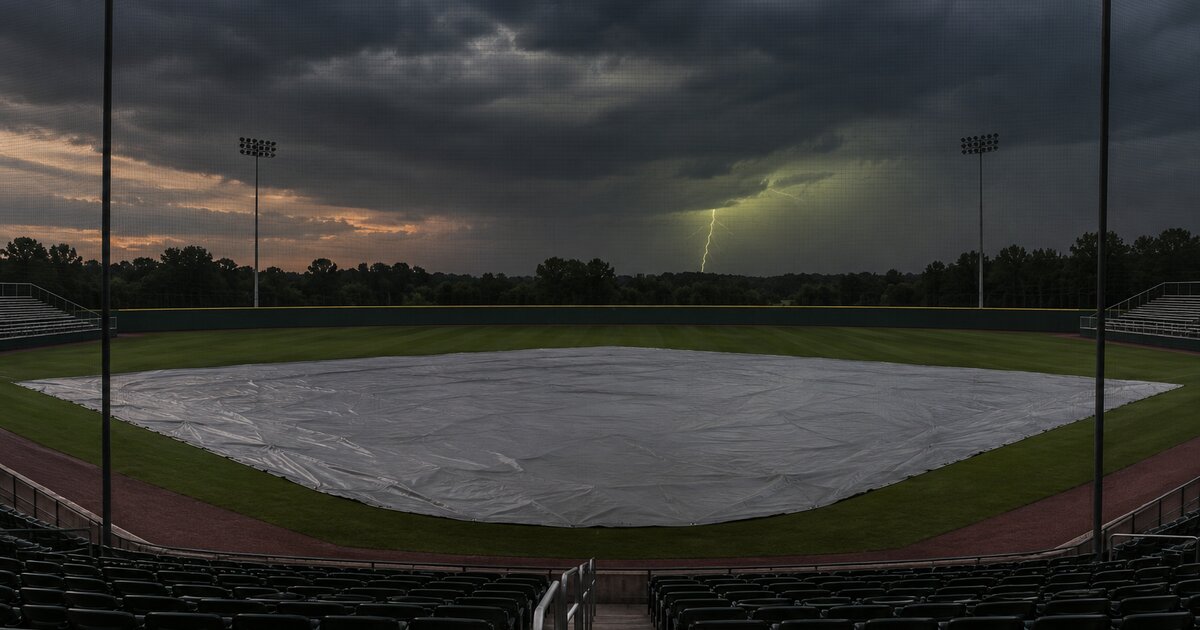
Major League Baseball’s Official Baseball Rules give no distance and no waiting time for lightning. They say who decides: the home team before the game, the umpire-in-chief once the lineups are exchanged, with each club free to act under a lightning policy it has filed with the league office. The 30 minutes in the 2026 rules is the shortest time an umpire-in-chief must wait after suspending play before calling a game, not a wait after the last strike.
The rule book mentions lightning only to leave room for each club’s own policy
The 2026 Official Baseball Rules, published by the Office of the Commissioner of Baseball, use the word lightning twice: at the end of Rule 4.03(e) and at the end of Rule 4.04(a). Both end with the same sentence, which says nothing in the rule is meant to affect a club’s ability to suspend or resume a game under “a policy governing severe weather, significant weather threats, and lightning safety that has been filed with the league office” before the championship season. A 2022 paper by Vaisala’s Chris Vagasky says these two rules entered the rule book in 2019. Neither rule gives a distance, a detection service or a wait after a flash (our reading of the full 2026 text as of November 19, 2026).
The home team decides before the game, and the umpire-in-chief decides after the lineups are exchanged
Rule 4.04(a) makes the home team the sole judge of whether a game is not started because of unsuitable weather, with an exception for the second game of a doubleheader. Rule 4.03(e) moves the authority at a set moment: as soon as the home team’s batting order is handed to the umpire-in-chief, that umpire has sole authority to determine when a game is called, suspended or resumed on account of weather or the condition of the playing field. Rule 7.01(c) adds that the umpire-in-chief or the Office of the Commissioner may postpone or call a game for reasons that include weather and “the health and safety of fans, players, team or stadium employees.”
Fox Weather reported in April 2022 that MLB has no set lightning criterion, unlike the NCAA or high school leagues, and described the same hand-off at the lineup card. The Minnesota Twins’ game-day meteorologist told Fox Weather that umpires decide when to stop, that the team keeps them informed on storm location and arrival time, and that the club posts a notice on the big screen when lightning is within 10 miles (16 km) of Target Field. That is one club’s practice as described in 2022, not a league rule.
A game cannot be called until 30 minutes after play stops
Rule 4.03(e) says the umpire-in-chief “shall not call the game until at least 30 minutes after he has suspended play,” and may continue the suspension “so long as he believes there is any chance to resume play.” The comment to the rule adds that the umpire-in-chief shall at all times try to complete a game and shall end one only when there appears to be no possibility of completing it. The 30 minutes therefore sets a floor under calling a game, for any weather suspension. It does not say when a game stopped for lightning may restart, and Rule 4.03(e) sets no cap on how long the suspension may last.
The rule does not apply in the postseason. The comment states that the Major Leagues have determined Rule 4.03(e) does not apply to any Wild Card Series, Division Series, League Championship Series or World Series game, or to a game played to break a tie for the championship season. Rule 7.02 separately lets the Major Leagues adopt different rules for postponing, suspending, calling, resuming and completing games in those four series. The rule book does not say what applies in their place.
Whether a called game counts or is resumed depends on Rules 7.01 and 7.02
Under Rule 7.01(d), a called game is a regulation game if five innings have been completed, or in two cases that turn on the home team’s half of the fifth inning, and its score is the score at the time it was called. A called game is instead treated as a suspended game if it is called while tied, or midway through an inning with the visiting team having tied the game or taken the lead and the home team not having retaken it. A game called before it becomes a regulation game is also a suspended game under Rule 7.02. Rule 7.02 requires such a game to be scheduled to be resumed or played to a completed regulation game during a series between the two clubs, preferably on the same grounds, or on a mutual off-day. The Office of the Commissioner decides when and whether to play it if that cannot be arranged during the season. A resumed game restarts at the exact point of suspension.
In 2022 MLB said a relatively small number of clubs had filed thresholds, and filing is not mandatory
An MLB spokesperson told Fox Weather in April 2022 that “a relatively small number of clubs have filed what their thresholds are for stopping and resuming a game. It is not mandatory to do so.” Fox Weather added that most, if not all, clubs consult meteorologists or weather companies for game-day information. Vagasky’s paper, also from 2022, says it was unclear how many teams had filed plans or knew of the rules, and that without a policy any weather delay or suspension falls to the umpire-in-chief. The rule book prints no club’s filed policy, so a distance or wait quoted for one ballpark cannot be checked against it.
Lightning came within 8 miles of 717 of 9,717 MLB games from 2016 to 2019
Vagasky’s paper, in the April 2022 issue of Weather, Climate, and Society, counted lightning detected by Vaisala’s U.S. National Lightning Detection Network within 8 miles (12.8 km) of each ballpark, from one hour before the game’s start time to one hour after its end time. It found 717 of 9,717 regular season games with lightning inside that circle, about 7 percent (our arithmetic) and what the paper calls roughly one game in 14. The study had no record of delays, so the count is of games with nearby lightning, not of games that were stopped. Vagasky chose that radius because the National Weather Service’s Lightning Safety Toolkit sets it as the initial radius for suspending outdoor events; it is not an MLB figure.
The spread was uneven. Lightning games occurred at 27 of the 30 ballparks, and only Dodger Stadium, Oakland Coliseum and Petco Park had none. Games in Miami (80 lightning games) and Saint Petersburg, Florida (78) were the likeliest to have lightning nearby, and August had the most, 176. A roof did not remove the exposure: 272 of the 717 lightning games were at ballparks with fixed or retractable roofs. On July 23, 2020, at Nationals Park, 2,993 discharges were detected within 8 miles (12.8 km) in the 34 minutes before the umpire-in-chief delayed the game when rain arrived, with cloud-to-ground strokes as close as about 1.2 miles (2 km). Vagasky’s paper argues that lightning safety at MLB games could improve significantly if clubs filed policies that use NWS and National Athletic Trainers’ Association guidance.
The NCAA and the National Weather Service write down a wait and a distance that MLB’s rules leave out
The table sets MLB’s text beside college baseball and the National Weather Service. The NCAA row joins baseball’s rule book with the Sports Medicine Handbook, which describes itself as providing “considerations” for member schools, and the NWS page is guidance for anyone running outdoor sports; neither of those two is a rule book.
| Document | Who decides | Wait | Distance |
|---|---|---|---|
| MLB Official Baseball Rules, 2026 (Rules 4.03(e), 4.04(a)) | Home team before the game; umpire-in-chief after the lineups are exchanged; a club may act under a policy it filed with the league office | At least 30 minutes after play is suspended before the umpire-in-chief may call the game; no lightning-specific wait | None stated |
| NCAA Baseball Rules, 2027 and 2028 (Rule 4-2), and NCAA Sports Medicine Handbook, 26th edition | Host coach and athletics director before the game; umpire-in-chief with the game administrator after, following the lightning guidelines | 30 minutes after the last thunder heard or lightning seen, restarting with each new flash or thunder | Threat extends about six to 10 miles from the base of a storm; handbook checklist restarts the clock for each flash within 6 miles (9.7 km) |
| National Weather Service, Lightning Safety and Outdoor Sports Activities | A designated lightning monitor, who should not be the coach, umpire or referee | At least 30 minutes after the last thunder | A significant lightning threat extends about 6 to 10 miles from the base of a storm cloud; thunder can usually be heard about 10 miles away without background noise |
The NWS’s 30-minute wait counts from the last thunder. The MLB minimum counts from a different event, the suspension of play, and runs toward a different decision, calling the game.
During a delay, fans follow the ballpark’s instructions, and shelter means a building
The Official Baseball Rules say nothing about where fans go during a delay, so the instructions come from the club and the ballpark’s staff and announcements. The National Weather Service says substantial buildings with wiring and plumbing provide the greatest protection, a hard-topped metal vehicle with the windows closed provides good protection when no building is available, and small outdoor buildings including dugouts, rain shelters and sheds do not give that protection.
Fans who want their own view of strikes near the ballpark can use Lightning Tracker, an iPhone app that alerts you when a strike is detected inside the radius you set, 10 miles by default, and starts a 30-minute wait after the last detected strike in that radius, restarting it with each new one. The decision to stop or restart a game belongs to the umpires and the club, and the app does not replace official warnings or the ballpark’s instructions.
Not a substitute for official weather warnings.
If you hear thunder, seek shelter even if the app shows no nearby strike.
Sources
- Major League Baseball, Official Baseball Rules, 2026 Edition (Rules 4.03, 4.04, 7.01, 7.02)
- Vagasky, C., Weather, Climate, and Society 14(2), One Strike, You’re Out: Lightning during Professional Baseball Games (April 2022)
- Fox Weather, 1 strike, ‘you’re out’: Study finds dangerous lightning close by in 1 of every 14 MLB games (April 29, 2022)
- National Collegiate Athletic Association, Sports Medicine Handbook, Twenty-sixth Edition
- National Collegiate Athletic Association, 2027 and 2028 NCAA Baseball Rules (October 2026; Rule 4-2 and Appendix C)
- National Weather Service, Lightning Safety and Outdoor Sports Activities