 Lightning Tracker
App Store
Places and activities
Do Florida theme park rides close for lightning? What Disney, Universal and SeaWorld say
November 19, 2026 · 6 min read
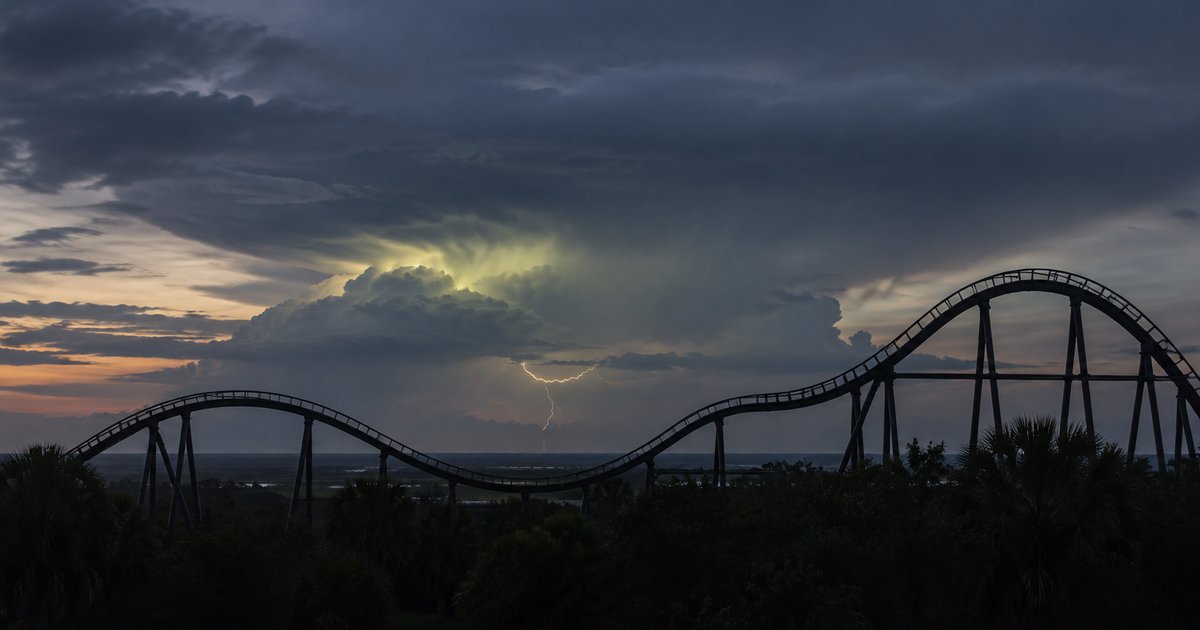
Yes, outdoor rides at Central Florida theme parks, including Walt Disney World, can pause when lightning is in the area, while the parks typically stay open and indoor attractions keep running, according to answers on Disney’s planDisney site and SeaWorld Orlando’s weather page. For rides, none of the operator pages we could read gives the distance that triggers a pause or the wait before reopening, so a closure can end sooner or later than you hope. The National Weather Service’s advice is to get inside a substantial building or a hard-topped vehicle and stay there until 30 minutes after the last thunder or lightning.
Central Florida is one of the most lightning-dense parts of the country
The NOAA National Severe Storms Laboratory puts the year-round maximum of cloud-to-ground lightning in Florida, between Tampa and Orlando, and ties it to a large amount of moisture in the low atmosphere on many days and to strong sea breezes along the Florida coasts. National Weather Service forecasters in Melbourne and Tampa Bay, who mapped ten years of detected flashes from 1986 to 1995, describe thunderstorms forming along sea-breeze boundaries on the east and west coasts and moving inland, with cloud-to-ground flashes frequent by late afternoon as the two boundaries collide over the west-central part of the peninsula. On the Melbourne office’s monthly maps of the same data, July is the month for lightning over Florida and December has the least. A Walt Disney World planDisney panelist wrote on September 23, 2022, that thunderstorms are typical at the resort, especially in seasons such as summer, and sometimes last an entire day.
Walt Disney World, Universal Orlando Resort and SeaWorld Orlando publish different amounts about lightning
Walt Disney World, Universal Orlando Resort and SeaWorld Orlando each describe weather closures in general terms, and as of November 2026 none of the pages we could read gives a lightning distance or a reopening wait for rides. The table summarizes what we found; the paragraphs below give the dates.
| Operator | What its pages say | Distance or wait for rides |
|---|---|---|
| Walt Disney World | Some outdoor attractions may close temporarily when lightning is present; indoor attractions typically keep running (planDisney answers, 2019 to 2022) | None found |
| Universal Orlando Resort | Parks, attractions or entertainment may close for weather (Volcano Bay rider guide); its weather pages did not load as readable text | None found |
| SeaWorld Orlando | The park usually stays open; rides closed more than 60 minutes for lightning, wind, heat, rain or snow are examples covered by its return-visit program | None found |
Disney’s own weather page says some Resort experiences can be delayed, rescheduled or cancelled due to severe weather, and it does not mention lightning. The lightning details are on planDisney, a question-and-answer site on a Disney domain where panelists answer guests, with a note that policies may have changed since each answer. On October 6, 2021, a panelist wrote that outdoor attractions such as Test Track and Seven Dwarfs Mine Train may close temporarily in heavy rain or lightning. On June 3, 2022, another wrote that this typically happens when lightning is present and that the closures do not last that long in the panelist’s experience. In an answer dated October 20, 2019, a panelist wrote that thunder and lightning storms would likely cause a delay until the worst of the storm had passed. On September 23, 2022, a panelist said the parks typically remain open with indoor attractions and shows still functioning. These are panelists’ accounts, some framed as personal experience, not a published rule.
Disney’s pages for its water parks say they may close due to inclement weather and that temporary day-of closures may occur, sometimes with little advance notice, without appearing on the park calendar. The one Disney page we found with a lightning distance and wait is a Typhoon Lagoon surfing-program FAQ: if lightning strikes within 10 miles of the water park, the event takes a 30-minute delay, and guests are offered options for continuing or cancelling. That answer describes a surf event, not park rides.
Universal Orlando Resort’s Volcano Bay guide for rider safety and accessibility says parks, attractions or entertainment may close due to refurbishing, capacity, weather or special events, and may change without notice. Universal’s weather and help pages load with a script, and the plain copy we could open held no text, so we could not read what they say about lightning. SeaWorld Orlando’s inclement weather page says the park usually remains open when weather is poor. It lists rides closed for over 60 minutes due to lightning, strong winds, heat, rain or snow among its examples for a Weather-or-Not Assurance return visit, and says the policy is subject to change at the discretion of Guest Services. If a number appears elsewhere for a distance or a wait, treat it as unconfirmed unless the operator publishes it.
The National Weather Service offers venues a template, not a rule for each park
The National Weather Service runs a voluntary recognition program for large outdoor venues, and its list of eligible sites includes water parks and amusement parks. The program’s sample lightning plan uses three stages: 15 miles, 12 miles and 8 miles from the venue, with an event delay at 8 miles. The same plan says lightning radii vary with venue size, capacity and the time patrons need to reach shelter, and that distances can be modified. For resuming, a venue without a meteorologist using real-time lightning data waits 30 minutes after the last observed thunder or lightning by day, or after the last thunder at night. None of the operator pages we read says whether the park follows this program.
The OSHA and NOAA fact sheet of June 2021 for outdoor workers says employers should have a written lightning protocol for outdoor workers that says when to suspend and resume outdoor work and accounts for the time to evacuate customers and members of the public. It tells workers to remain in a shelter at least 30 minutes after the last thunder. The fact sheet does not name theme parks, and the operator pages we read do not say whether the parks use it.
The NWS names buildings and hard-topped vehicles, not outdoor structures
The National Weather Service says no place outside protects you when a thunderstorm is in the area, and that substantial buildings with wiring and plumbing provide the greatest protection. Its examples are office buildings, schools and homes. Without a substantial building, a hard-topped metal vehicle with the windows closed provides good protection. The NWS adds that small outdoor buildings, including rain shelters and sheds, do not protect, and its venue toolkit says the same of partially enclosed vending areas and picnic shelters. The park pages do not say which of a park’s buildings count; the NWS toolkit asks recognized venues to give directions to shelters and to post signs showing where they are.
The NWS’s rule for returning is wait 30 minutes after the last lightning or thunder. Because the count runs from the last lightning or thunder, it starts over with each new one.
Checking whether a ride has reopened
A Disney panelist’s answer of October 6, 2021, tells guests to install the My Disney Experience app before a trip so they can monitor the status of attractions that have a rain closure. Disney’s Lightning Lane is unrelated to weather: Disney describes it as passes to skip the standby line and join a shorter line for select attractions.
What Lightning Tracker shows near a park
Lightning Tracker is a free iPhone app, on the App Store, that shows recently detected strikes on a live map, with the distance and direction to the nearest one and how many minutes ago it was detected. It alerts you when a strike is detected inside a radius you set for each place; the default is 10 miles (16 km). The app’s 30-minute wait starts after the last strike detected inside the radius, restarts with each new one, and ends with a report of what the app observed and a request that you judge conditions yourself; it does not announce that the storm is over. Detection networks miss some strikes, especially weak ones, and data can arrive late; the app labels delays instead of treating them as quiet. It does not replace official warnings or local procedures.
Not a substitute for official weather warnings.
If you hear thunder, seek shelter even if the app shows no nearby strike.
Sources
- NOAA National Severe Storms Laboratory, Severe Weather 101: Lightning FAQ
- Hodanish et al., National Weather Service Melbourne and Tampa Bay, A 10-yr Monthly Lightning Climatology of Florida: 1986–95, September 1997
- National Weather Service Melbourne, Monthly Florida Lightning Climatology
- Walt Disney World Resort, Weather Updates & Information
- planDisney, Do the rides close down in Disney World theme parks in Florida if it rains?, October 6, 2021
- planDisney, In the case of a raining day, are all attractions as well as shows opened?, June 3, 2022
- planDisney, Do outdoor rides still operate when it’s raining and/or during thunder storms?, October 20, 2019
- planDisney, What will happen if it is raining and thunderstorms?, September 23, 2022
- Walt Disney World Resort, Disney’s Blizzard Beach (water park FAQ)
- Walt Disney World Resort, Surfing at Typhoon Lagoon (FAQ)
- Walt Disney World Resort, Lightning Lane passes
- Universal Orlando Resort, Guide for Rider Safety and Accessibility: Universal Volcano Bay
- SeaWorld Orlando, Inclement Weather Policy and Park Closures
- National Weather Service, Lightning Safety Toolkit for Outdoor Venues
- National Weather Service, Lightning Safety for Sports and Outdoor Events
- National Weather Service, Overview: Lightning Safety
- OSHA and NOAA, Lightning Safety When Working Outdoors (Fact Sheet 3863), June 2021