 Lightning Tracker
App Store
Storm basics
Frankenstein and lightning: what the book says and what is true
November 19, 2026 · 6 min read
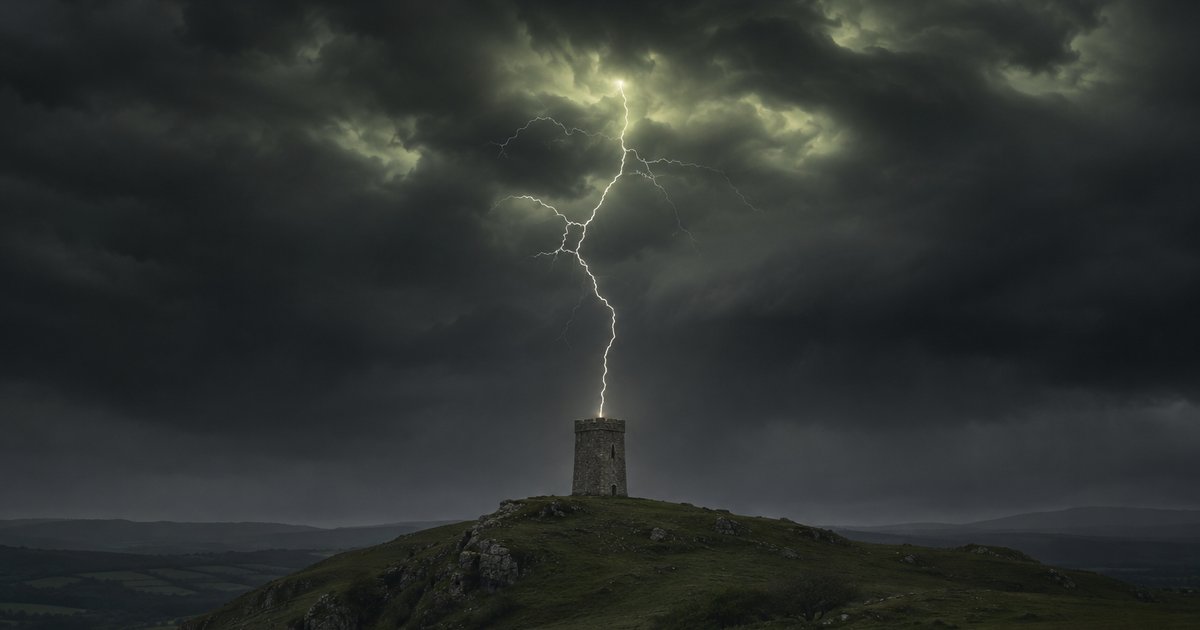
Frankenstein is tied to lightning in two ways: Mary Shelley’s 1818 novel shows lightning wrecking an oak and prompting the narrator to ask what lightning is, but names no agent for the creature’s spark, and film versions such as the 1931 film show lightning charging a laboratory. The science behind the idea is real: Luigi Galvani’s frog experiments began with atmospheric electricity, and his nephew Giovanni Aldini applied current to a hanged criminal’s body in 1803. A real strike is another matter: the National Weather Service describes it as primarily an injury to the nervous system, with cardiac arrest the immediate cause of death for those who die.
The 1818 novel puts lightning in a boyhood storm and names no agent for the creature’s spark
The 1818 first edition of Frankenstein, which the National Library of Medicine (NLM) says appeared anonymously, brings in lightning early, in the narrator’s boyhood. In the Project Gutenberg text transcribed from a photo-reprint of that edition, Victor Frankenstein is about fifteen when a violent thunderstorm crosses the mountains and he sees a stream of fire strike an old oak about twenty yards from the house. The next morning the family finds the tree reduced to thin strips of wood. He asks his father what thunder and lightning are, and the father answers that it is electricity, shows a few experiments with a small electrical machine, and makes a kite with a wire and string that draws electric fluid down from the clouds. Business Insider (February 2024) reads the kite as a reenactment of Benjamin Franklin’s experiment linking lightning and electricity.
A tree wrecked by lightning has a physical explanation. The NOAA National Severe Storms Laboratory (NSSL) says lightning traveling down a trunk turns water to steam, and the rapidly expanding steam can blast pieces of bark and branches from the tree.
The creation scene is a different matter. In the 1818 chapter that holds the creation night, Victor gathers the instruments of life around him to infuse a “spark of being” into the body, and the passage sets the scene with rain against the window panes and a nearly burnt-out candle. It names no lightning. Business Insider says Shelley does not explicitly specify the animating agent, and it reports that some scholars suggest the spark could be fire or chemical in nature. The Science Museum’s blog (October 2023) says she appears to depict electricity as that spark, and the NLM’s classroom excerpts list the creation passage among its electricity references. The text names no agent, so these are readings of the book, not statements in it.
Lightning appears elsewhere in the 1818 text as part of Alpine storms, for example the lightning playing on the summit of Mont Blanc that the narrator sees from a boat on the lake.
The 1831 edition replaced the father’s kite with a lecture on galvanism
The 1831 edition, for which the NLM says Mary Shelley wrote a new preface and made several changes to the text, keeps the oak storm but changes who explains it. In the Project Gutenberg text of that edition, a visitor learned in natural philosophy explains a theory he had formed about electricity and galvanism, and the father’s machine and kite are gone. Our own search of the two Gutenberg texts finds the kite only in the 1818 text and the word galvanism only in the 1831 text.
The 1831 introduction also recalls an evening of talk in 1816 about whether a corpse might be re-animated, adding that galvanism had given token of such things. The Science Museum places that summer at Lord Byron’s Villa Diodati near Lake Geneva, in June 1816. The word galvanism, which the NLM ties to Galvani’s animal electricity, therefore enters the novel’s own text in 1831, not in the first edition.
Galvani and Aldini supplied the real science, and lightning stood at the start of the chain
Lightning sits at the beginning of the history behind galvanism. The Science History Institute (March 2026) says Franklin’s proof that lightning and electricity were one and the same led physicians to connect the electricity they believed was latent in the atmosphere to the electricity applied to the body. Wellcome Collection (April 2017) notes that the Russian professor Georg Wilhelm Richmann was killed by lightning while experimenting with atmospheric electricity, a case that showed the dangers of the new field. Luigi Galvani’s own start was atmospheric electricity, according to the Whipple Museum of the History of Science at the University of Cambridge.
| Who | When | What the source says |
|---|---|---|
| Luigi Galvani | 1780s | Studying atmospheric electricity, he and his assistants hung prepared frog legs from an iron railing on brass hooks; a leg kicked where a hook touched the rail (Whipple Museum). |
| Galvani | 1791 | His published essay argued that animal tissue holds an inherent electrical force, which he called animal electricity (Science Museum). |
| Alessandro Volta | 1799 | Volta, who held that the frog’s body does not make its own current, first built his battery pile to show moistened metals produce current by contact (Whipple Museum). |
| Giovanni Aldini, Galvani’s nephew | 1803 | In London he applied current to the body of a hanged criminal; the left eye opened (Wellcome Collection). |
The Science Museum places Aldini’s most famous demonstration at Newgate Prison and says newspapers widely reported it, while Wellcome Collection places his London experiments at the Royal Society and quotes an account of one application as a reaction “almost to give an appearance of reanimation.” The NLM says Aldini administered electricity to the bodies of newly executed criminals. The sources used here describe a current applied to bodies, and none says lightning was used.
How much of this reached the novel is hedged. The Science Museum says the Aldini episode had a lasting impact on Shelley, who appears to depict electricity as the spark of being; Wellcome says such experiments may have provided inspiration; and the NLM says the 1818 book reflected the period’s interest in reanimating dead tissue with electricity.
The 1931 film put lightning in the laboratory, and later versions kept it
The American Film Institute (AFI) Catalog summary of the 1931 film, released November 21, 1931, says two characters prepare to use the power of lightning to charge their electrical mechanisms and give life to a body. The catalog credits Kenneth Strickfaden with the special electrical props for the laboratory. The NLM says other artists freely adapted the novel for audiences in England, America and Europe, and Columbia Surgery writes that in the film adaptations lightning is famously also a direct mechanism. Business Insider (February 2024) says many film versions use lightning or another form of electricity to jolt the creature into consciousness. The premise of charging machinery from a bolt belongs to the adaptations, because the 1818 creation passage names no lightning.
Screen Daily’s interview of November 24, 2025 with Tamara Deverell, production designer of a new Frankenstein film, says the top of the tower set was built for the scene in which Victor climbs it with a lightning rod.
Real lightning injures the nervous system, and the NWS response is 911, CPR and an AED
The National Weather Service (NWS) says a typical lightning flash is about 300 million volts and about 30,000 amps, against 120 volts and 15 amps in household current. The NWS describes lightning injury as primarily an injury to the nervous system, often with brain injury and nerve injury, and says serious burns seldom occur. Its guide for the public says most people survive a strike, that some survivors are left with permanent, painful neurological disabilities, and that cardiac arrest is the immediate cause of death for those who die.
For someone who has been struck, the NWS guide says to call 911 and, if necessary, begin CPR and use an automated external defibrillator (AED), because lightning victims do not carry an electrical charge. Columbia Surgery makes a comparison with the novel’s imagery: it writes that the defibrillator, in its way, is a modern lightning bolt, a controlled surge of electricity that resets the heart’s rhythm. The NWS also lists five ways lightning reaches people, from a direct strike to ground current.
The National Weather Service rule for a real storm starts with thunder
The NWS says that if you hear thunder, you are likely within striking distance of the storm, and it advises waiting 30 minutes after the last lightning or thunder before going back outside, a count that restarts with each strike.
Lightning Tracker, an iPhone app, shows recently detected strikes on a live map, with the distance and direction to the nearest one and how many minutes ago it was detected.
Not a substitute for official weather warnings.
If you hear thunder, seek shelter even if the app shows no nearby strike.
Sources
- Mary Shelley, Frankenstein; or, The Modern Prometheus, 1818 edition, Project Gutenberg eBook #41445 (text from a photo-reprint of the 1818 edition)
- Mary Shelley, Frankenstein; or, The Modern Prometheus, 1831 edition, Project Gutenberg eBook #42324 (text from a photo-reprint of the 1831 edition)
- National Library of Medicine, Frankenstein: Penetrating the Secrets of Nature, The Birth of Frankenstein (undated)
- National Library of Medicine, Frankenstein: Penetrating the Secrets of Nature, Boundary Crossing / 1818 (undated)
- National Library of Medicine, Frankenstein: Penetrating the Secrets of Nature, Transformation of a Monster (undated)
- National Library of Medicine, Frankenstein Novel Excerpts with Electricity References (PDF lesson-plan handout, undated)
- Science Museum Group, Katie Crowson, The science behind Mary Shelley’s Frankenstein (October 31, 2023)
- Wellcome Collection, Ruth Garde, The current that kills (April 20, 2017)
- Whipple Museum of the History of Science, University of Cambridge, Frogs and Animal Electricity (undated)
- Science History Institute, Samantha Wesner, When Electricity Met Democratic Revolution (March 5, 2026)
- American Film Institute, AFI Catalog: Frankenstein (1931) (undated)
- Screen Daily, Mark Salisbury, ‘Frankenstein’ production designer Tamara Deverell on mixing the “fantastic and the real” for the film’s epic sets (November 24, 2025)
- Business Insider, Jenny McGrath, How the mystery of electricity helped 18-year-old Mary Shelley create ‘Frankenstein’ (February 9, 2024)
- Columbia Surgery, Frankenstein and the Electricity of the Heart (undated)
- NOAA National Severe Storms Laboratory, Severe Weather 101: Lightning FAQ (undated)
- National Weather Service, How Powerful Is Lightning? (undated)
- National Weather Service, Medical Aspects of Lightning (undated)
- National Weather Service, John Jensenius, Dr. Lightning’s Guide: Lightning Victims (PDF, undated)
- National Weather Service, Lightning Science: Five Ways Lightning Strikes People (undated)
- National Weather Service, Overview: Lightning Safety (undated)