 Lightning Tracker
App Store
Places and activities
Can lightning hit a train? Why lightning delays them anyway
November 19, 2026 · 8 min read
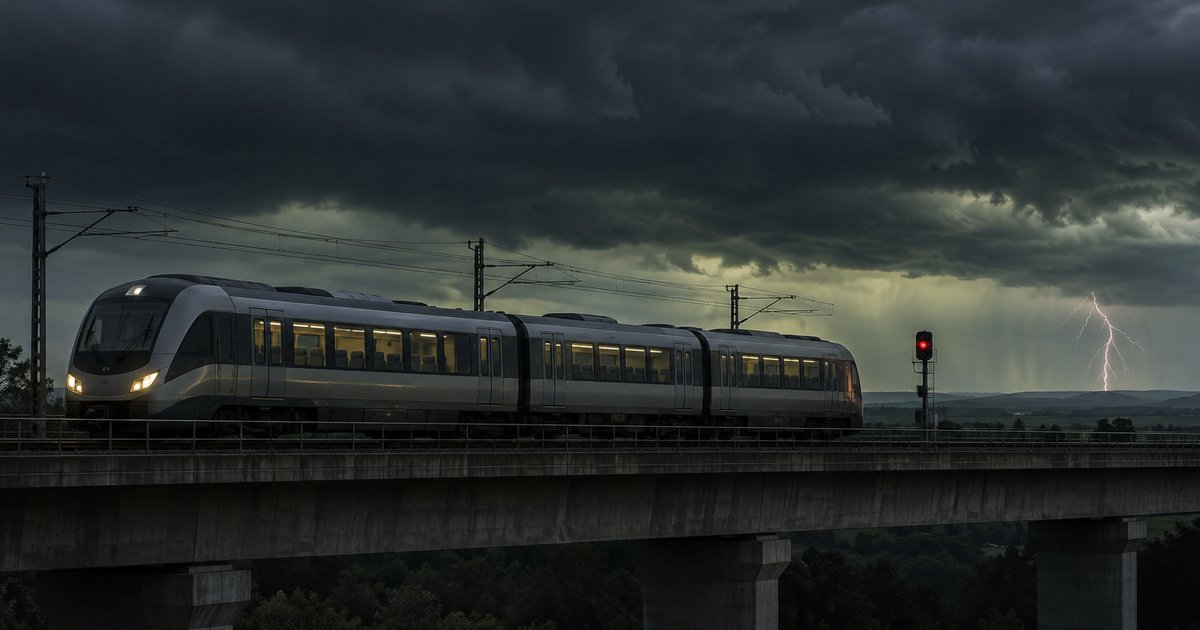
A train can stop after a lightning flash: in the one U.S. case this page opened, a Metra commuter train near Chicago shut down in 2016 after what appeared to be a strike, though Metra had not officially determined the cause, and no source opened counts trains struck. Lightning delays trains when a strike damages signal, crossing-warning or power equipment, or sends a surge through it, and the railroad stops trains or runs them under restrictions until the equipment works again. Whether passengers inside a train are protected is a question the National Weather Service does not address directly: it says the outer metal shell of a hard-topped metal vehicle protects the people inside, but its lightning and cars page does not name trains.
Federal and industry reports have treated lightning as a threat to railroad signal equipment for decades
The Federal Railroad Administration’s December 1975 report Lightning and Its Effects on Railroad Signal Circuits opens by saying that lightning causes damage and destruction of millions of dollars of railroad signalling equipment yearly in the United States. It says the protective devices and techniques in use did not completely eliminate that damage, and that solid-state components, which were spreading in signal and crossing equipment, were inherently far more susceptible to lightning damage than the electromechanical parts they replaced. The report names grade crossing motorist-warning systems as a primary application area for its study.
A June 2000 technology digest from Transportation Technology Center, Inc., a subsidiary of the Association of American Railroads (AAR), reports that the association’s Signal Research Technical Advisory Group identified signal failures caused by lightning and power surges as a significant cause of train delays. It adds that the railroad CSXT had separately identified surge damage to electronic signal equipment as a significant cause of delays. The digest also describes how the damage gets in: a metal wayside signal housing shields the electronics inside it, but the aerial and buried conductors that must enter the housing can carry surges inward. In laboratory tests, surges of 20,000 amps at peak, which the digest calls typical for a nearby lightning strike, were applied to the external circuits of a prototype signal house. The digest concluded that solid-state equipment installed and protected as it recommends should not be damaged even by the most severe surges, including nearby lightning strikes.
Both documents are decades old. They show how lightning reaches signal equipment without a direct hit on it, and neither gives a count of delays. As of November 2026, none of the sources opened for this page gives a current count of U.S. train delays caused by lightning, or of U.S. trains struck.
Network Rail says its signals fail to a stop, so lightning damage becomes delay in Britain
Network Rail, which owns and runs Britain’s track and signals, says its signalling systems are designed so that a fault leaves signals at red, which is why faulty components can often cause train delays. Its December 2021 adaptation report describes the lightning case: when lightning strikes its equipment or the surrounding area, the high voltage can damage sensitive electronic equipment such as signalling, and because the system fails to a stop, all signals in the area turn red and trains must stop. Those are a British operator’s words about British signals. U.S. federal rules state a related principle in their own terms: control circuits whose functioning affects the safety of train operation must be designed on the closed circuit principle (49 CFR 236.5), which the regulations define as a normally energized circuit that, when interrupted or deenergized, causes the controlled function to assume its most restrictive condition (49 CFR 236.786). Neither section mentions lightning. By our reading, a U.S. signal circuit that a lightning surge interrupts is designed to fall to its most restrictive condition, much as the British signals fall to red.
The same report gives a 2018 case. On July 27, 2018, lightning struck signalling equipment near York and caused the total loss of two signal centres, Leeds East and Leeds West, plus multiple failures of sets of points around York because communications were interrupted. The line was closed for several hours, dozens of trains were cancelled, and delays to Network Rail’s services totaled nearly 19 thousand minutes. A more recent case is dated May 28, 2026: Network Rail said crews were fixing blown fuses in signalling equipment at Weaver Junction near Runcorn after thunderstorms overnight, that the damage was in line with a suspected lightning strike while the exact cause was investigated, and that only one train an hour was running between Crewe and Liverpool during the repairs.
Why a fix takes time is also in Network Rail’s own words. Its signalling explainer says a failure very often involves a component located alongside the track, which staff must physically reach and repair, and that multiple trains will already have been stopped by red signals, so it is not a quick fix. The adaptation report adds a second route: lightning strikes may result in tree fall, which can lead to delays through track obstruction and damage to lineside equipment. The report’s chart of key storm risks also lists power distribution, with the note that a direct lightning strike will damage electrical equipment.
A federal rule sets what a railroad does when a crossing warning system fails
The federal rule on grade crossing warning failures, 49 CFR 234.105, applies when a railroad receives a credible report of a warning system malfunction involving an activation failure. It does not limit itself to one cause and does not name lightning. As of the November 1, 2026 edition of the regulations, the railroad must notify the train crew before any train arrives at the crossing, notify law enforcement or railroad police, and provide another way to warn highway users. What the train may do then depends on who is warning traffic:
| Who is warning highway traffic | What the train may do |
|---|---|
| A flagger for each direction of traffic, or at least one uniformed officer | Proceed through the crossing at normal speed |
| A flagger, but not one for each direction | Proceed with caution at no more than 15 miles per hour |
| No flagger and no officer | Stop before the crossing; a crewmember dismounts to flag traffic to a stop |
The 2000 digest shows how lightning can reach those systems: its tests applied surges representative of nearby lightning strikes to the track, flasher, gate and AC power circuits of a crossing control system with working lights and gates. If lightning damage keeps a crossing’s warning from activating, the rule above applies, and it can slow or stop trains (our reading).
One 2016 Chicago-area commuter train stopped after what appeared to be a lightning strike
CBS Chicago reported on August 30, 2016, that around 6:40 a.m. the engineer of a Metra UP-North train saw a lightning flash, after which the locomotive shut down and would not restart. More than 400 people were on board. After about 45 minutes they were taken off the train and onto the platform of the nearby Rogers Park station, and no injuries were reported. Trains on the outbound side were delayed up to 90 minutes while another train was called in to link up and pull the stopped train back to the railyard, and more than half a dozen inbound trains were delayed at least 15 minutes. Metra officials said they had not officially determined that lightning caused the shutdown, though that appeared to be the case.
One report is one case. It shows a train stopping and the delay spreading to other trains on the line, and it does not show how often U.S. trains are struck or what a strike does to a railcar.
The National Weather Service names hard-topped vehicles, not trains, as protection from lightning
The National Weather Service says the outer metal shell of hard-topped metal vehicles does protect those inside a vehicle with the windows closed. On its lightning and cars page it describes a strike passing through the shell and the tires to the ground, and it warns that part of the discharge can reach the electrical system, damage or destroy electronic components, and leave the car inoperable. The same agency’s lightning safety overview says nowhere outside protects people when thunderstorms are in the area and lists substantial buildings and hard-topped vehicles as the shelter options.
Neither of those NWS pages mentions trains, and no source opened for this page says whether a passenger railcar counts as a hard-topped metal vehicle. The agency does say something about another transport vehicle: commercial transport planes are designed and built with conducting paths through the plane to carry a strike’s current. It makes no matching statement for trains. Read together, the sources support only a narrow summary: the NWS states its protection rule for the vehicles it describes and makes no statement about trains, and the one U.S. train case above reported no injuries.
Railroad workers who repair signals and track are outdoor workers under the same hazard
Network Rail’s adaptation report lists staff working to prevent or respond to events in poor weather among the sources of injury risk from storms. The OSHA and NOAA fact sheet of May 2016 says workers whose jobs involve working outdoors in open spaces, on or near tall objects, or near explosives or conductive materials such as metal have significant exposure to lightning risks, and it advises that workers not begin any task they cannot quickly stop once signs of a thunderstorm appear. Its list of higher-risk activities names power utility field repair and airport ground personnel operations but does not name railroad work. No source opened for this page gives a U.S. railroad’s own lightning rule for track crews, so a crew’s rule would come from its employer, within the emergency action plan OSHA and NOAA say should include a written lightning safety protocol for outdoor workers.
Lightning Tracker is an iPhone app, free on the App Store, that shows recently detected strikes on a live map, with the distance and direction to the nearest one and how many minutes ago it was detected; it does not replace official warnings or local procedures.
Not a substitute for official weather warnings.
If you hear thunder, seek shelter even if the app shows no nearby strike.
Sources
- Federal Railroad Administration, Lightning and Its Effects on Railroad Signal Circuits, report FRA-OR&D-76-129 (PDF, December 1975)
- Transportation Technology Center, Inc. (Association of American Railroads), Technology Digest TD00-008: Lightning Protection of Wayside Train Control Systems (PDF, June 2000; copy hosted by MXV Rail)
- Electronic Code of Federal Regulations, 49 CFR 234.105, Activation failure (November 2026 edition)
- Electronic Code of Federal Regulations, 49 CFR 236.5, Design of control circuits on closed circuit principle (November 2026 edition)
- Electronic Code of Federal Regulations, 49 CFR 236.786, Principle, closed circuit (November 2026 edition)
- Network Rail, Third Adaptation Report (PDF, December 2021)
- Network Rail, Signals explained
- Network Rail media centre, West Coast Main Line disruption after lightning storms overnight (May 28, 2026)
- CBS Chicago, Metra Train Struck By Lightning (August 30, 2016)
- National Weather Service, Lightning and Cars
- National Weather Service, Overview: Lightning Safety
- National Weather Service, Lightning and Planes
- OSHA and NOAA, Fact Sheet: Lightning Safety When Working Outdoors (PDF, May 2016)