 Lightning Tracker
App Store
Storm basics
Lightning gods in mythology: Zeus, Thor, Indra, Perun
November 19, 2026 · 8 min read
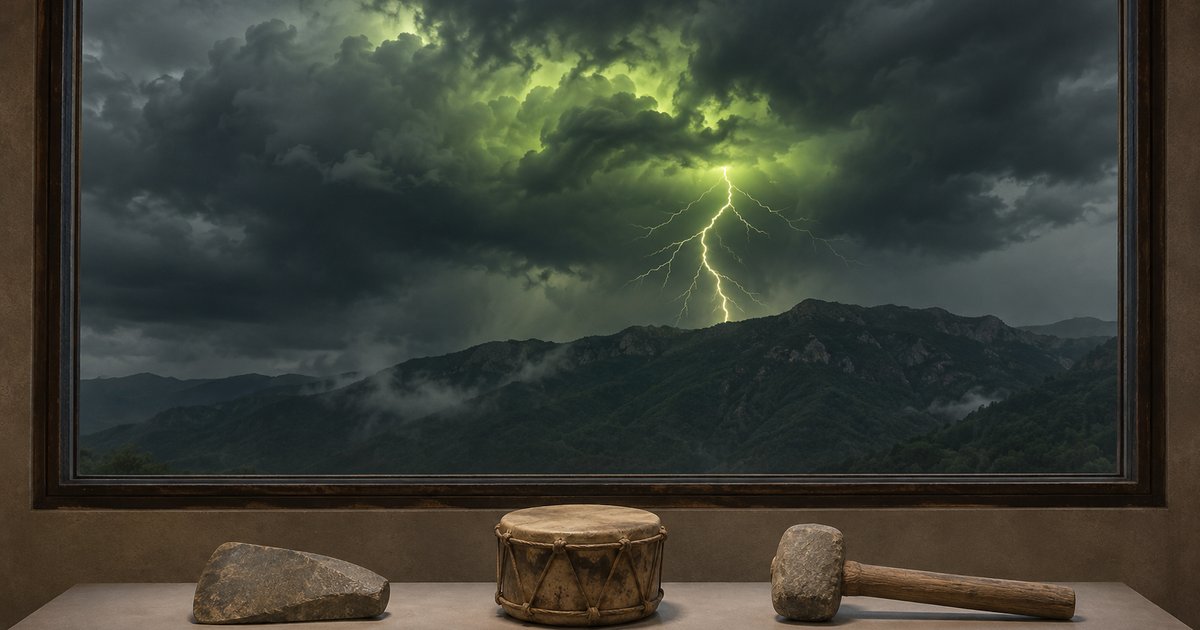
Many cultures tie thunder and lightning to a god or spirit, but the sources describe separate figures, not one story: Zeus holds a thunderbolt, Thor’s name was the Germanic word for thunder, Indra’s thunderbolt frees the waters, and the Ojibwe Archive calls Anishinaabe Thunderbirds powerful spiritual beings with a protective bond to people. Some of these traditions are described as practiced today, among them Yoruba worship of Shango and Anishinaabe teaching, and others are known from texts and museum objects.
Zeus holds the thunderbolt in Greek poetry and art
In Hugh Evelyn-White’s 1914 English translation, Hesiod’s Theogony says the Cyclopes gave Zeus the thunder and made the thunderbolt. Later the poem shows Zeus coming down from Olympus, hurling his lightning against the Titans, with bolts flying thick and fast from his hand together with thunder. Encyclopaedia Britannica describes him as a sky and weather god who was regarded as the sender of thunder and lightning, rain and winds, with the thunderbolt as his traditional weapon. A Cypriot limestone relief at the Metropolitan Museum of Art, dated to about the 3rd century BCE, shows the same attribute in stone: Zeus sits on a throne holding a thunderbolt in his right hand, with Apollo and Hermes in the scene.
Thor’s hammer stands for the thunderbolt in Norse tradition
Britannica says Thor’s name was the Germanic word for thunder, and that his hammer represented the thunderbolt. For readers who ask whether Thor is the god of thunder or of lightning, the sources give both: the god bears the word for the sound, and the weapon is the flash. The reason is the one the National Severe Storms Laboratory states in its lightning FAQ: thunder is caused by lightning, so the two are one event heard and seen separately.
The British Museum’s Room 41 guide describes a T-shaped pendant, adapted from a balance arm, among Viking-age objects found in England and dated to the AD 800s–1000s. It may represent “the hammer of Thor, the Norse god of thunder.” A small silver hammer pendant from the Cuerdale Hoard, dated to the AD 800s or early 900s, is described there as an amulet for protection or luck. The Prose Edda, in Rasmus Anderson’s 1879 translation, tells of the duel between Thor and the giant Hrungner: the giant sees flashes of lightning and hears loud crashings, then sees Thor swinging his hammer. Read together with Britannica, that order of events fits a god whose weapon is tied to the storm, though the Edda does not say so in those words.
Indra’s thunderbolt releases the waters in the Rigveda
Ralph Griffith’s 1896 translation of Rigveda hymn 1.32 opens by praising Indra, “the Thunder-wielder,” and says he slew the Dragon and then disclosed the waters. Britannica’s entry on Indra reads the same story as rain: it says he brings rain as god of the thunderbolt, and that the dragon Vritra is a demon of drought who hoards the waters. A 9th-century bronze from Sri Lanka at the Metropolitan Museum shows Indra, Regent of the East, holding a thunderbolt; the museum says the lokapalas, the guardians of the four directions, protect the Buddhist teachings and the religious community.
Indra is not described in these sources as the object of Hindu worship today. Britannica says that in later Hinduism he is no longer worshipped but plays the roles of god of rain, regent of the heavens and guardian of the east, and that he also appears in Jain and Buddhist mythology. A reader who knows Indra from a family or community tradition should treat that entry as one encyclopedia’s summary, not as the last word.
Perun is the lightning god of the Slavs, from a sixth-century report to a saint’s day
The Byzantine historian Procopius, in a translation published by the Loeb Classical Library in 1928, writes that the Sclaveni and the Antae believe one god, the maker of lightning, is alone lord of all things, and that they sacrifice cattle and other victims to him. Britannica ties that report to Perun, the thunder god of the ancient pagan Slavs, and says the Russian Primary Chronicle, compiled around 1113, records Perun as invoked in the treaties of 945 and 971. The same entry notes that Polish piorun and Slovak parom denote thunder or lightning. In the Christian period, Britannica says, worship of Perun was gradually transferred to St. Elijah, and communal feasts on July 20 for Perun or Elijah continued in Russia until modern times.
Japan’s thunder god appears with drums among the clouds
The Smithsonian’s National Museum of Asian Art holds a painting by Katsushika Hokusai dated 1847. The museum’s label says it shows the Thunder God beating the drums carried on his back during storms, and that Japanese painters enjoyed showing this deity among rolling clouds and sparks of lightning. The Metropolitan Museum titles an 18th-century Japanese netsuke, a small carved toggle, “Netsuke of God of Thunder (Raijin) in Clouds,” which gives the figure’s Japanese name.
Shango is an orisha whom Yoruba devotees still honor
The Metropolitan Museum, which spells the name Sango, says the ritual objects for his worship were developed at the court of the kings of Oyo in the 18th century. On annual festival days, it says, the ose Sango, a wooden staff topped with a double ax-head, is taken from shrine altars and carried as a dance wand by devotees who sing his praises. Britannica lists fire and lightning as the natural forces associated with Shango, who it says is both a deified ancestor and a natural force, as all Yoruba orishas are. It adds that Shango is said to have played bata drums to summon storms, and that his devotees continue to use them for that purpose. The Art Institute of Chicago explains the double ax blades as representing the Neolithic stone ax heads that the god is said to hurl to Earth during thunderstorms. Britannica says Shango was worshipped in the early 21st century in the Vodou religion of Haiti, the Santería tradition of Cuba and the Candomblé of Brazil. This is a living religion, so the descriptions here are a museum’s and an encyclopedia’s, and practitioners’ own accounts take precedence over them.
Anishinaabe Thunderbirds are spiritual beings with a protective bond to people
The Ojibwe Archive, a University of Pennsylvania site that presents stories from Anishinaabe storytellers in Minnesota, Manitoba and Ontario, says that the Animkiig (“Thunderbirds”) are among the most powerful spiritual beings in Anishinaabe cosmology and keep a special, protective relationship with the Anishinaabe people. It says they are invisible forces that reveal themselves through stories, and that understanding them calls for some Anishinaabe language. Its text uses the names Animikii and Binesi for them in northern Anishinaabe communities. The archive writes about them in the present tense, and it is a better place than this page to learn the teaching.
The National Museum of the American Indian holds a 1963 Tlingit yellow cedar carving titled Thunderbird and Killer Whale. One museum record does not tell what Tlingit teachings say about the Thunderbird, so this page leaves that to Tlingit sources.
The sources tie these figures to the storm in different ways
The table sets out what each source on this page attaches to the storm and whether the source describes the tradition as practiced. It compares what the sources say, not the figures themselves, and none of the sources ranks one figure against another.
| Figure | Tied to the storm by the source | Practice described by the source |
|---|---|---|
| Zeus (ancient Greek) | Sender of thunder and lightning; the thunderbolt as weapon (Britannica, Hesiod, Met relief) | Not stated |
| Thor (Norse) | His name is the Germanic word for thunder; the hammer represents the thunderbolt (Britannica) | Hammer pendants as amulets, AD 800s–early 900s (British Museum) |
| Indra (Vedic) | God of the thunderbolt who brings rain (Britannica, Rigveda) | No longer worshipped in later Hinduism; present in Jain and Buddhist stories (Britannica) |
| Perun (Slavic) | Thunder god; Polish piorun means thunder or lightning (Britannica) | Feasts for Perun or St. Elijah on July 20 into modern times in Russia (Britannica) |
| Thunder god (Japan) | Beats drums during storms among clouds and lightning (Smithsonian) | Not stated |
| Shango (Yoruba) | Fire and lightning; stone ax heads hurled in thunderstorms; bata drums summon storms (Britannica, Art Institute) | Annual festivals; worshipped in Haiti, Cuba and Brazil (Met, Britannica) |
| Animkiig (Anishinaabe) | Invisible forces that reveal themselves through stories (Ojibwe Archive) | Described in the present tense (Ojibwe Archive) |
Stone axes and fossils were called thunderstones, and lightning does not make either
The idea that a thunder god leaves stones behind reaches past the ax heads of Shango. The Metropolitan Museum says a small jadeitite axe dated to the 5th–4th millennium BCE belongs to a kind known as thunderstones in ancient Greek times and believed to be physical manifestations left by the lightning bolts of Zeus. Christopher Faraone, in a 2014 paper in the journal Kernos, writes that there is no evidence the Greeks or Romans realized such axe heads were made by earlier stone-age cultures, and that in modern Greece they are called astropelékia, “lightning axes,” and kept in houses to ward off lightning and fire. National Museums Scotland says belemnites, the fossils of an extinct squid-like animal that lived 201 to 66 million years ago, became known as thunderbolts or thunder stones, and that people believed they could offer protection from lightning strikes.
Matthew Goodrum, in a 2002 paper in the British Journal for the History of Science, says that by the end of the seventeenth century several works argued that these stones were human-made implements, although their prehistoric origin was not recognized until over a century later. What a strike does leave in the ground, the Utah Geological Survey says, is a fulgurite: a natural tube or crust of glass formed by the fusion of silica sand or rock, with a shape that mimics the path of the bolt.
A thunderstorm works the same way whichever tradition describes it
The National Severe Storms Laboratory says a lightning return stroke heats the air in the channel to above 50,000 °F in a few millionths of a second, and the expansion of that air produces the shock wave that becomes thunder. None of the old stories changes what the National Weather Service says: if you hear thunder, you are likely within striking distance of the storm, so get to shelter and wait 30 minutes after the last lightning or thunder before going back outside.
For a storm you can hear today, Lightning Tracker, an iPhone app, maps recent detected lightning strikes and shows the distance and direction to the nearest one.
Not a substitute for official weather warnings.
If you hear thunder, seek shelter even if the app shows no nearby strike.
Sources
- Hesiod, Theogony, translated by Hugh G. Evelyn-White (1914), Project Gutenberg
- Snorri Sturluson, The Younger Edda (Prose Edda), translated by Rasmus B. Anderson (1879), Project Gutenberg
- Rig Veda, Book 1, Hymn XXXII, translated by Ralph T. H. Griffith (1896), Internet Sacred Text Archive
- Procopius, Gothic Wars III.12–15, Loeb Classical Library (1928), LacusCurtius
- British Museum, Room 41 large-print guide
- Metropolitan Museum of Art, Limestone inscribed relief (Cypriot, ca. 3rd century BCE)
- Metropolitan Museum of Art, Indra, Lord of the Gods: Regent of the East (Sri Lanka, 9th century)
- Metropolitan Museum of Art, Netsuke of God of Thunder (Raijin) in Clouds
- Metropolitan Museum of Art, Sango Staff: Kneeling Female Figure (Ose Sango)
- Art Institute of Chicago, Dance Staff (Oshe Sango)
- Smithsonian National Museum of Asian Art, Thunder god (Hokusai, 1847)
- Smithsonian National Museum of the American Indian, Thunderbird and Killer Whale
- Ojibwe Archive, University of Pennsylvania, Thunderbird
- Encyclopaedia Britannica, Zeus
- Encyclopaedia Britannica, Thor
- Encyclopaedia Britannica, Indra
- Encyclopaedia Britannica, Perun
- Encyclopaedia Britannica, Shango
- Metropolitan Museum of Art, Small jadeitite axe
- Christopher A. Faraone, Kernos, 2014, Inscribed Greek Thunderstones as House- and Body-Amulets in Roman Imperial Times
- Matthew R. Goodrum, The British Journal for the History of Science, September 2002, The meaning of ceraunia: archaeology, natural history and the interpretation of prehistoric stone artefacts in the eighteenth century
- National Museums Scotland, Snakestones, toadstones, and other myths about fossils
- Utah Geological Survey, January 2005, What are fulgurites and where can they be found?
- NOAA National Severe Storms Laboratory, Severe Weather 101: Lightning FAQ
- National Weather Service, Overview: Lightning Safety