 Lightning Tracker
App Store
Storm basics
Roy Sullivan: the ranger struck by lightning seven times
November 19, 2026 · 7 min read
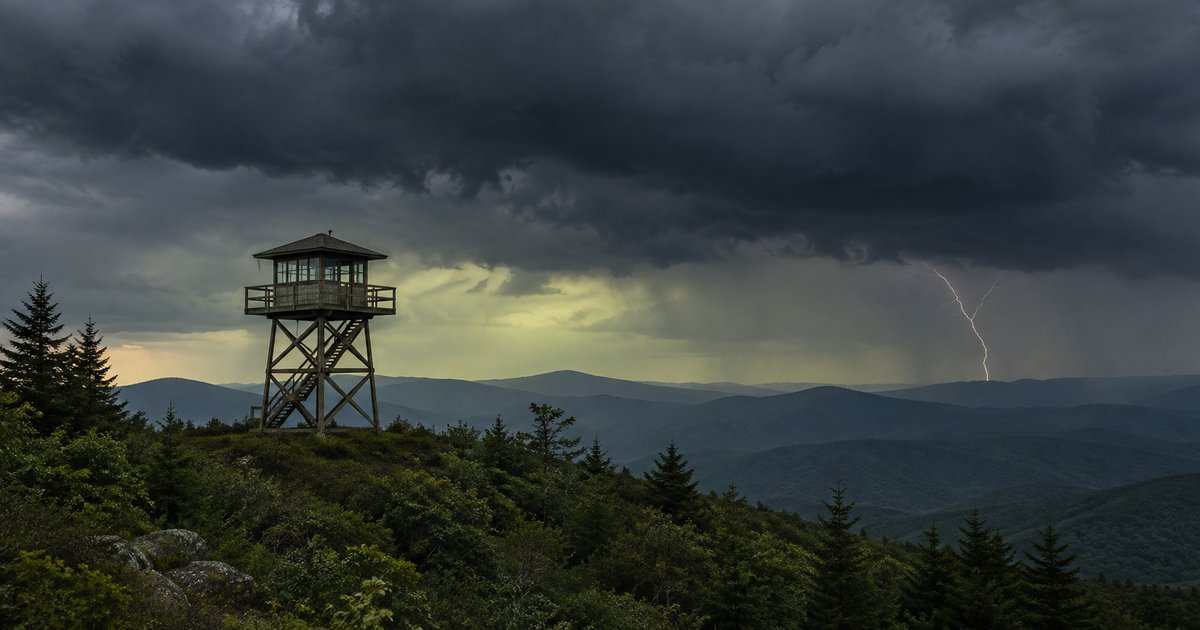
Roy Sullivan was a Shenandoah National Park ranger in Virginia whom Guinness World Records lists as the only person struck by lightning seven times, between 1942 and 1977, surviving every strike. The record rests on dated injuries and his own accounts. It is no measure of anyone else’s odds: the National Weather Service puts the lifetime odds of being struck at about 1 in 15,300 (2009 to 2018 averages) and says a person’s risk depends on behavior when thunderstorms are in the area.
Roy Sullivan was a ranger at Shenandoah National Park in Virginia
Guinness World Records lists Roy C. Sullivan of Virginia as the only man in the world struck by lightning seven times, and its “Most lightning strikes survived” page was still online on November 11, 2026. Its January 26, 2023 feature describes him as an ex-park ranger who worked at Shenandoah National Park in the Blue Ridge Mountains, says he earned the nickname Spark Ranger, and says he died in 1983 at the age of 71. The National Park Service’s Bryce Canyon lightning page, which is undated, also calls him a retired ranger who survived all seven strikes.
The Washington Post’s August 15, 2013 magazine profile, a retrospective written 30 years after his death, says Sullivan joined the park’s fire patrol in 1940 and retired from the Park Service about five months after the sixth strike. The Post adds that the 1972 edition of the Guinness Book of World Records called him the only living man struck four times, and that the editors had to update his entry within a year. The Post reports that Sullivan died on September 28, 1983, and that lightning was not the cause; it adds that the circumstances of his death have been disputed, and this page does not repeat any account of them.
Guinness dates the seven strikes from April 1942 to June 25, 1977
The dates in the table come from Guinness’s record page and its 2023 feature, and the settings and injuries from both, with the feature giving more detail. The record page gives only the year for the first two strikes, 1942 and 1969, and the feature supplies the months. Details marked “Post” come from the Washington Post profile, which draws partly on interviews Sullivan gave in the 1970s.
| Strike | Date | Setting | Injuries listed |
|---|---|---|---|
| 1 | April 1942 | Fleeing a fire watchtower that lightning had set ablaze; the Post names the Millers Head tower, which had no lightning rods yet | Lost a big toenail; the Post adds a half-inch burn stripe down the right leg |
| 2 | July 1969 | Driving his truck; the Post says lightning hit trees beside the road and passed through the truck’s open windows | Knocked unconscious, eyebrows burned, wristwatch destroyed |
| 3 | July 1970 | In his garden; the Post says lightning hit a power transformer near his home first | Left shoulder seared |
| 4 | April 16, 1972 | In a guardhouse at work; the Post says on Loft Mountain, in light rain | Hair set on fire |
| 5 | August 7, 1973 | In his vehicle; the Post says on Skyline Drive, after he tried to get away from a storm | Hair set on fire again, legs seared |
| 6 | June 5, 1976 | On a walk; the Post says alone on a trail | Ankle injured; the feature adds burned hair |
| 7 | June 25, 1977 | Fishing; Guinness’s 2023 feature says from a boat, the Post says trout fishing, thrown into the water | Chest and stomach burned; the Post adds hearing loss in one ear |
The Post says that before the seventh strike Sullivan smelled sulfur and felt the hair bristle on his arms, and that the strike came seconds later. It also says Sullivan fitted copper lightning rods to his trailer, its TV antenna and electric meter, and six of the tallest trees after he retired.
The sources agree on the dates and differ on smaller details
The National Park Service’s Bryce Canyon page says Sullivan was struck seven times “over 40 years,” while the Guinness dates run from April 1942 to June 1977, which is 35 years. The same page lists one of the injuries as being thrown out of his truck, but Guinness and the Post describe him as knocked unconscious in the truck, which the Post says rolled to the lip of a ditch.
Guinness’s own pages differ on voltage: the record page says a single strike is made up of several 100 million volts, and the 2023 feature says several million. This page uses neither figure.
Much of the record rests on Sullivan’s own accounts
The Washington Post reports that nobody witnessed any of the seven strikes, not a fellow ranger, not his wife and not an attending doctor. It says newspaper articles credit his family doctor and Park Superintendent R. Taylor Hoskins with verifying his injuries, though not the strikes themselves. For the fifth strike, the Post says the details come from an account Sullivan gave three weeks later, the exact location is lost, Guinness’s files on him were lost in corporate changes, and the National Park Service kept no documentation.
Opinions in the Post profile split. Reed Engle, a retired National Park Service historian, says the lightning happened and was well documented. A ranger who took Sullivan to a hospital, quoted without a name, says he was probably struck several times but found the later reports harder to believe. Guinness has listed the seven strikes as a record, and this page reports them that way: as Guinness’s record, built on Sullivan’s accounts and on injuries that newspapers say others verified.
Six of the seven strikes found Sullivan outdoors or in a vehicle
The National Weather Service says no place outside protects you when thunderstorms are in the area, and that hearing thunder means you are likely within striking distance. It names substantial buildings and hard-topped vehicles as the options that work, and it says open vehicles, small sheds and rain shelters do not. Guinness places the strikes at a watchtower he was fleeing, in a truck, in a garden, in a vehicle, on a walk and on a fishing trip, and one in a guardhouse; the Post says the truck’s windows were open in 1969.
The NWS says a person’s risk depends on behavior when thunderstorms are in the area. Sullivan’s own account of the 1973 strike, as the Post tells it, is of driving away from a storm and stopping to look at it, and the seventh strike came during a fishing trip. The Post says that in 1970 the lightning came from a relatively clear sky. The NWS says “bolts from the blue” can strike 10 to 15 miles (16 to 24 km) from the thunderstorm; the sources used here do not say whether the 1970 strike was one of those.
In a fall 1977 interview, the Post says, Sullivan guessed that some chemical or mineral in his body drew lightning to him. None of the sources used here tests that idea. The NWS says height, pointy shape and isolation are the dominant factors controlling where lightning strikes, and that metal makes no difference to where lightning strikes. It also lists “lightning never strikes the same place twice” among its lightning myths, and says the Empire State Building is hit an average of 23 times a year. Sullivan’s strikes were at different places over 35 years.
The National Weather Service puts the lifetime odds of being struck at about 1 in 15,300
The NWS “How Dangerous is Lightning?” page estimates the odds of being struck, meaning killed or injured, at 1 in 15,300 over an 80-year lifetime, based on 2009 to 2018 averages of 27 deaths and an estimated 243 injuries a year, and on a 2019 population estimate of 330 million. Guinness’s 2023 feature gives 1 in 10,000 for one strike in 80 years without naming a source, so this page uses the NWS figure. The sources used here give no calculation of the odds of seven strikes for one person, so this page offers none.
The same NWS page says about 10% of people struck by lightning are killed and the rest are left with various degrees of disability. The Washington Post and Guinness describe Sullivan’s injuries as burns, an injured ankle, one loss of consciousness and hearing loss in one ear. The NWS medical page lists problems of the nervous system among the lasting effects some survivors report, and the sources used here do not say whether Sullivan had any. A list of seven survivals says nothing about the outcome of the next strike for anyone else.
The NWS advice for rangers and everyone else is the same
The NWS says to go indoors when thunder roars and to wait 30 minutes after the last lightning or thunder before going back outside. It says too many people wait far too long to reach shelter, and that those delays lead to many of the lightning deaths and injuries in the United States. Sullivan’s record is a dated list of strikes at work and away from it, and it leaves that advice unchanged.
Lightning Tracker is an iPhone app that alerts you when a strike is detected inside a radius you set for each place, 10 miles (16 km) by default, and it does not replace official warnings.
Not a substitute for official weather warnings.
If you hear thunder, seek shelter even if the app shows no nearby strike.
Sources
- Guinness World Records, Most lightning strikes survived
- Guinness World Records, Incredible story of man who survived being struck by lightning SEVEN times (January 26, 2023)
- The Washington Post Magazine, Lightning strikes: A man hit seven times (August 15, 2013)
- National Park Service, Bryce Canyon National Park, Don’t Get Zapped!
- National Weather Service, How Dangerous is Lightning?
- National Weather Service, Overview: Lightning Safety
- National Weather Service, Lightning Myths
- National Weather Service, Medical Aspects of Lightning