 Lightning Tracker
App Store
Storm basics
Can lightning strike from a clear sky? Bolts from the blue
November 19, 2026 · 4 min read
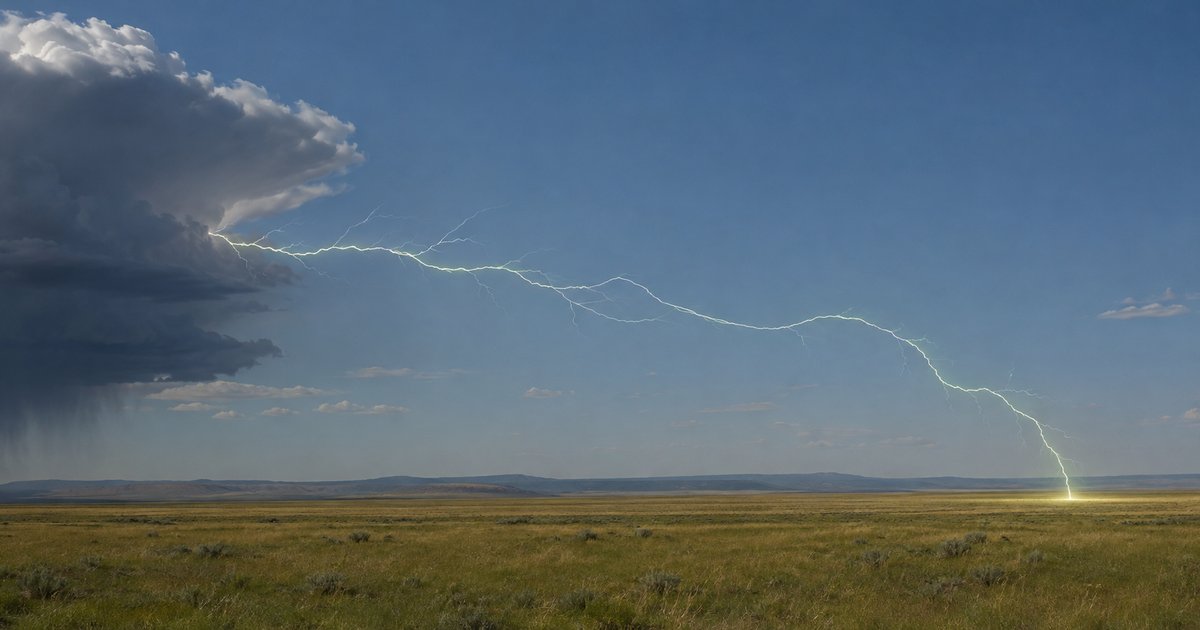
Yes. A bolt can leave a thunderstorm, travel through clear air and strike under blue sky: an undated National Weather Service Pueblo case study tracks one flash about 25 miles (40 km) east in less than one second before it hit ground. Blue sky over your head does not mean there is no parent storm nearby.
A bolt from the blue still starts in a thunderstorm
The NOAA National Severe Storms Laboratory (NSSL) defines a bolt from the blue as a cloud-to-ground flash that comes out of the side of a thunderstorm, travels horizontally through relatively clear air, then angles down to the ground. “Blue” describes the sky over the landing place, not an electrical discharge formed in cloudless air. NSSL's lightning-types page says a storm six miles (10 km) away can therefore be dangerous even when the patch of sky directly above a person is blue.
The National Weather Service (NWS) office in Pueblo describes such a channel leaving the back side of a cloud and traveling a relatively large distance before descending. Its example from east-central Florida was observed by a three-dimensional lightning detection system called LDAR. The tracked flash moved east about 25 miles (40 km) in less than one second and then struck the ground. The Pueblo page says the sky at the nearby Melbourne forecast office was mostly sunny at the time. The storm itself was about 22 miles (35 km) west of Melbourne. Those are two different measurements: one follows the flash's path; the other places the storm relative to the office.
Reported distances describe different things
The NSSL FAQ says bolts from the blue have been documented several miles from their thunderstorm clouds. The Pueblo office reports flashes that travel more than 25 miles (40 km) away from a cloud. The first is a broad description; the second is an unusual documented case. Neither is a radius beyond which the next ground strike is impossible. NOAA's August 2020 myth page gives the practical point without an exact radius: thunder can signal an immediate threat even with blue sky overhead.
The CDC's lightning FAQ says lightning can strike as far as 10 miles (16 km) from any rainfall. Rainfall distance uses the edge of rain as its reference point, while the Pueblo example describes a channel leaving a storm cloud. A storm cloud and its rain area do not have identical outlines, so the figures should not be substituted for each other. A cloud-to-ground strike may also land outside the heavy rain without being visible as a dramatic long channel from where an observer stands.
Clear overhead sky is therefore a weak distance test. A person may see the distant storm to one side, or a hill may hide it. In the NSSL FAQ, a documented strike to a bicyclist under a cloudless sky was judged likely to have come from a thunderstorm about 10 miles (16 km) away, hidden by mountains.
Dry lightning names a different condition
NSSL defines dry lightning in a thunderstorm as lightning without rain nearby. A bolt from the blue is defined by the flash's path from the storm into clear air before it reaches the ground. A dry storm can produce lightning near its own rain-free base; a bolt from the blue can come from a storm that is raining elsewhere. The absence of rain at the strike point alone does not identify which label applies.
The NSSL lightning-types page also separates bolts from the blue from cloud flashes that stay inside a cloud or extend into the air without touching ground. The endpoint separates ground strikes and cloud flashes: a bright sky flash does not always mean a ground contact at that spot.
| Term | What defines it | What it does not tell you |
|---|---|---|
| Bolt from the blue | A cloud-to-ground flash that comes out of the side of a thunderstorm, travels horizontally through relatively clear air, then angles down to the ground | A distance beyond which the next ground strike is impossible |
| Dry lightning | Lightning without rain nearby | Which label applies: the absence of rain at the strike point alone does not identify it |
| Cloud flash | A flash that stays inside a cloud or extends into the air without touching ground | Ground contact at that spot, even when the flash looks bright |
Blue overhead sky does not cancel storm cues
NOAA's August 2020 account of the clear-sky lightning myth advises acting before a storm is directly overhead or rain begins. Its stated trigger is thunder: if you hear it, lightning can threaten the area even if the overhead sky is blue. The NWS sports guidance says thunder is normally audible about 10 miles (16 km) away in quiet conditions, and traffic, wind or precipitation can shorten that audible range. Silence is therefore an imperfect test as well.
The NWS sports page asks outdoor-event organizers to monitor forecasts, radar and detection technology, and to allow time for everyone to reach shelter. It lists seeing lightning, hearing thunder and threatening skies as cues to stop activity. For someone already outdoors when thunder sounds, the NWS recommends a substantial building with wiring and plumbing; if one is unavailable, a hard-topped metal vehicle with closed windows offers protection. Picnic shelters and sheds do not. A substantial building or hard-topped car is the destination, even while the rain and the sky directly overhead look ordinary.
Lightning Tracker is an iPhone app that shows recently detected strikes and their distance and direction on a live map; its place alerts use a radius you choose, 10 miles (16 km) by default. The alert radius for a place is a detection setting, not a promised limit on bolt-from-the-blue travel; detection can miss some strikes or arrive late, and the app does not replace official warnings or local procedures.
Not a substitute for official weather warnings.
If you hear thunder, seek shelter even if the app shows no nearby strike.
Sources
- National Weather Service Pueblo, Bolts From the Blue
- NOAA National Severe Storms Laboratory, Lightning FAQ
- NOAA National Severe Storms Laboratory, Lightning Types
- NOAA, 5 striking facts versus myths about lightning you should know
- Centers for Disease Control and Prevention, Frequently Asked Questions About Lightning
- National Weather Service, Lightning Safety and Outdoor Sports Activities