 Lightning Tracker
App Store
Places and activities
How Often Does Lightning Strike the Eiffel Tower?
November 19, 2026 · 5 min read
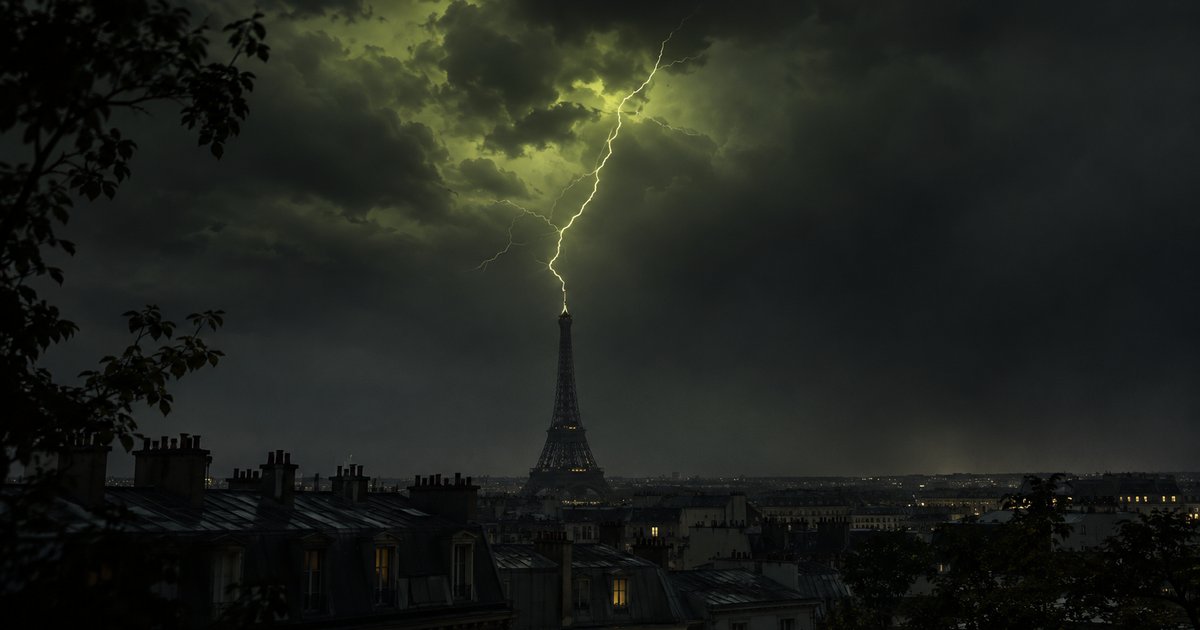
The Eiffel Tower is struck about five times a year on average, according to its operator’s undated account, checked in November 2026. That figure is the operator’s estimate, not a schedule for any given storm. A Musée d’Orsay record independently documents Gabriel Loppé’s famous photograph of lightning at the tower on June 3, 1902; the image shows one evening, not the annual average.
Five impacts a year is the operator’s average, not a timetable
The Eiffel Tower’s operator, Société d’Exploitation de la tour Eiffel (SETE), says on its undated official page that the monument has an average of five lightning impacts each year. That is a statement about a long-run average. It cannot tell a visitor whether lightning will hit the tower on a particular day, and it does not imply one strike every few months. The operator does not publish a year-by-year count or calculation for the average on that page.
SETE also says the tower has been struck since it opened in 1889. It describes a modern way to inspect its electrical paths: lightning strike counters on the earth circuits let electricians check those connections when needed. The page does not say that the counters supply the published five-per-year average. That distinction matters because a count reported by an operator and a direct public record of every strike are different forms of evidence. How lightning is detected by remote networks covers a different kind of record, made by sensors away from the tower.
A 2022 Earth Science Picture of the Day feature from the Universities Space Research Association gives a different figure, about ten strikes a year, but its number links to a commercial source rather than a published tower count. The two figures should not be averaged together. For the tower itself, the operator’s directly attributable estimate is five; neither page provides a year-by-year series with which to test a particular year.
Height and exposure explain the repeated strikes
The National Weather Service says the height, shape and isolation of an object affect its likelihood of being struck. Metal conducts current, but the agency says metal by itself does not attract lightning or determine the strike location. The Eiffel Tower is a tall, exposed metal structure above much of its surroundings, so its repeated strikes fit that general pattern. The tower is one example of lightning striking the same place repeatedly, not an exception to an otherwise reliable rule.
SETE describes several possible contact points. A flash can connect to one of the summit conductors, or it can reach the antenna or lattice girders instead. That is why a photograph of a channel near the summit does not reveal exactly which metal part took the current. It also explains why the tower is not an electrical magnet pulling every Paris lightning flash toward itself. The operator notes that other high buildings in the city can be struck and that each storm’s cloud mass and electrical activity matter.
Four summit rods and the metal frame give current paths to ground
SETE says four lightning rods were installed at the summit during construction. It describes them as copper-broom-like conductors attached to insulated cables that descend toward the ground. When a strike reaches the antenna or the lattice instead, the operator says the metal framework can conduct current down its exterior, in a way it compares to a Faraday cage. The specific contact path can therefore differ from strike to strike.
The National Weather Service explains the broader engineering principle behind a complete lightning protection system: it intercepts a strike, supplies a conductive route and disperses energy into the ground. Rods do not prevent a strike. Bonding the system’s parts helps reduce sparks and side flashes. The tower operator also reports surge arresters in electrical panels and added copper circuits or cables to limit electrical surges. These are measures for routing current and reducing damage, not evidence that lightning cannot affect the monument or people near it.
The 1902 photograph documents a strike, not an annual rate
Musée d’Orsay’s collection record identifies a photograph by Gabriel Loppé titled La Tour Eiffel foudroyée. The museum dates the print to 1902 and transcribes its inscription: Paris, 14 avenue du Trocadéro, June 3, 1902, at 9:20 in the evening. Its description places Loppé on the balcony of his apartment on avenue du Trocadéro. The museum also preserves part of a letter he wrote to Gustave Eiffel in June 1905 about making prints of the lightning view.
The Museum of Fine Arts, Houston, records a 1902 gelatin silver print of the same subject and says Eiffel admired the view and requested copies. These museum records give a documented maker, date and physical object behind an image often shared online. The photograph establishes that Loppé captured lightning at the tower that evening. A single exposure cannot establish how many times the tower was struck that year, and visible branches in a lightning image should not be counted as separate yearly impacts.
This page does not reproduce the photograph. The historical record matters here because it anchors the familiar image to a named museum object and a dated inscription, while the operator’s five-impact average addresses a separate, much longer span of time.
Visitors should follow thunderstorm precautions
SETE’s official description explains that visitors do not access the tower’s exterior lattice girders, but its promotional wording goes further and calls storms no risk to visitors. A metal framework and a lightning protection system do not justify an unconditional promise about every visitor location or every storm. The National Weather Service says that when thunder is heard, people outdoors should move into a substantial enclosed building or a hard-topped metal vehicle. An exposed viewing area is not the same as being inside a building.
The Weather Service also advises waiting 30 minutes after the last thunder before returning outdoors. If you are visiting, follow the tower staff’s directions and official weather warnings as conditions change. The tower’s repeated strikes are a reason to understand where to shelter during lightning, not a reason to stay outside for a photograph.
For a storm near where you are, Lightning Tracker, an iPhone app, shows recently detected strikes on a live map and the distance to the nearest one.
Not a substitute for official weather warnings.
If you hear thunder, seek shelter even if the app shows no nearby strike.
Sources
- Eiffel Tower / SETE, Lightning, thunderstorms and the Eiffel Tower
- Musée d’Orsay, La Tour Eiffel foudroyée
- Museum of Fine Arts, Houston, La Tour Eiffel foudroyée
- National Weather Service, Lightning Safety Awareness Week
- National Weather Service, Lightning Rods
- Universities Space Research Association, Lightning and the Eiffel Tower