 Lightning Tracker
App Store
Places and activities
Lightning capital of the US: why Florida, and which part
November 18, 2026 · 7 min read
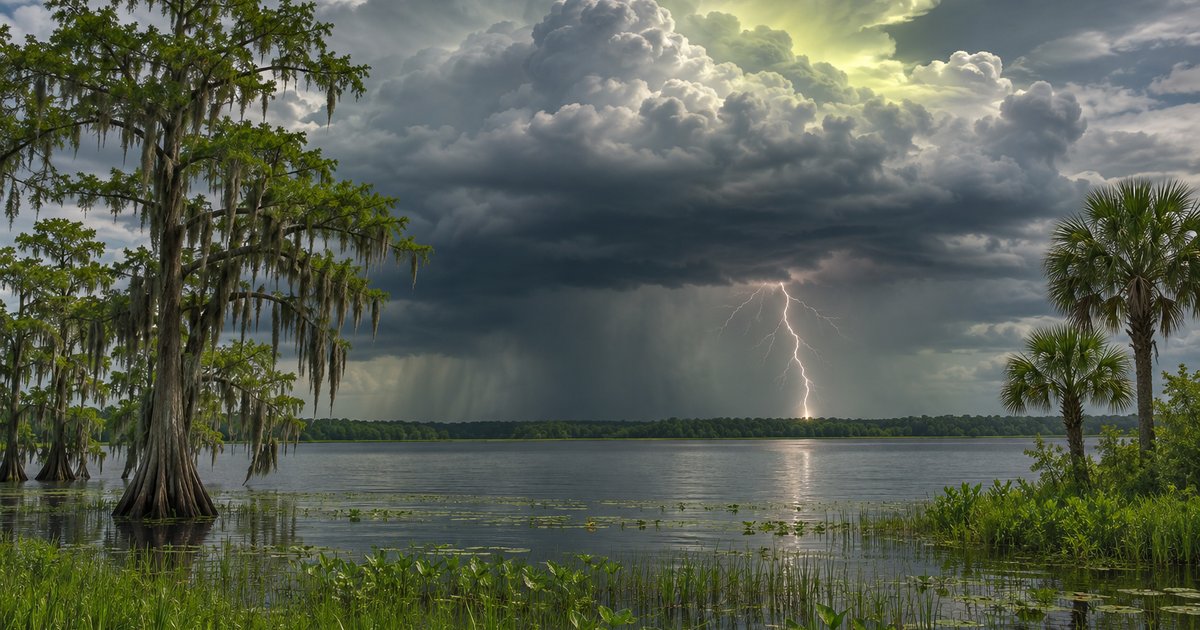
Florida is the lightning capital of the United States by density: Vaisala Xweather’s 2025 annual report, released January 5, 2026, found 305 lightning events per square mile there, ahead of Oklahoma at 253 and Louisiana at 241. By total count Texas leads, with 47,361,143 events in 2025, more than Florida and Oklahoma combined. “Lightning capital” is not an official title, and a second company’s report released the same day put Oklahoma narrowly first on its own count.
Which state has the most lightning: the densest or the biggest count?
Vaisala Xweather’s report ranks the states twice, and the two lists have different leaders. Lightning count is the number of lightning events over a region. Lightning density divides that count by the region’s area, so a large state can be compared with a small one. The report counts total lightning: individual pulses and strokes inside both in-cloud and cloud-to-ground flashes. It says Texas always has the highest count, partly because of its size. The table takes every number from that one report, so the columns compare.
| State | Events per square mile | Total events | Year and source |
|---|---|---|---|
| Florida | 305 (1st) | 20,034,067 (2nd) | 2025, Vaisala Xweather |
| Oklahoma | 253 (2nd) | 17,658,353 (3rd) | 2025, Vaisala Xweather |
| Louisiana | 241 (3rd) | 12,624,227 (4th) | 2025, Vaisala Xweather |
| Mississippi | 231 (4th) | 11,176,370 (6th) | 2025, Vaisala Xweather |
| Arkansas | 230 (5th) | 12,229,238 (5th) | 2025, Vaisala Xweather |
| Texas | outside the top five | 47,361,143 (1st) | 2025, Vaisala Xweather |
Densities come from Vaisala’s January 5, 2026 release of the report, and counts from the report page. Texas has more events than Florida and Oklahoma combined, yet it drops out of the top five once the numbers are adjusted for area. The report adds that over 50% of US lightning occurs in the top 7 states and that the bottom 14 states account for less than 1%.
Florida’s lead by density is not new. Vaisala’s 2022 report, released January 3, 2023, ranked Florida first at 285 events per square mile, its 2023 report did the same, and its 2015–2019 state averages listed Florida, Oklahoma and Louisiana first, in the same order as 2025.
Did Oklahoma take the title from Florida in 2025?
AEM, which runs its own lightning network, released its 2025 US Lightning Report on January 5, 2026, the same day as Vaisala, and ranked Oklahoma first by flash density: 73 flashes per square mile, followed by Florida, Louisiana and Kansas. The Palm Beach Post reported the gap as a photo finish, 73 flashes for Oklahoma against 72.9 for Florida.
The two reports count different units. AEM counts flashes, which it defines as collections of pulses close in space and time that approximate a complete lightning event; its network detected 88.4 million flashes in the United States in 2025. Vaisala counts the pulses and strokes inside flashes as events and reports 251,800,297 total events across the continental US, so the two companies’ per-square-mile figures are not interchangeable.
AEM’s lightning scientist, Elizabeth DiGangi, told USA Today that Florida had a drier-than-average 2025, in part because most Atlantic hurricanes stayed out to sea, while Oklahoma had an active year for severe weather. She said it is difficult to say whether the shift is part of a larger trend. Henry Fuelberg, a Florida State University meteorology professor, told the Palm Beach Post that he did not think Florida had been “dethroned on a permanent basis.”
Which part of Florida gets the most lightning?
Sources place the peak in different parts of central Florida, depending on the measure and the years:
| Source | Where | Measure |
|---|---|---|
| NOAA National Severe Storms Laboratory | Florida between Tampa and Orlando | Highest frequency of cloud-to-ground lightning over the entire year |
| National Weather Service, as quoted by Space Launch Delta 45 on June 22, 2023 | The corridor from Tampa Bay to Titusville, called “Lightning Alley” | Most lightning in the US each year |
| T. L. Koehler, 25 years of National Lightning Detection Network data, 1993–2017 | Near Tampa, in Hillsborough County | Maximum of the annual mean cloud-to-ground flash density map: about 45 flashes per square mile a year (17.2 per square kilometer) |
| Vaisala Xweather, 2025 | Seminole County for density, Polk County for count | About 668 events per square mile (258 per square kilometer); 1,057,635 events |
| Vaisala Xweather, 2022 | Four Corners, Florida, two miles west of Disney’s Animal Kingdom Lodge | 1,229 events per square mile, the highest of any US community that year |
The National Weather Service office in Melbourne, Florida, calls central Florida the “Lightning Capital” of the United States on its lightning information page. “Lightning Alley” is the nickname for the Tampa Bay to Titusville corridor. The descriptions do not agree on one boundary: NSSL names Tampa to Orlando, Koehler’s maximum sits near Tampa, and Vaisala’s 2025 county leaders are Seminole and Polk.
No single city holds the title, because the town-level one changes hands. Vaisala Xweather named Flatonia, Texas, for 2021; Four Corners, Florida, for 2022; Teague, Texas, for 2024, with Orlando, Florida, second at 1,072 events per square mile; and Shady Grove, Oklahoma, for 2025, at 3,005 events per square mile. Its 2025 release calls that the first time in four years that the capital was outside Texas or Florida.
Why does Florida get so much lightning?
NOAA’s National Severe Storms Laboratory says thunderclouds form wherever upward air motion, unstable air and moisture come together, and it ties Florida’s year-round maximum to a large amount of moisture in the lowest 5,000 feet of the atmosphere on many days, plus high surface temperatures that produce strong sea breezes along the Florida coasts.
The National Weather Service in Melbourne built monthly flash maps from ten years of data, 1986 to 1995. In its reading, the collision of the two sea breezes over the peninsula causes the high flash rates in June and the rest of the summer. It calls July the month for lightning over Florida, when warm coastal waters and near-maximum sunshine let both breezes become well developed.
The National Weather Service in Tampa Bay ties the thunderstorm season in West Central and Southwest Florida to the tropical climate shifting north in June through September, together with the surrounding oceans and daily sea breezes. It puts the rainy season at May 25 to October 10 for most of West Central Florida and May 15 to October 15 for Southwest Florida.
Not every part of the state is a hot spot. The Melbourne office’s maps show a minimum over south Florida, which it attributes partly to the narrowness of the peninsula there and to the cooler, less unstable Everglades. Vaisala’s 2023 report, on a different decade and a different measure, named Miami–Fort Lauderdale the most lightning-prone US metropolitan area that year, with 120,998 cloud-to-ground strokes.
How many people does lightning kill in Florida?
The National Weather Service in Melbourne says Florida has the highest number of lightning casualties of all 50 states and that lightning there is responsible, on average, for more weather-related deaths than all other weather hazards combined. In the National Lightning Safety Council’s table of US lightning deaths for 2016 to 2025, dated January 6, 2026, Florida had 51 of the 196 deaths, about a quarter, and ranked first; Texas was second with 21.
One year’s count differs by source. The National Weather Service in Miami counts 20 US lightning deaths in 2025, including 3 in Florida, in its awareness-week document of February 2, 2026; the Palm Beach Post reported 21 deaths nationwide and four in Florida. The Miami office adds that the greatest number of people in Florida are struck near or on a body of water.
Is Florida the lightning capital of the world?
No: NASA reported on May 2, 2016, that a study using 16 years of satellite observations ranked Lake Maracaibo in Venezuela first, at about 603 flashes per square mile a year (233 per square kilometer). Those are satellite-counted flashes, not the ground-network events in the table above, so the numbers do not compare directly.
Where to check Florida’s lightning outlook for today
The National Weather Service does not issue specific lightning warnings, the Miami office says; its routine products, the Hazardous Weather Outlook and the Surf Forecast, describe the daily lightning danger in South Florida from none to high. The Tampa Bay office’s graphical hazardous weather outlook carries a lightning hazard level for the day, from None to Extreme; its Moderate level is a frequency of 50 to 99 strikes with scattered to numerous storms.
Lightning Tracker, an iPhone app, shows recently detected strikes on a live map, with the distance and direction to the nearest one and how many minutes ago it was detected, and it alerts you when a strike is detected inside the radius you set for each place. It works outside the United States too. Detection networks miss some strikes, especially weak ones, and the app marks delayed or missing data instead of reading it as quiet.
Not a substitute for official weather warnings.
If you hear thunder, seek shelter even if the app shows no nearby strike.
Sources
- Vaisala Xweather, The Annual Lightning Report 2025
- Vaisala, Vaisala Xweather Annual Lightning Report 2025: U.S. lightning hits eight-year high (press release, January 5, 2026)
- Vaisala, Top airports and towns in the U.S. struck by lightning in 2024 (press release, January 7, 2025)
- Vaisala, Report reveals the most lightning-prone U.S. metropolitan areas and at-risk wind farms (press release, January 4, 2024)
- Vaisala, Vaisala Xweather Annual Lightning Report explores 2022’s extremes (press release, January 3, 2023)
- Vaisala, hosted by the National Weather Service, Total Lightning Counts by State from 2015 to 2019 (datasheet)
- AEM, AEM Releases 2025 U.S. Lightning Report (press release, January 5, 2026)
- AEM, 2025 United States Lightning Report
- USA Today, There’s a new lightning capital of the US. It’s no longer Florida (January 5, 2026)
- Palm Beach Post, Florida vs. Oklahoma: The battle for lightning capital explained (January 7, 2026)
- NOAA National Severe Storms Laboratory, Severe Weather 101: Lightning FAQ
- National Weather Service Melbourne, Florida Lightning Climatology
- National Weather Service Melbourne, Lightning Information Center
- National Weather Service Tampa Bay, Thunderstorm Climatology Quick Reference
- National Weather Service Tampa Bay, Graphical Hazardous Weather Outlook
- National Weather Service Miami, 2026 Severe Weather Awareness Week: Lightning Awareness Day (February 2, 2026)
- Space Launch Delta 45 via DVIDS, Guardians of the Sky: Overcoming Lightning’s Fury for Mission Success (June 22, 2023)
- T. L. Koehler, American Meteorological Society, A U.S. Thunderstorm Climatology Based on 25 Years of NLDN Observations (1993–2017), extended abstract
- National Lightning Safety Council, Number of Lightning Deaths by State from 2016 to 2025 (January 6, 2026)
- NASA, Earth’s New Lightning Capital Revealed (May 2, 2016)