 Lightning Tracker
App Store
Places and activities
Thunderstorms and lightning in New York
November 19, 2026 · 6 min read
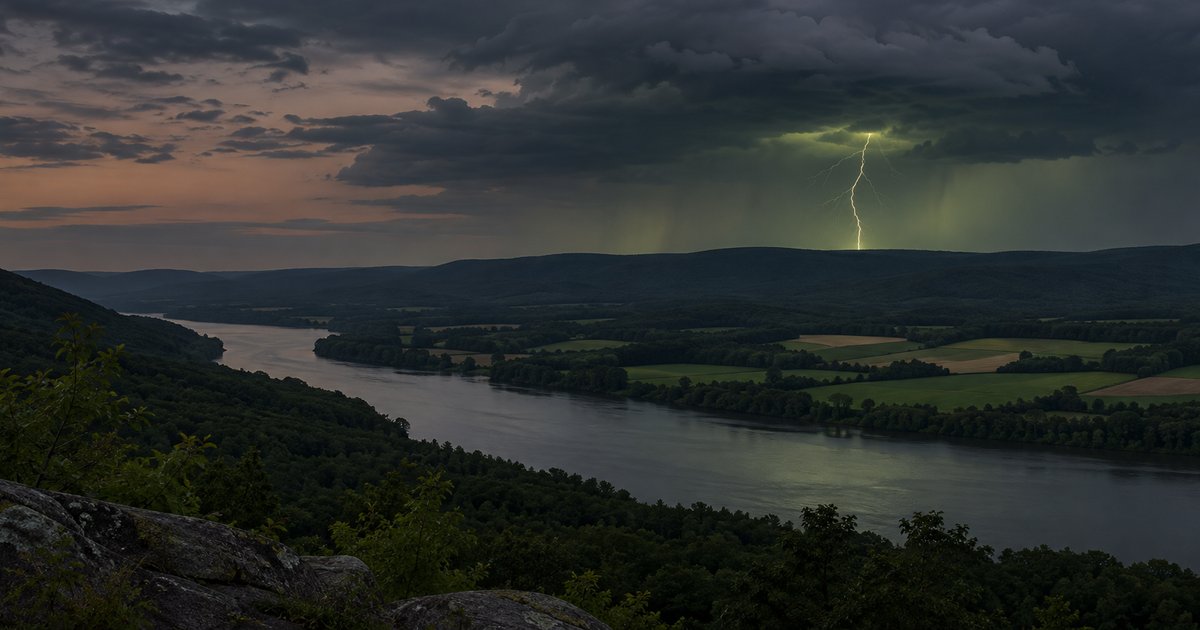
New York recorded 620,915 total lightning events in Vaisala Xweather’s 2025 report, while the National Lightning Safety Council counted seven New York lightning deaths over 2016–2025. The count is statewide history, not a measure of conditions at a particular place; regional NWS climate evidence and the serving forecast office help answer when and where to check.
What New York’s counts actually count
Vaisala Xweather’s 2025 report ranks New York 37th among the 50 states and Washington, DC, with 620,915 total lightning events. Its network counts individual pulses within clouds and strokes between cloud and ground. Several strokes can belong to one flash, so 620,915 does not mean that many separate ground impacts. The national lightning count comparison explains why an event total and a cloud-to-ground flash total cannot be read as the same measurement.
The National Lightning Safety Council’s state table lists seven lightning deaths in New York for 2016–2025. That is a count of people who died over ten years, not a count of injuries or of lightning strikes in 2025. The fatality period and the Xweather event year differ, so dividing one by the other would produce a misleading risk figure. The national state rankings also use other measures, including density, which cannot be inferred from New York’s raw annual total.
Does New York get thunderstorms?
New York gets thunderstorms across the state, but their frequency varies. The National Weather Service’s Albany office gives a regional contrast in its New York thunderstorm fact sheet, drawing on 1993–2018 observations. It shows 28 to 36 thunderstorm days per year in western New York, the Finger Lakes, central New York, the Southern Tier, the mid-Hudson Valley and New York City. The same sheet shows 18 to 27 in the North Country, Capital District, Mohawk Valley and Long Island. Those are historical thunderstorm-day ranges, not a number of lightning events or a prediction for an individual summer.
| Thunderstorm days per year | Regions |
|---|---|
| 28 to 36 | Western New York, the Finger Lakes, central New York, the Southern Tier, the mid-Hudson Valley and New York City |
| 18 to 27 | The North Country, Capital District, Mohawk Valley and Long Island |
Source: National Weather Service Albany, New York thunderstorm fact sheet.
The New York State Department of Health’s lightning guidance says thunderstorm activity is greatest during July and August. The NWS Buffalo climate narrative adds a local exception to any simple statewide calendar: cool Lake Erie water suppresses thunderstorms in the immediate Buffalo area through much of July, while August becomes more humid and sometimes brings nighttime storms as the lake warms. That description concerns Buffalo and nearby lakeshore areas; inland western New York can behave differently. A summer trip across the Adirondacks, Finger Lakes and Long Island therefore needs a forecast for its actual stops, rather than a single New York season label.
Thunderstorms and lightning in New York City
New York City is in the NWS Albany fact sheet’s 28-to-36-thunderstorm-days-per-year range, based on 1993–2018 observations; Long Island is in its 18-to-27 range. Those regional figures do not say whether a storm is approaching the five boroughs on a particular day. NYC Emergency Management says it monitors severe weather with the NWS and uses Notify NYC for city emergency messages. Its thunderstorm guidance says every thunderstorm produces lightning and tells readers to move indoors when a severe thunderstorm warning is issued. For a city address, use the NWS city or ZIP search to identify the serving forecast office and its alerts.
Thunderstorm watches and warnings in New York
The NWS Albany thunderstorm fact sheet says a severe thunderstorm watch means severe storms are possible over a broad area. A warning means severe weather from a thunderstorm is imminent or occurring in a smaller area. Lightning alone does not make a storm “severe” under that NWS classification. Suffolk County emergency management says the NWS does not issue watches or warnings for lightning itself, so hearing thunder is a reason to seek shelter even when there is no severe thunderstorm warning. For a warning query, check the NWS forecast and alerts for the city or ZIP rather than relying on this article’s historical counts.
Rules for school sports and outdoor plans
The New York State Public High School Athletic Association’s 2026 handbook applies its thunder and lightning policy from the regular season through its finals. It calls for play to stop when thunder is heard or lightning is seen. The handbook also names a 15-mile trigger when its specified detection app is used, and directs participants to a normally occupied building or a solid-metal-top vehicle. It says to wait 30 minutes after the last thunder, visible strike or qualifying app detection before resuming. That association rule is for its contests; it is not a state law governing every park, concert or private field. The named app in the association policy is a different product from Lightning Tracker.
New York’s Department of Environmental Conservation tells hikers to watch for darkening skies, wind, lightning and thunder, and to leave summits and open areas for lower ground and shelter when a thunderstorm approaches. Its Hike Smart NY guidance is particularly relevant on exposed Adirondack and Catskill routes, where getting down from a ridge takes time. A low spot or shorter trees are last-resort risk reductions when a building or hard-topped vehicle cannot be reached; the substantial shelter guidance still governs the trip plan. For an organized crowd, the outdoor event procedure needs a person authorized to stop activity and a route that can move everyone indoors.
The New York State Division of Homeland Security and Emergency Services recommends multiple channels for emergency information, including NY-ALERT, NOAA Weather Radio and Wireless Emergency Alerts. Its preparedness advice notes that severe weather warnings are issued by county, so knowing the county as well as nearby cities matters when traveling within the state. Alerts for severe wind or hail are useful, but lightning itself can call for shelter even without such a warning; Suffolk County emergency management says to go inside when thunder is heard and remain there until 30 minutes after the last rumble.
Where to check New York lightning strikes today
New York does not have one NWS forecast office for every county. The NWS 2026 New York State fire-weather operating plan names Albany, Binghamton, Buffalo, Burlington and New York as offices serving parts of the state. The NWS says to enter a city and state or ZIP code in its forecast search and follow the serving-office link above the local forecast. That matters at the Vermont border and elsewhere near forecast-area boundaries. For a New York lightning strike map, NOAA nowCOAST offers an official lightning-density layer, while NWS radar shows precipitation. This article has no live map, strike count for today or forecast of its own.
- Find the serving NWS office — enter the city or ZIP for local forecasts, alerts and office information.
- Storm Prediction Center outlooks — check the issue time and area for the official convective outlook.
- NWS radar — precipitation imagery, not a lightning-detection plot.
- NOAA nowCOAST — NOAA describes its lightning strike density layer for land and water, distinct from radar.
- New York State emergency alerts — the state’s NY-ALERT and other notification routes.
- NYC Emergency Management — city thunderstorm guidance and Notify NYC information.
The ways to check nearby strikes vary in what they can show. Lightning Tracker is an iPhone app that works in New York and elsewhere, showing recent detected lightning and the distance to the nearest detection; it can alert for a radius around the current location, and Premium adds up to 5 saved places. Official warnings and local procedures remain the decision source.
Not a substitute for official weather warnings.
If you hear thunder, seek shelter even if the app shows no nearby strike.
Sources
- Vaisala Xweather, The Annual Lightning Report 2025
- National Lightning Safety Council, Deaths by State, 2016–2025
- National Weather Service Albany, New York State Thunderstorms
- NYC Emergency Management, Thunderstorms & Lightning
- National Weather Service Buffalo, Buffalo Climate Narrative
- New York State Department of Health, Lightning Safety Tips
- New York State Public High School Athletic Association, 2026 NYSPHSAA Handbook
- New York State Department of Environmental Conservation, Hike Smart NY
- New York State Division of Homeland Security and Emergency Services, Before an Emergency Happens
- Suffolk County Office of Emergency Management, Lightning Safety
- National Weather Service, 2026 New York State Fire Weather Annual Operating Plan
- National Weather Service, Contact Your Local NWS Office
- National Oceanic and Atmospheric Administration, Where Do I Get Real-Time Coastal Conditions?