 Lightning Tracker
App Store
Storm basics
Does Hawaii get thunderstorms and lightning?
November 19, 2026 · 4 min read
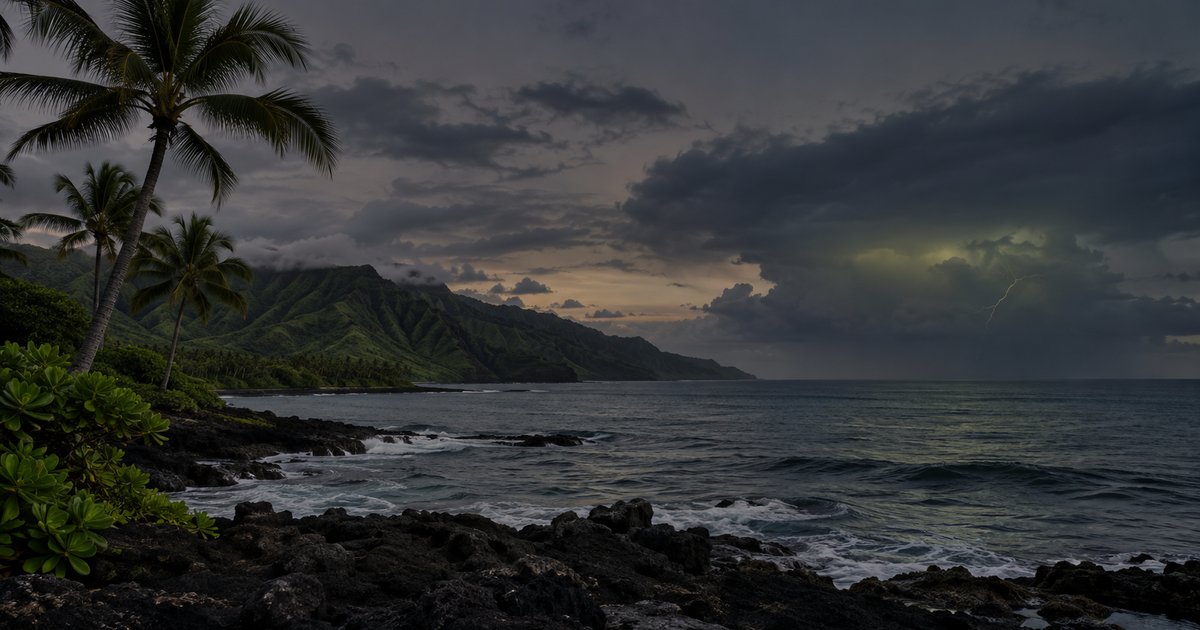
Yes. Hawaii does get thunderstorms and lightning, though NWS Honolulu describes them as less frequent than in most continental regions. Vaisala Xweather recorded 9,255 total lightning events in Hawaii in 2025. The islands’ usual trade winds favor showers, while winter fronts and Kona storms can bring thunderstorms. The Big Island also has a distinct afternoon rain cycle, but rain alone does not establish that thunder will occur.
Why rain does not always mean thunder
Hawaii’s familiar northeast trade winds carry moist air toward the islands. NWS Honolulu’s undated climate summary explains that air rises over windward slopes, where clouds and rain develop, while descending air leaves many leeward areas sunnier and drier. This terrain pattern can produce a shower on one side of an island while the other side stays dry. It does not mean that each shower is a thunderstorm. The same NWS summary calls severe storms infrequent and says Hawaii’s lightning and thunderstorms occur less often than their counterparts in continental regions.
The usual trade-wind pattern also tends to limit how tall clouds can grow. A 2018 U.S. Geological Survey report cites a 2007 peer-reviewed study finding a trade-wind inversion about 82% of the time in Hawaii. The study used 1979–2003 weather-balloon records at Hilo and Līhuʻe. An inversion is a layer where temperature stops falling normally with height and acts as a cap on rising air. That measured frequency describes a historical sample, not the odds of a storm on any particular day. Rain can be common along a windward slope while lightning remains relatively uncommon.
When thunderstorms become more likely
Winter brings the clearest shift in Hawaii’s broad weather pattern. NWS Honolulu says Pacific storm tracks move south in winter, when cold fronts, migrating cyclones and Kona storms can interrupt the trade winds for days or weeks. Its climate summary calls winter the season of more frequent clouds and rainstorms. A Kona low is a low-pressure system near the islands that can replace the ordinary northeast flow with southerly or westerly winds. That change can bring widespread, deeper storm clouds rather than the brief showers typical of trade-wind weather.
NWS Honolulu’s seasonal FAQ says that when winter storm systems or cold fronts reach the islands, lighter winds, humidity, cloudiness, showers and heavier thunderstorms become possible. The office also says October and November are a transition: trade winds still dominate much of the time, but breaks in that pattern can bring heavy showers and thunderstorms. These are descriptions of seasonal opportunity, not dates when thunder is expected every year. A winter rainstorm can occur without lightning, and a thunderstorm can happen outside winter.
Across the islands, geography changes the experience as much as season does. NWS Honolulu says mountains deflect and lift air, creating large rainfall differences over short distances. A shower at a beach, a cloud over a ridge and an island-wide Kona storm are different settings. The U.S. lightning density rankings describe statewide totals; they do not tell someone whether the next shower above a specific valley will produce thunder.
Why Big Island afternoons are a special case
The Kona side of Hawaii Island has a local afternoon rainfall cycle even when most of the island chain follows the trade-wind pattern. An NWS Pacific ENSO Applications Climate Center study explains that Mauna Loa and Hualālai block the prevailing winds near Kona. When the trades weaken, daytime heating drives air uphill from the coast; rising air produces convective rain around middle elevations in the afternoon, and nighttime cooling reverses the flow. The study identifies a summer rainfall maximum there, unusual for Hawaii.
Convection means rising air that can build clouds, but the Kona study describes rain, not a claim that every afternoon shower contains lightning. The local cycle does explain why a dry morning at the coast can become a cloudy or rainy afternoon upslope. If you are planning a hike or a long outdoor stay, the timing of afternoon storm development matters even though the afternoon rain cycle alone cannot predict thunder.
What the lightning counts actually show
Vaisala Xweather’s 2025 Annual Lightning Report lists 9,255 detected total lightning events for Hawaii in 2025, ranking it 49th among the 50 states by raw count. The report includes lightning in clouds as well as lightning reaching the ground. Its Hawaii row is evidence that lightning occurs, not an estimate of a resident’s chance of being struck or a count of thunderstorm days. One year’s rank can change with the year’s weather and the detection method.
AEM’s separate 2025 U.S. Lightning Report found Hawaii among the ten states with the most “thunder hours” but among the bottom ten for flash density. A thunder hour is an hour with detected lightning in an area; density is flashes per square mile. AEM says this combination reflects many storms with relatively little lightning in each. The statewide count gives context, but the two companies count different units and their raw totals should not be interchanged.
Where to check before going outdoors
The NWS Honolulu office is the local source for Hawaii forecasts and warnings. Its product list includes island zone forecasts, a forecast discussion, severe thunderstorm watches and warnings, and special weather statements. Check the relevant island forecast and any warnings before a hike, beach visit or other outdoor plan; conditions can differ sharply from one slope to another.
If thunder is audible, NWS lightning guidance says you are likely within striking distance. Move into a substantial building or a hard-topped vehicle; shelter from lightning matters even when rain is falling somewhere else. NWS guidance says to wait 30 minutes after the last thunder before going back outdoors; a new clap of thunder restarts the 30-minute wait.
Lightning Tracker works in Hawaii too and shows recently detected strikes on an iPhone map, although detection coverage can vary.
Not a substitute for official weather warnings.
If you hear thunder, seek shelter even if the app shows no nearby strike.
Sources
- National Weather Service Honolulu, Climate of Hawai`i
- National Weather Service Honolulu, Frequently Asked Questions
- National Weather Service Pacific ENSO Applications Climate Center, Pilot Kona District Precipitation Study
- Vaisala Xweather, The Annual Lightning Report 2025
- AEM, 2025 United States Lightning Report
- U.S. Geological Survey, Spatially Distributed Groundwater Recharge Estimated Using a Water-Budget Model for the Island of Maui, Hawai‘i, 1978–2007
- University of Hawai‘i, Application Briefs 2007: Trade Wind Inversion Variability in Hawai‘i
- National Weather Service Honolulu, CPHC/WFO Honolulu Products
- National Weather Service, Overview: Lightning Safety