 Lightning Tracker
App Store
Places and activities
Lightning in Florida: counts, deaths and official checks
November 19, 2026 · 6 min read
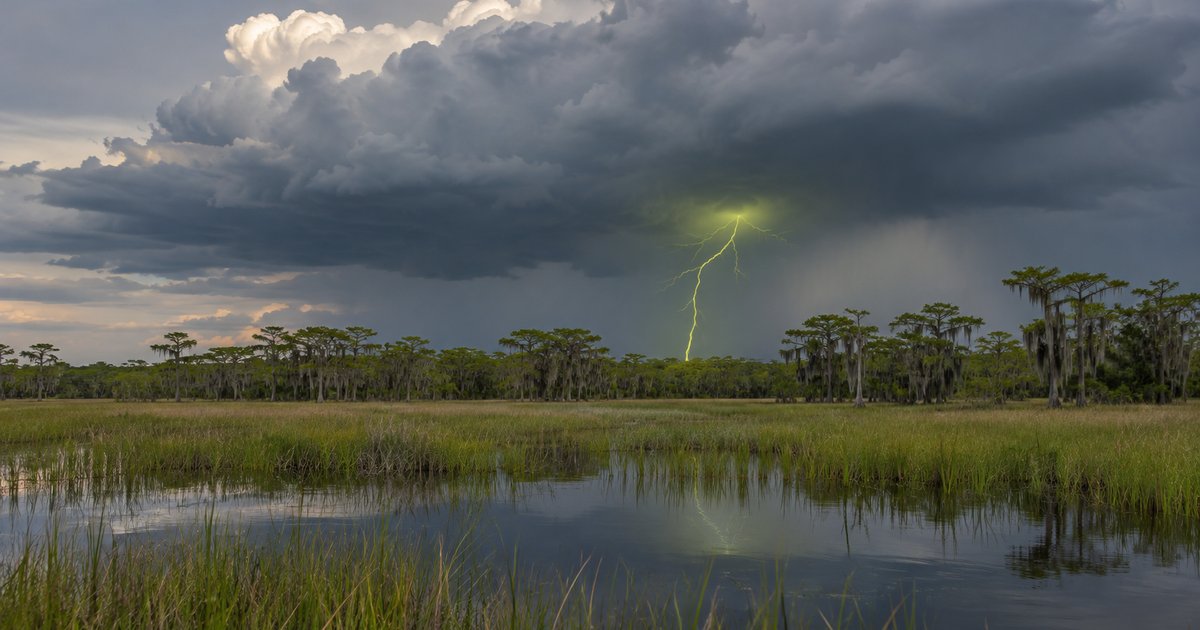
Florida had 20,034,067 total lightning events in Vaisala Xweather’s 2025 report, second by state count, while the National Lightning Safety Council recorded 51 Florida lightning deaths in 2016–2025, the highest state total in that table. Those historical figures do not locate a storm at your destination: use the serving National Weather Service office and the rules for the school, park or workplace you are visiting.
What the Florida numbers count
Vaisala Xweather's 2025 report ranks Florida second in total lightning events among the states and Washington, DC, behind Texas. It defines a lightning count as events over a region and a density as events divided by area. Its detection system includes individual in-cloud pulses and cloud-to-ground strokes within flashes; several strokes may belong to one flash. Therefore, 20,034,067 does not mean that many distinct ground impact points. The difference between events and flashes matters whenever two headline totals appear to disagree.
The same report says Polk County, Florida, had 1,057,635 total events in 2025, the highest county total nationally; Seminole County had 258 total events per square kilometer, its highest county density. Its state lightning-capital table gives Placid Lakes 527 events per square kilometer. These are three different geographic comparisons, and none is an estimate of what will occur at a particular address. Florida's place in the national density rankings depends on the period and counting unit used.
| Figure | Florida | Source and period |
|---|---|---|
| Total lightning events | 20,034,067, second among the states and DC, behind Texas | Vaisala Xweather, 2025 |
| Lightning deaths | 51, the most in the table; Texas is next with 21 | National Lightning Safety Council table, 2016–2025 |
| NWS forecast offices | Jacksonville, Key West, Melbourne, Miami, Tallahassee and Tampa Bay, plus Mobile, Alabama/Pensacola, Florida | NWS Southern Region directory |
Is Florida the lightning capital?
The 2025 Vaisala Xweather report calls Florida the leading state by lightning density, while Texas led by total event count, and it named Shady Grove, Oklahoma, the 2025 US lightning capital by event density. “Capital” needs a unit and a year; which place holds the lightning capital title has its own page.
How many lightning deaths were recorded in Florida?
The National Lightning Safety Council's state table records 51 Florida lightning deaths from 2016 through 2025, the most in that ten-year state table; Texas is next with 21. The table counts deaths, not injuries or how many people were exposed outdoors. It does not measure the chance that any one visitor will be struck. The ten-year death period and one-year detection period cannot be divided into a meaningful individual risk rate. They show why a Florida outdoor plan needs both historical perspective and a way to respond to a storm at the actual venue.
One state, several forecast offices
The National Weather Service's Southern Region directory lists Florida offices at Jacksonville, Key West, Melbourne, Miami, Tallahassee and Tampa Bay, plus Mobile, Alabama/Pensacola, Florida. The office serving an address can differ from the office named for its nearest large city. Enter a city or ZIP code through the NWS local-office lookup before relying on a regional forecast, and check the office and issue time shown there. The ways to check nearby lightning answer different questions: a forecast describes expected weather, while a detection display describes observed events.
Why Florida thunderstorms produce so much lightning
NWS Melbourne’s monthly climatology says summer thunderstorms over the peninsula often form where Atlantic and Gulf sea breezes meet, and the NWS Key West office says thunderstorms can occur in any month in the Keys; Florida’s lightning season covers the months, hours and regions. The Florida Division of Emergency Management says lightning occurs with every thunderstorm and that audible thunder means lightning can reach the listener, even where rain has not begun.
Rules for school contests and outdoor visits
The Florida High School Athletic Association's publications index points member schools to its current handbook. In its 2026–27 handbook, Policy 32 requires outdoor contest officials to consult the principals or their designees when a thunderstorm or electrical storm occurs and to honor a request to interrupt or postpone, with a distinct process for state finals. A school must use its current association and local procedures for interrupting outdoor events.
Florida State Parks says closure decisions under tropical storm and hurricane warnings follow emergency action plans; parks on barrier islands or near major bridges may close sooner depending on conditions. Its park alerts page is the route for a particular park's closure or reopening notice. The parks page does not set a universal lightning-distance trigger for every Florida park, so a visitor should follow that park's instructions and have a substantial shelter identified before going onto a beach, trail or open field. The beach lightning risk is not resolved by waiting for rain to reach the shoreline.
The Florida Division of Emergency Management advises checking the forecast before extended outdoor activity and postponing it when storms are imminent. Its thunderstorm page distinguishes an SPC severe-thunderstorm watch, which means conditions favor severe storms in an area, from a local NWS warning, issued for a storm detected by radar or reported by observers. A lightning threat does not require a severe-thunderstorm warning: the division's simpler trigger is thunder you can hear. Workers and event organizers should follow their employer's or venue's procedure as well as official weather information; the FHSAA rule concerns member-school contests, not every outdoor job or attraction in Florida.
OSHA and NOAA’s 2021 outdoor-work fact sheet tells supervisors and workers to treat approaching thunderstorms as a reason not to begin tasks they cannot quickly stop. It calls for a lightning plan with a place workers can reach in time, and for moving into a substantial building or a hard-topped metal vehicle when thunder is heard. Those are federal workplace recommendations, not an FHSAA contest procedure or a Florida-specific countdown. For a Florida landscaping crew, construction site or lifeguard team, the practical question is whether everyone can stop work and reach the identified shelter before the storm arrives.
Where to check Florida lightning strikes today or on a map
This article has no live Florida lightning map or current strike count. For Jacksonville, the Keys or another Florida location, enter the city or ZIP in the NWS local-office lookup, then read that office’s forecast and warnings. The Storm Prediction Center provides official convective outlooks. NWS radar shows precipitation rather than a plot of lightning detections, so a quiet-looking radar image cannot clear an outdoor activity. Check each product’s place and issue time instead of using the historical Florida event total as a report for today.
Lightning Tracker is an iPhone app that shows recent detected lightning and the distance to the nearest detection. It can alert for a chosen radius around the current location in the free version, and Premium adds up to 5 saved places; official warnings and local procedures remain the basis for decisions.
Official quick links for Florida
Use the product that answers the question for your location: local forecast and warnings, severe-storm outlook, precipitation radar, or the park and school procedure.
- NWS local office lookup — enter a Florida city or ZIP for the serving office.
- NWS office directory — find the Florida and Mobile/Pensacola forecast offices.
- SPC convective outlooks — official severe-storm outlooks with issue times.
- NWS radar — precipitation, not lightning detections.
- Florida State Parks alerts — check the park's own notice.
- Florida Disaster lightning guidance — state preparedness advice.
- FHSAA rules and publications — current handbook for member schools.
Not a substitute for official weather warnings.
If you hear thunder, seek shelter even if the app shows no nearby strike.
Sources
- Vaisala Xweather, The Annual Lightning Report 2025
- National Lightning Safety Council, Deaths by State from 2016 to 2025
- National Weather Service, Weather Forecast Offices
- National Weather Service, Contact Your Local NWS Office
- National Weather Service Key West, Thunderstorm Hazards
- National Weather Service Melbourne, Monthly Florida Lightning Climatology
- Florida Division of Emergency Management, Thunderstorms
- OSHA and NOAA, Lightning Safety When Working Outdoors
- Florida State Parks, Safety
- Florida High School Athletic Association, Rules & Publications
- Florida High School Athletic Association, 2026–27 Handbook