 Lightning Tracker
App Store
Places and activities
Lightning strikes in Arkansas: counts, Hazel Valley and official checks
November 19, 2026 · 5 min read
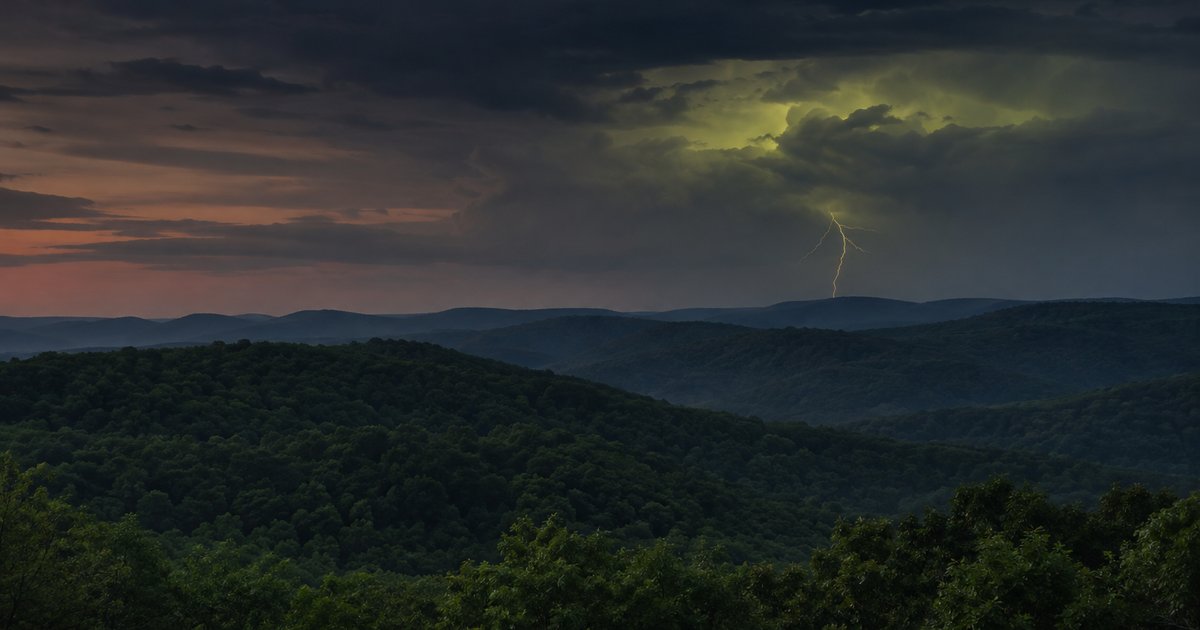
Arkansas recorded 12,229,238 total lightning events in Vaisala Xweather’s 2025 report, fifth among U.S. states and D.C.; its Hazel Valley hotspot shows why a statewide total hides local variation. The National Lightning Safety Council counted two Arkansas lightning deaths in 2016–2025, a different measure and period. For an Arkansas location, start with the serving National Weather Service office and its official outlooks.
What the 2025 count measures
Vaisala Xweather's 2025 annual report counted 12,229,238 total lightning events in Arkansas, fifth among the 50 states and the District of Columbia. Its network includes electrical pulses within clouds and strokes between cloud and ground; a total event is therefore not necessarily a ground strike. Vaisala calls a count the events over a region and density the events per unit of area. That distinction matters when comparing Arkansas with larger states: the count is a year's observed activity across the state, not the chance that lightning will reach one person or one field.
Vaisala's 2019 cloud-to-ground datasheet provides another measure: Arkansas averaged 15.7 cloud-to-ground flashes per square mile per year during 2009–2018, fifth in that older table. Its National Lightning Detection Network measured flashes over land inside state borders. Those are cloud-to-ground flashes across ten years, while the 2025 number includes in-cloud and cloud-to-ground events during one year. The national lightning density rankings need the same unit and period before their figures can be compared.
| Figure | Arkansas | Source and period |
|---|---|---|
| Total lightning events | 12,229,238, fifth among the states and DC | Vaisala Xweather, 2025 |
| Cloud-to-ground flashes per square mile per year | 15.7, fifth in that table | Vaisala datasheet, 2009–2018 |
| Hazel Valley local density | 815 total events per square kilometer, third in the local-density list | Vaisala Xweather, 2025 |
| Lightning deaths | Two | National Lightning Safety Council table, 2016–2025 |
| Lightning deaths and injuries | 128 deaths and 331 injuries | NWS Little Rock, 1959–2023 |
Why Hazel Valley stands out
Vaisala's 2025 report named Hazel Valley, an unincorporated community in northwest Arkansas, the state's lightning capital and third in its U.S. local-density list. Its table gives Hazel Valley 815 total lightning events per square kilometer, or about 2,111 per square mile, in 2025. That is a local density for the report's selected place, not the average for Arkansas. It points to concentrated activity in that one year; it does not make every place in northwest Arkansas equally active or identify the next storm's path.
NWS Tulsa's spring climatology describes eastern Oklahoma and northwest Arkansas as a transition into warmer, more humid weather, with showers and thunderstorms among the region's spring conditions. That regional account helps explain why an Arkansas reader should check the serving office rather than assume that a Little Rock forecast covers the northwest corner. It does not give a lightning count for Hazel Valley or establish a single statewide start date for thunderstorms.
What the Arkansas injury and death records say
NWS Little Rock's Arkansas table records 128 lightning deaths and 331 injuries from 1959 through 2023. The office reports that the casualties occurred mostly in summer; its monthly table puts 37 deaths in June, 32 in July, and 25 in August, while August has the most recorded injuries, 82. Those are historical casualties, not the count of strikes or a prediction for a particular month. A family planning a spring game still needs the day's weather information: the same table includes deaths in March, April, and May.
The National Lightning Safety Council's state table, dated January 6, 2026, records two Arkansas lightning deaths during 2016–2025. Its ten-year period differs from the NWS's 1959–2023 series; the figures should not be added together. The running 2026 lightning death count answers yet another time-window question. A small recent death total does not describe how many thunderstorms occurred or whether a particular outdoor venue has protection.
Arkansas rules for school sports and pools
The Arkansas Activities Association's 2026–27 handbook labels Rule 8 “Required Lightning Guidelines” for its member-school activities. It directs staff to monitor local weather, plan an evacuation, and identify a substantial building or fully enclosed metal vehicle or school bus. When thunder is heard or lightning is seen, Rule 8 says to suspend outdoor play and move to the designated place immediately. Play waits at least 30 minutes after the last thunder or observed lightning, and each new event resets the count. Its optional technology criterion is a detected strike within 10 miles, but the rule says hearing thunder or seeing lightning takes precedence over a device. The school sports lightning delay applies to an organized activity, not every private gathering.
The Arkansas Department of Health's 2026 guidance for commercial pools, spas, and other aquatic facility operators says to close the pool and clear the deck immediately when lightning is observed or thunder is heard. Operators wait at least 30 minutes after the last observed lightning or thunder before reopening. The guidance is for aquatic facilities; it does not set the rule for a school ball field or a boat launch. The pool and water park lightning procedures vary by setting, so operators should use the rule that governs their facility.
Official quick links for a place in Arkansas
NWS Little Rock's county-warning-area page says its office serves 47 Arkansas counties, while Memphis serves 10, Shreveport nine, Tulsa seven, and Jackson two. Use the NWS city or ZIP lookup to find the office above a local forecast; county boundaries can put a nearby town under a different office. The five serving offices are Little Rock, Memphis, Shreveport, Tulsa, and Jackson.
For a broader forecast, check the Storm Prediction Center's convective outlooks; for precipitation, use NWS radar, which is not a lightning-detection display. The Arkansas Activities Association links its current handbook, and the state pool-operator guidance supplies the aquatic-facility procedure. If thunder is audible, follow the NWS instruction to go indoors, regardless of what a nearby lightning display shows.
Lightning Tracker is an iPhone app that shows recent detected strikes and the distance and direction to the nearest one on its map.
Not a substitute for official weather warnings.
If you hear thunder, seek shelter even if the app shows no nearby strike.
Sources
- Vaisala Xweather, The Annual Lightning Report 2025
- Vaisala, Cloud-to-Ground Lightning Data (2009–2018)
- National Lightning Safety Council, Number of Lightning Deaths by State from 2016 to 2025
- National Weather Service Little Rock, Lightning Safety Awareness Week
- National Weather Service Tulsa, Spring Climatology for Eastern Oklahoma and Northwest Arkansas
- National Weather Service Little Rock, County Warning Areas
- Arkansas Activities Association, 2026–2027 AAA Handbook
- Arkansas Department of Health, Guidelines for Arkansas Pools, Spas, and Other Aquatic Facility Operators
- National Weather Service, Contact Us