 Lightning Tracker
App Store
Places and activities
Lightning in Texas: counts, seasons and official checks
November 19, 2026 · 5 min read
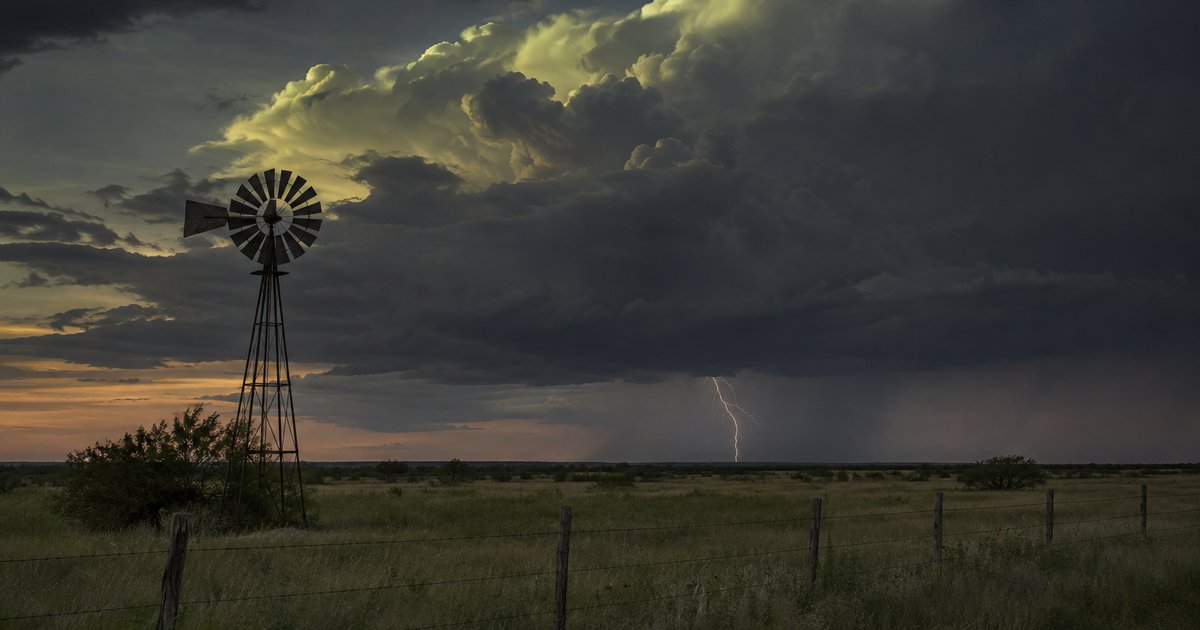
Texas led the US in Vaisala Xweather’s 2025 count with 47,361,143 total lightning events, but that annual count does not say when or where a particular Texas venue will see a storm. The National Lightning Safety Council recorded 21 Texas lightning deaths in 2016–2025; local NWS offices and the venue’s own rules are the route from those historical figures to decisions on a specific day.
What the Texas counts measure
Vaisala Xweather's 2025 report ranks Texas first among the states and Washington, DC, with 47,361,143 total lightning events. Its network counts individual in-cloud pulses and cloud-to-ground strokes within flashes. A flash can contain several strokes, so an event total is not a count of places hit on the ground. The same report puts Florida second by total count, at 20,034,067, and says Florida led by density. For a broader explanation of what lightning totals count, the distinction between events and ground flashes matters more than the rank alone.
A different Vaisala datasheet, updated February 2019 and hosted by the National Weather Service, measured cloud-to-ground flashes over state land areas in 2009–2018. It reports a Texas average of 2,923,584 such flashes per year and 11.0 per square mile per year, ranking Texas fifteenth by that density. Florida's corresponding density was 20.8. Those older figures describe ground flashes over ten years, while the 2025 number includes in-cloud activity and counts individual events in one year. Neither can be substituted for the other. Texas's first-place total does not mean every Texas location has the nation's highest lightning exposure; the state density rankings answer a different question.
The National Lightning Safety Council's state table records 21 lightning deaths in Texas from 2016 through 2025, second to Florida's 51 in that table. The table counts deaths, not detections, injuries, the number of storms, or an individual's chance of being struck. Its ten-year span also differs from the one-year Xweather count. A large state total is useful context for planning, but the decision for any outdoor activity depends on the storm near that venue and its route to shelter.
| Figure | Texas | Source and period |
|---|---|---|
| Total lightning events | 47,361,143, first among the states and DC | Vaisala Xweather, 2025 |
| Cloud-to-ground flash density | 11.0 per square mile per year, fifteenth | Vaisala datasheet hosted by the NWS, 2009–2018 |
| Lightning deaths | 21, second to Florida’s 51 | National Lightning Safety Council table, 2016–2025 |
Texas does not have one storm season
The National Weather Service's Amarillo climate narrative says three-fourths of that area's average precipitation falls from April through September, generally with thunderstorms. It describes warm-season storms with hail, lightning and damaging wind, especially in spring. A dryline can form where moist air arriving from the southeast meets warm, dry air from the southwest; the office says thunderstorms can develop near it in spring and early summer. That is a Panhandle pattern, not a calendar for all of Texas.
The NWS Houston/Galveston office's 2017 lightning campaign describes a different Gulf Coast context. It says southeast Texas averages 50 to 60 thunderstorm days per year and that lightning casualties near the Gulf Coast can occur at almost any time of year. The page identifies summer late afternoon and early evening as common times for casualties nationwide, which is not a Texas strike-by-hour dataset. A North Texas, Panhandle or coastal plan should therefore begin with its own local forecast and shelter plan rather than treating one statewide season as a stop or start date.
What Texas organizations tell outdoor groups
The University Interscholastic League (UIL) publishes a lightning standard for outdoor practices and contests at its member schools. The UIL says a designated person should monitor conditions and have authority to start suspension and evacuation. When schools use lightning-detection technology, the UIL recommends suspending activity for lightning detected within 10 miles of the venue. Its return conditions require no lightning detected within that radius and at least 30 minutes since the last strike there; its broader return-to-play rule resets the 30-minute clock after observed lightning or thunder. A detected strike within the radius restarts the wait, even if the prior clock was almost finished.
When that technology is unavailable, the UIL says a flash-to-bang count of 30 seconds or less, about 6 miles, is a suspension trigger. It calls for a substantial building with plumbing or wiring, or a fully enclosed metal-roofed vehicle, and says dugouts, bleachers and tents do not qualify as shelter. These are UIL school procedures, not a statewide rule for every Texas field or event. At another venue, a named decision-maker, a place for the entire group to go, and enough time to get there still matter; the outdoor event plan depends on that venue's own procedures.
Texas Parks and Wildlife's June 2022 Texas Outdoor Family policy is narrower still: it governs that program's workshops. Its staff are told to take shelter when strikes are within 10 miles of the camping area and to remain sheltered until 30 minutes after the last thunder before resuming outdoor activities. Its published policy does not set the operating rule for all Texas state parks or private camps. Participants should follow the instructions for their actual program and location.
Official quick links for a Texas location
The NWS says to enter a city and state or ZIP code in its local forecast search, then use the serving-office link above the forecast. Texas has multiple offices: the NWS Southern Region directory lists Amarillo, Austin/San Antonio, Brownsville, Corpus Christi, Dallas/Fort Worth, El Paso, Houston/Galveston, Lubbock, Midland/Odessa and San Angelo in Texas, while offices headquartered across state lines also serve border areas. A fixed statewide office link can therefore send a reader to the wrong forecast area. The ways to check nearby lightning differ in what they show.
- Find your serving NWS office by city or ZIP — local forecast, alerts and office contact.
- NWS Southern Region office directory — Texas offices and neighboring offices.
- Storm Prediction Center convective outlooks — official severe-storm outlooks; check the issue time and area.
- NWS radar — precipitation, not a plot of lightning detections.
- Texas Division of Emergency Management preparedness — state preparedness resources.
- UIL lightning rule — the school-activity procedure described above.
Lightning Tracker is an iPhone app that shows recent detected lightning and the distance to the nearest detection. Its alerts can be set for a chosen radius around the current location in the free version, and Premium adds up to 5 saved places; official warnings and venue procedures still govern decisions.
Not a substitute for official weather warnings.
If you hear thunder, seek shelter even if the app shows no nearby strike.
Sources
- Vaisala Xweather, The Annual Lightning Report 2025
- National Lightning Safety Council, Deaths by State from 2016 to 2025
- Vaisala, Cloud-to-Ground Lightning Data 2009–2018
- National Weather Service Amarillo, Climate Narrative for Amarillo
- National Weather Service Houston/Galveston, Spring Weather Safety Campaign: Lightning
- University Interscholastic League, Lightning Safety
- Texas Parks and Wildlife Department, Texas Outdoor Family Weather Cancellation and Lightning Safety Policy
- National Weather Service, Contact Your Local NWS Office
- National Weather Service, Weather Forecast Offices