 Lightning Tracker
App Store
Places and activities
Arizona lightning in the monsoon: when storms arrive and why dry strikes matter
November 19, 2026 · 9 min read
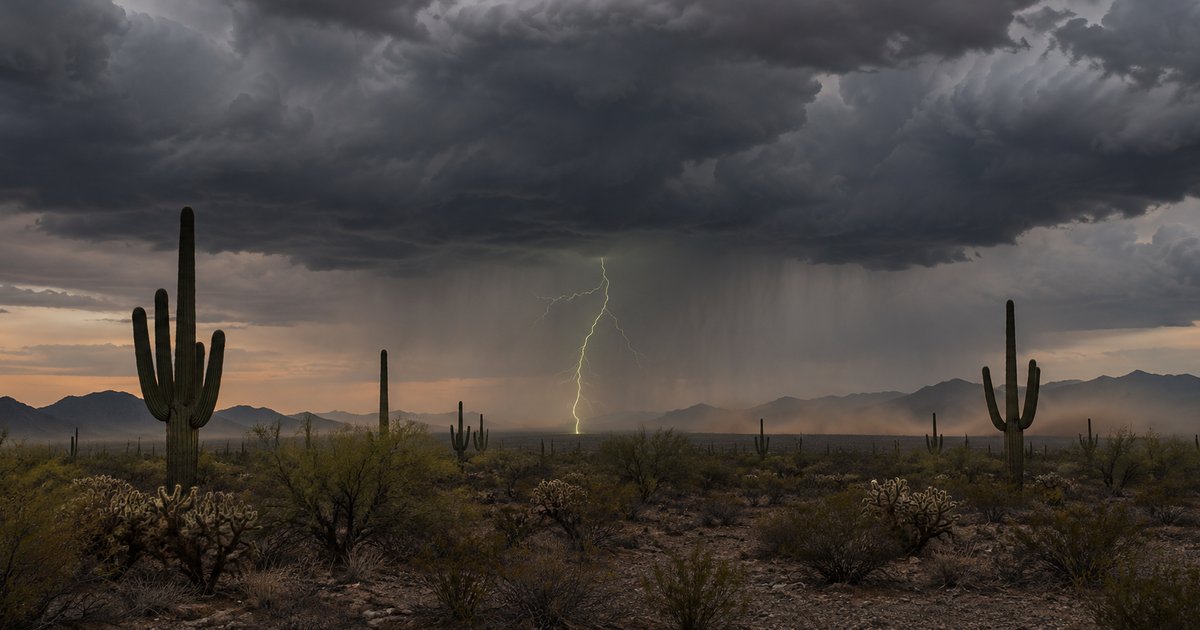
Arizona lightning is closely tied to the monsoon season, officially June 15 to September 30; its thunderstorms mostly arrive in the afternoon and evening once moisture reaches the state in late June or early July. Some leave little rain on the ground, so rain is not a lightning warning: the National Weather Service offices in Tucson and Phoenix both say lightning can strike away from rain, and that thunder means go inside.
The Arizona monsoon is a season, and its June 15 start date is a convention
Arizona’s monsoon is a season, not a single storm. The School of Geographical Sciences and Urban Planning at Arizona State University says so in one line: “A monsoon is a season; a monsoon is NOT a thunderstorm.” The same page says Arizona weather agencies and researchers set the season as June 15 to September 30 in 2008, so that information could be lined up across states, much like the Atlantic hurricane season. The National Weather Service in Tucson says the Southwest’s forecast offices defined those dates together, and the University of Arizona Cooperative Extension gives the same ones.
The dates do not say when storms begin. The National Weather Service in Flagstaff says monsoon moisture typically does not reach northern Arizona until the first week of July, and that many factors in spring and early summer decide the exact start each year. The Cooperative Extension says the wind shift that brings moisture up from Mexico can start anywhere from early to mid-summer, with summer rains typically starting in late June to early July. Arizona State University adds an older working rule for Phoenix: the monsoon counted as started after three or more consecutive days with dew points averaging 55°F or higher. The dew point is the temperature at which condensation begins, so a higher one means more moisture available to build storms.
Moisture arrives when the high-pressure ridge moves north, and storms then come in bursts and breaks
The National Weather Service in Flagstaff explains why June is usually dry: a strong subtropical ridge of high pressure sits over Mexico and blocks moisture from moving north, so northern Arizona normally sees some of its hottest and driest weather of the year. In late June and early July the ridge shifts north, and moisture follows. That office names the Gulf of California and the eastern Pacific Ocean as the two main sources for northern Arizona; the University of Arizona Cooperative Extension says the flow pulls moisture mostly from the Pacific but also from the Gulf of Mexico.
Once the moisture is in, storms do not come every day. Arizona State University describes “bursts,” brief periods of heavy thunderstorm activity with strong heating and southerly moisture flow, and “breaks,” brief periods with little or none, which it ties to the ridge stabilizing the atmosphere. The Flagstaff office adds that every season differs in almost every respect, from its start and end to where the heaviest rain falls.
Arizona storms usually build from early afternoon and can reach Phoenix in the evening
The sources give different clocks for different places, and the table puts them side by side. All of them describe tendencies of the monsoon’s afternoon thunderstorms, not a schedule for any one storm.
| Where | What the source says | Source |
|---|---|---|
| High mountains of the Southwest | The first flashes of the day came between 10 a.m. and noon local mean time, which follows the sun; on an Arizona clock that is about 10:30 a.m. to 12:30 p.m. (our arithmetic) | Holle, 2006–2010 data |
| Tucson area | Summer thunderstorms typically form in the early to mid-afternoon | NWS Tucson |
| Phoenix area | Afternoon storms along the Mogollon Rim can sometimes move down into the area, bringing storms later in the evening | Arizona State University |
| Higher elevations | Avoid being outside between mid afternoon and mid evening, especially at higher elevations, where lightning is more common | NWS Phoenix and NWS Tucson |
Arizona State University calls monsoon thunderstorms convective, powered by intense surface heating, and names the Mogollon Rim in central Arizona as a lifting mechanism that forces warm, moist air to rise. The Phoenix office notes that some of the region’s worst flash floods have come in the middle of the night, so afternoon is the common hour and not the only one. For mountain trips, the Tucson and Phoenix offices both tell hikers and mountain bikers to get out earlier in the day to avoid flash flooding and lightning.
Arizona ranks 34th for lightning density, and its peak months are July and August
Arizona is not near the top of the lightning density list. A Vaisala datasheet hosted by the National Weather Service counted total lightning over land within each state for 2015 through 2019. Arizona averaged 3,218,418 a year, or 28.2 per square mile, which ranks 34th on the datasheet’s density list. Florida ranks first at 244.1 per square mile and Oklahoma second at 213.8. Arizona State University says Arizona is well known for high-based thunderstorms, which give an easier view of cloud-to-ground lightning.
The seasonal peak is sharp. Holle, Cummins and Brooks mapped National Lightning Detection Network flashes for 2005 through 2014 and found that Arizona and portions of adjacent states have the highest incidence in July and August. Arizona State University likewise says Arizona tends to have more lightning in July. For a season’s own record, the National Weather Service in Tucson posts charts of cloud-to-ground strike counts for southeast, central and northern Arizona, from Vaisala’s network, updated around 5 p.m. daily as of November 2026.
Monsoon storms can strike with little rain, so rain is a poor cue
Arizona State University says dry thunderstorms are especially common before the monsoon season is fully established, and that such a storm might not drop enough rain to put out a fire its lightning started. The Phoenix office says that as the monsoon arrives, an increased threat of lightning comes with it. The Tucson office is plainer about rain: it does not have to be raining for you to be struck by lightning.
The offices also give distances, and they do not measure from the same point:
| Page | Distance | Measured from |
|---|---|---|
| NWS Phoenix, Monsoon Safety | Up to 60 miles | The nearest rainfall |
| NWS Tucson, Monsoon Safety | Up to 10 miles | The parent storm |
| NWS, Lightning Myths | Often more than 3 miles; “bolts from the blue” 10 to 15 miles | The center of the thunderstorm |
The Phoenix page cites no study for its 60-mile figure, and the three pages cannot be merged into one number. What they share is the rule. The Tucson page says that if you can hear thunder, you are close enough to be struck, the Phoenix page says the same, and both say to stay inside until 30 minutes after the last rumble of thunder.
Dry strikes start fires early in the monsoon, and one lightning fire can dominate a year’s acres
The National Weather Service in Flagstaff says fire season in northern Arizona normally peaks near the end of June, and that the start of the monsoon continues the threat because fire starts from dry lightning are common. After one to two weeks of widespread rain in early to mid July, it says, the fire threat is greatly reduced in most years. The Arizona Department of Forestry and Fire Management makes the same seasonal point in slides hosted by the Arizona State Climate Office: lightning-caused fires are more prevalent from June onward because of the monsoonal buildup. The Phoenix office adds a balance: lightning with little rainfall starts many wildfires each year, but humans are the number one cause.
The Southwest Coordination Center of the National Interagency Fire Center tabulates each fire year by cause and dispatch area. Adding the 2025 report’s Arizona areas, the ones with codes starting AZ, gives 474 lightning-caused fires on about 220,000 acres and 999 human-caused fires on about 51,000 acres. The sums are this article’s arithmetic, not the report’s. One fire, Dragon Bravo, is listed as lightning-caused, with a July 4 start and 145,504 acres, roughly two-thirds of the lightning acres. The report does not say whether any of the lightning came with rain.
Arizona monsoon storms push out dust and wind, and the National Weather Service issues no lightning warning
The National Weather Service in Tucson says warnings are not issued for lightning, mainly because most thunderstorms, no matter how weak, produce deadly cloud-to-ground lightning. It does issue warnings for what else the storms do. A Severe Thunderstorm Warning in the Tucson office’s wording means damaging winds of 60 mph or greater are about to occur or underway, and it notes that heavy rain does not always accompany a severe thunderstorm.
Thunderstorm winds can lift dust. The Tucson office says straight-line winds in any thunderstorm can lift huge clouds of it, and Arizona State University explains that a storm’s downdrafts hit the ground and are forced out ahead of it as a gust front, which in the desert can carry a large wall of dust and sand. The Phoenix office says a dust storm usually arrives suddenly as an advancing wall of dust that may be miles long. The Tucson office also says thunderstorm gusts in Arizona almost always exceed 40 mph, that straight-line winds can travel dozens of miles from the storm that produced them, and that dust storms are more common early in the monsoon but can come at any time thunderstorms are near. Read together, as this article’s inference, a wall of dust or a sudden wind shift tells you a storm is nearby, not where its lightning is. A day with no warning in effect says nothing about lightning either.
Arizona’s lightning deaths are few, and they cluster in July
The National Lightning Safety Council’s Arizona list for 2006 through 2025 has 18 deaths. By this article’s reading of the list’s dates, all fall between June 27 and September 20, nine of them in July. The council’s table of deaths by state for 2016 through 2025 shows one Arizona death, against a U.S. total of 196, and its table of the most recent death in each state, current through December 31, 2025, gives Arizona as Coconino County on July 20, 2016. Arizona State University says all Arizona lightning deaths in the last 30 years happened outdoors, such as while hiking or camping.
Arizona’s short death list does not mean low exposure. The council’s March 2026 analysis of U.S. lightning deaths from 2006 through 2025 says that, based on media reports, many victims were headed to safety when struck or were just steps away from it. The National Weather Service in Tucson gives substantial buildings and fully enclosed metal-topped vehicles as the locations that protect best, and says no place outside protects you from a lightning strike.
What Lightning Tracker adds on a monsoon afternoon
Lightning Tracker is an iPhone app, free on the App Store, that shows recently detected strikes on a live map, with the distance and direction to the nearest one and how many minutes ago it was detected. It watches your current location for free; Premium adds up to five saved places, such as a trailhead near Flagstaff. It alerts you when a strike is detected inside the radius you set for each place, 10 miles (16 km) by default. Because that trigger is a detected strike, rain at your location does not decide it. Premium also shows a thunderstorm forecast for several days with a daily probability. Detection networks miss some strikes, especially weak ones, and data can arrive late; the app labels delayed or missing data instead of treating it as quiet. It does not replace official warnings or local procedures.
Not a substitute for official weather warnings.
If you hear thunder, seek shelter even if the app shows no nearby strike.
Sources
- National Weather Service Flagstaff, Northern Arizona Monsoon Season
- National Weather Service Tucson, Monsoon Safety
- National Weather Service Tucson, Monsoon (lightning chart)
- National Weather Service Phoenix, Monsoon Safety Page
- National Weather Service, Lightning Myths
- Arizona State University, School of Geographical Sciences and Urban Planning, Basics of the Arizona Monsoon & Desert Meteorology
- University of Arizona Cooperative Extension, Monsoon
- Holle, Cummins and Brooks, Monthly Weather Review, Seasonal, monthly, and weekly distributions of NLDN and GLD360 cloud-to-ground lightning (2016)
- R. L. Holle, American Meteorological Society, Diurnal variations of NLDN-based lightning activity (2013, PDF)
- Vaisala, hosted by the National Weather Service, Total Lightning Counts by State, 2015 to 2019 (datasheet, PDF)
- Arizona Department of Forestry and Fire Management, hosted by the Arizona State Climate Office, 2024 Arizona Fire Season Outlook (slides, PDF)
- National Interagency Fire Center, Southwest Coordination Center, Southwest Area Annual Report: 2025 Fire Year (PDF)
- National Lightning Safety Council, Arizona Lightning Fatalities, 2006-2025 (PDF)
- National Lightning Safety Council, R. Holle, Number of Lightning Deaths by State from 2016 to 2025 (PDF)
- National Lightning Safety Council, Most Recent Lightning Fatality by State (PDF)
- National Lightning Safety Council, J. Jensenius, A Detailed Analysis of Lightning Deaths in the United States from 2006 through 2025 (PDF, March 2026)