 Lightning Tracker
App Store
Places and activities
Utah thunderstorms and lightning: seasons, counts and official checks
November 19, 2026 · 5 min read
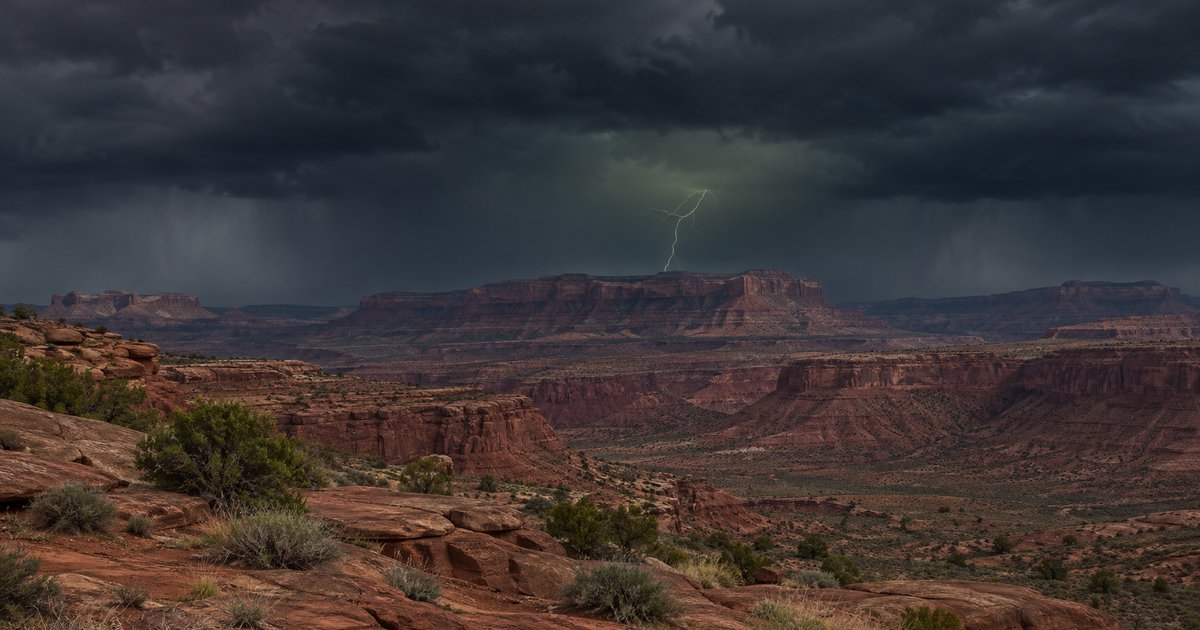
Vaisala Xweather counted 559,532 total lightning events in Utah in 2025, while the National Lightning Safety Council recorded two Utah lightning deaths over 2016–2025. Those are different historical measures; for an outdoor plan, Utah’s regional storm patterns, the serving NWS office and the location’s shelter procedure matter more than either statewide number.
Utah lightning strikes and deaths: what the counts measure
Vaisala Xweather’s Annual Lightning Report 2025 places Utah thirty-eighth among the states and Washington, DC, with 559,532 total lightning events. The company counts individual electrical pulses within clouds and strokes between clouds and ground; several strokes may belong to one flash. The figure therefore does not mean that 559,532 Utah sites were struck. Its annual statewide total also cannot tell a hiker what is happening near a trail. The distinction behind what lightning totals count matters before comparing Utah with another state or year.
The National Lightning Safety Council’s state table records two Utah lightning deaths across 2016–2025. That is a count of people who died, not a count of strikes, injuries or storms. The ten-year fatality window and the single-year Xweather detection window measure different things, so dividing one by the other would not produce an individual risk estimate. Nor does a low statewide total tell a group whether a particular exposed location has shelter nearby.
When do Utah thunderstorms occur?
The National Weather Service office in Grand Junction says the Southwest monsoon generally begins around the second week of July in eastern Utah and western Colorado. It usually ends by late August, but may last into October; parts of southeast Utah can have a second precipitation maximum in October from tropical moisture. The office also warns that high-based storms in June can produce evaporating rain and gusty surface winds before the monsoon begins. A June thunderstorm in eastern Utah should not be dismissed merely because the seasonal label has not started.
The same Grand Junction page describes bursts and breaks: monsoonal flow does not make thunderstorms every day. Its timing covers eastern Utah and western Colorado, not every valley in the state. The National Park Service says July through September is the usual monsoon period for Arches, Canyonlands, Hovenweep and Natural Bridges, with afternoon thunderstorms most frequent then. That park guidance also says thunderstorms with lightning and flash floods can happen at other times of year. These two official descriptions use different areas and purposes, so their date ranges are context rather than a trip forecast.
Utah State Parks’ Kodachrome Basin page, last updated September 4, 2026, names late June through early September as the park’s hottest stretch and warns that summer thunderstorms can bring heavy downpours, extreme winds, lightning and flash flooding. That is one park’s seasonal guidance, not a measurement of every Utah county. The national lightning pattern cannot replace a forecast for a Utah trailhead.
Park canyons add a second storm hazard
The National Park Service’s monsoon guidance for four southeast Utah park units advises finishing hikes in the morning and leaving canyons or washes before afternoon storms. Rain can send water downstream from a storm miles away, so a dry sky directly over a canyon does not rule out a flash flood there. For lightning, the same NPS page says to go indoors during a thunderstorm. A narrow canyon, exposed slickrock and a parked vehicle are different situations; the guidance to leave washes addresses floodwater, while Utah Emergency Management’s lightning advice directs people to a sturdy building or a hard-topped vehicle when thunder is heard.
Zion National Park’s July 29, 2026 monsoon notice likewise describes clear mornings changing rapidly into afternoon thunderstorms during July through September. It warns that rainfall upstream can reach the Narrows even when visitors do not see that rain. These park warnings are reasons to check conditions for the actual route and its upstream drainage, not evidence that every Utah afternoon will storm. In drier periods, lightning with little ground rain can still be a fire concern: Utah Emergency Management says wildfires can start from lightning, while the Grand Junction office distinguishes high-based pre-monsoon storms from the later moist monsoon pattern.
Utah school contests have a specific suspension procedure
The Utah High School Activities Association’s 2026–27 handbook says a host school at a UHSAA-sanctioned outdoor event must name a weather monitor. Before the contest, that person meets the head official to discuss the NFHS lightning guidelines, responsibilities and possible suspensions; the head official consults the monitor about suspension. These are association procedures for sanctioned events, not rules for every private hike, festival or recreation league. Other organizers need their own outdoor event shelter plan.
The handbook’s lightning guidance calls for immediate suspension and shelter when thunder is heard or cloud-to-ground lightning is seen. After suspension, it says to wait at least 30 minutes after the last thunder or visible lightning before resuming; another occurrence resets that clock. Its advice names sturdy buildings, or a hard-top vehicle with windows closed if a building is unavailable, and rejects sheds, dugouts and bleachers as shelters. The association’s clock is a restart rule, not a prediction that a storm has ended.
Utah thunderstorms today: official warnings and lightning checks
The NWS directs readers to search a city and state or ZIP code and follow the serving-office link above the local forecast. For Utah County or a city such as Lehi or Layton, enter the exact place rather than assume one statewide office. NWS Salt Lake City serves southwest Utah, while Grand Junction issues forecasts for eastern Utah; a place lookup identifies the office for a particular address. The ways to check nearby lightning have different measurements and delays.
For “Is there a storm in Utah today?” or a “Utah thunderstorm warning” search, use that NWS place forecast and its warnings, then check the Storm Prediction Center outlook for the broader storm setup. The NWS Salt Lake City office has a watches, warnings and advisories page for its area. A severe thunderstorm warning is not a lightning alarm: the NWS says the severe criteria involve hail at least 1 inch across or winds of at least 58 mph, while every thunderstorm has lightning. If thunder is audible, follow Utah Emergency Management’s direction to get into a sturdy building or hard-topped vehicle even without a severe warning.
This article site has no live Utah lightning map or current strike count. For the map wording, the NWS Grand Junction archive offers dated daily lightning graphics for its region, while NWS radar shows precipitation rather than lightning detections.
- NWS local forecast and serving office lookup — enter the actual city or ZIP.
- NWS Salt Lake City and NWS Grand Junction — offices serving Utah areas.
- NWS Salt Lake City watches and warnings — check the affected area and issue time.
- Storm Prediction Center convective outlooks — official storm outlooks by issue time and area.
- NWS radar — precipitation, not lightning detections.
- NWS Grand Junction lightning archive — dated, daily cloud-to-ground and satellite flash graphics for its region, not a live statewide map.
- NPS southeast Utah park guidance and Utah Emergency Management protective actions — local outdoor procedures.
Lightning Tracker is an iPhone app that shows recent detected lightning on a map and the distance to the nearest detection. It works in Utah and elsewhere; detections supplement official warnings and local procedures.
Not a substitute for official weather warnings.
If you hear thunder, seek shelter even if the app shows no nearby strike.
Sources
- Vaisala Xweather, The Annual Lightning Report 2025
- National Lightning Safety Council, Number of Lightning Deaths by State 2016–2025
- National Weather Service Grand Junction, Monsoonal Information
- National Park Service, Monsoon Season
- Utah State Parks, Kodachrome Basin Current Conditions
- National Park Service Zion, Visiting Zion National Park During Monsoon Season
- Utah Emergency Management, Protective Actions
- Utah Emergency Management, Wildfire
- Utah High School Activities Association, 2026–27 Handbook
- National Weather Service, Contact Your Local NWS Office
- National Weather Service Salt Lake City, Watches, Warnings and Advisories
- National Weather Service, Hazardous Weather Definitions
- National Weather Service Grand Junction, Local Forecasts
- National Weather Service, Southwest Utah Local Forecast
- National Weather Service, Basics of Weather Radar
- National Weather Service Grand Junction, Lightning Archive