 Lightning Tracker
App Store
Places and activities
Rock climbing in thunderstorms: why the descent is the problem
November 19, 2026 · 10 min read
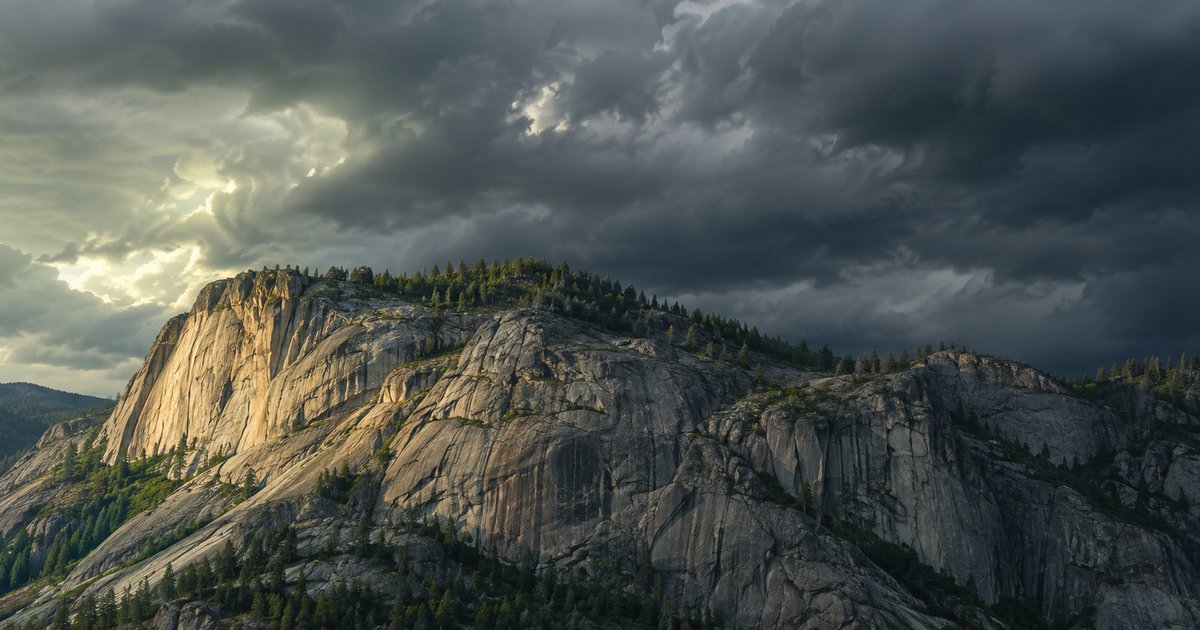
A thunderstorm is harder on a rock climber than on a hiker because a climber on a wall cannot leave in minutes, wet rock and ropes can carry current, and ledges and summits offer no cover. The National Weather Service says no place outdoors protects you from lightning, so the sources here ask climbers to be off exposed rock early in the day and to start down at the first thunder.
A climber needs more time to leave a wall than a storm may give
The National Weather Service says you can normally hear thunder about 10 miles (16 km) from a strike, and that lightning can strike outward 10 miles from a thunderstorm, so hearing thunder means you are likely within striking distance. Hikers above treeline can answer that by walking down. A climber partway up a long route has no such quick exit, and the accident reports and the study below describe what that has cost.
The American Alpine Club’s 2004 edition of its annual accident report describes a July 26 strike on the Exum Ridge of the Grand Teton, a Wyoming route. Lightning hit at 3:35 p.m. and fatally injured one climber; the same strike injured seven others, five of them seriously, in a group of 13. The year was 2003 by our reading, since the report’s editor’s note cites a July 30, 2003 newspaper story. The Grand Teton National Park staff member who wrote the analysis said the fatal strike was reportedly the first lightning from its storm cell, with no audible thunder as the cell approached. He judged it doubtful that the group could have moved off the mountain fast enough even if thunder had sounded 20 to 40 minutes before the storm reached the peak, and he noted how hard it is for 13 people to climb quickly.
A 2022 paper in the International Journal of Environmental Research and Public Health points the same way for the Alps. Using the Swiss Alpine Club’s rescue registry, it counted 15 lightning cases among 4,687 high-altitude mountaineering emergencies from 2009 to 2020, or 0.32 percent. Two were fatal, and in both the rope partners were seriously injured by flashovers. The cases were mainly on popular high peaks such as the Matterhorn and the Eiger. The author wrote that on an exposed ridge, seeking shelter quickly during a sudden weather change is sometimes simply impossible, so prevention has to happen in the planning, with the forecast.
The International Commission for Alpine Rescue and the medical commission of the UIAA, the international climbing federation, published guidelines in 2005 that add a rule for resuming. They say the beginning and the end of a storm are the most dangerous times, and that climbing should not resume until 30 minutes have elapsed after the last lightning and thunder.
Sources put the deadline between noon and 2 p.m., and storms have beaten it
Clock advice for mountain climbs differs by source, and as of November 2026 the pages compare as follows.
| Source | What it says about the day’s clock |
|---|---|
| National Weather Service (outdoor scenarios page, undated) | In mountainous areas thunderstorms typically develop in the early afternoon: be down the mountain by noon. |
| Yosemite National Park (page updated January 21, 2025) | Plan to climb above treeline in the morning and to summit peaks before noon. |
| American Alpine Club, “Essentials” article (2020 edition) | Be off summits and ridgelines no later than 2 p.m., and ideally by noon. |
| Climbing magazine (July 3, 2023) | Aim to be on the summit by 10 a.m. and off by noon. |
| NPS pages for Arches (June 2, 2026), Devils Tower (April 27, 2026) and Grand Teton (June 9, 2026) | Storms develop quickly or pop up without warning; no clock time is given. |
The clocks assume the usual pattern, and the accident reports show it breaking. The 2000 edition of the American Alpine Club’s report printed a Grand Teton entry about two climbers struck at about 11:30 a.m. on the Exum Ridge, and its editors noted that lightning in that range is less common in the mornings. The 2011 edition describes a storm that its timeline places on July 21 and that caught three parties of climbers on the Grand Teton. One survivor’s letter in the report puts the first strike close to 10:30 a.m., and the park’s account puts a series of very strong bolts at about 12:15 p.m. The park’s conclusion was that storms at other times of the day are not rare and are often missed by professional forecasters. A Yosemite Search and Rescue post of August 25, 2020 gives a trigger that does not depend on the clock: at the first sound of thunder, immediately descend from exposed summits, high ridges and open granite slabs.
Two reports describe climbers who waited and climbers who pressed on
That 2011 Grand Teton report says all three parties saw clouds building from a relatively clear morning sky. Two of the parties decided to wait out what they expected to be a quick disturbance, and huddled near rock alcoves. The park’s analysis says this put them near walls and overhangs, where electrical currents are more likely, and that the third party, which had decided earlier to descend, was still caught by the storm. One climber was thrown off the cliff and died. The report’s editors called it the Jenny Lake rangers’ largest rescue: over nine hours, seven people were flown from 13,200 feet (4,023 meters), nine more from other locations, and 92 emergency workers became involved.
A Yosemite Search and Rescue post dated August 25, 2020 summarizes an earlier case from June 2000 on Cathedral Peak, which the American Alpine Club’s 2001 edition covers in full. A party of three began a six-pitch climb at 10 a.m., two hours later than planned, and after the third pitch saw rain in the distance. They chose to press on rather than retreat. Rain and hail reached them on the last pitch and the rock around them began to buzz. Two of the three took shelter under a small overhang about 20 feet (6 meters) from the third, and a strike then knocked the third climber unconscious. He began to regain consciousness about seven minutes later, and rangers reached the party about three and a half hours after the strike. The climbers’ own analysis blamed the lack of a current forecast and of any plan for turning back once the climb began, and concluded that they raced for the summit instead of retreating.
Summits, ledges and small overhangs: no agency counts any of them as shelter
The American Alpine Club’s 2020 article says lightning is more of a possibility for climbers than for most people because of where they go: ridges, mountaintops and rock faces. A 1962 article in the club’s journal explains the reason in engineering terms: a prominent peak or exposed ridge acts like the air terminal of a lightning rod, and a mountaineer standing exposed on one may receive a stroke. The Swiss paper found a considerable number of its cases on highly exposed terrain, such as ridges on the Eiger and the Matterhorn, and the editors of the club’s 2000 edition called the Exum Ridge a particularly exposed place.
The National Weather Service tells people to run to a substantial building or hard-topped vehicle and says that no place outside protects you when thunderstorms are in the area. Its guidance for cave visitors adds that small overhangs can allow arcs to cross the gap. Rocky Mountain National Park says never to use a cliff, cave or rock overhang to shelter, because lightning can travel through the rock, bounce and strike you. A Mountain Climbing handout from Glacier National Park, with a file name dated 2016, says to get off the rocks immediately when there is any possibility of lightning. The alpine rescue guidelines of 2005 go further for the mountains: small caves, overhangs and wet stream beds may be more dangerous than open areas.
Wet rock, cracks and ropes give current more routes to a climber
The American Alpine Club’s 1962 journal carried an article by an electrical engineer at the National Bureau of Standards, and it is the most detailed description of current on rock in these sources. He wrote that current from a struck rock takes the easiest path, usually over the surface and downward on firm rock, especially when wet. He listed lichen patches and cracks that hold moisture, mineral salts, soil and plant roots as routes that most of the current may follow, and he gave a body resistance of about 100,000 ohms hand to hand when dry and 5,000 or lower when wet and salty. The author called his distance figures educated guesses, and the article is more than 60 years old, so treat it as an explanation of the mechanism, not as a current standard.
Newer sources agree on the mechanism. The 2022 Swiss paper says that on rocky ground the lightning current can spread over long distances and that, when a mountaineer touches rock, part of it can flow over the body. The alpine rescue guidelines of 2005 say lightning currents can follow ropes, especially wet ones, and they list blunt injury as a mechanism: current-induced muscle contractions can make mountaineers lose balance and fall. The Weather Service tells campers to stay away from wet items such as ropes. A 2020 American Alpine Club article by an emergency physician names ground strikes, where rock is struck and the current travels across or through it, as a particular risk to climbers, and says strikes can knock a climber off a ledge. This ground-current route is one of the five ways lightning strikes people. Park pages for Arches and Devils Tower list slippery surfaces among the effects of storms.
The Weather Service and climbing sources disagree on crouching and on metal gear
The Weather Service stopped recommending the crouch in 2008, and several climbing sources still describe a version of it. The table sets each next to the NWS position as of November 2026.
| Source | On crouching | On metal gear |
|---|---|---|
| National Weather Service (undated pages) | The crouch does not provide a significant level of protection; a channel arriving from overhead is very likely to strike whether you stand or crouch. | Metal makes no difference to where lightning strikes; do not waste time removing it. It does conduct current, so stay away from metal fences and railings. |
| Yosemite National Park (January 21, 2025) | As a last resort, crouch on your toes with your hands over your ears; do not lie flat. | Avoid tall, isolated trees, water, metal and power lines. |
| American Alpine Club article (2020 edition) | When hair rises, metal buzzes or a storm closes in fast, crouch with feet together and ears covered, on a pad if you have one. The author puts “safety” in quotation marks. | Get away from any metal climbing gear. |
| Alpine rescue and UIAA guidelines (2005) | Crouch immediately if your hair stands on end. | Remove and store all metal objects, such as carabiners and ice axes. |
| Climbing magazine (July 3, 2023) | Assume the lightning position if hair rises or gear vibrates; never lie flat. | Gear is not especially likely to attract lightning; get to shelter first, and shed it only if the storm overtakes you. |
The Weather Service says it focuses on how to avoid the dangerous situation, and how to get out of it, rather than on what to do inside it. Its myths page says crouching does not make you any safer outdoors, and that when no building or vehicle is within reach there is no other good alternative. No source in this comparison measures how much a crouch helps. The 1962 article’s author wrote, like the Weather Service, that metal as such does not attract lightning, and the American Alpine Club’s 2020 article says that no outside place protects you apart from a protected shelter or vehicle.
The sources give no count of how many U.S. climbers lightning has killed
The National Lightning Safety Council’s March 2026 analysis of U.S. deaths from 2006 through 2025 lists shares for camping (7 percent) and hiking (3 percent) among leisure activities, but has no line for climbing, so no climbing count can be taken from it. The American Alpine Club’s table of reported accidents in its 1999 edition covers 1951 through 1998 and attributes 39 U.S. accidents to lightning, against 2,471 to falls or slips on rock; it lists none for 1998. The 1962 article opened by saying statistics show lightning is not one of the major hazards of mountaineering. The records are small and uneven. Even so, one strike on the Exum Ridge injured seven climbers besides the one it killed, and the fatal Swiss cases also injured rope partners.
A struck climber may not know it, and help can be hours away
The American Alpine Club’s 2005 edition has a report from North Carolina’s Linville Gorge, where a climber on a belay ledge was found face down and regaining consciousness, with blood on his face. He was wearing a helmet and his head was uninjured. After two CT scans, and with the clue of a shoe blown off his foot, he concluded that lightning had struck him. The club’s 2020 article says everyone who has been struck should be evaluated medically. The Arches page says cell service in the park is limited, asks climbers to plan for self-rescue, and warns that help may not arrive on scene for several hours.
Lightning Tracker is an iPhone app that alerts you when a strike is detected inside a radius you set for each place; detection networks miss some strikes, data can arrive late, and the app does not replace official warnings.
Not a substitute for official weather warnings.
If you hear thunder, seek shelter even if the app shows no nearby strike.
Sources
- National Weather Service, Understanding Lightning Science
- National Weather Service, Lightning guidance for camping, climbing and other wilderness activities (outdoor scenarios page)
- National Weather Service, Lightning Tips
- National Weather Service, Lightning Myths
- National Weather Service, The NWS stopped recommending the crouch in 2008
- National Park Service, Yosemite National Park, Lightning Safety
- National Park Service, Yosemite Search and Rescue, Lucky Encounters with Lightning
- National Park Service, Rocky Mountain National Park, Lightning Safety
- National Park Service, Glacier National Park, Mountain Climbing (PDF)
- National Park Service, Arches National Park, Rock Climbing at Arches
- National Park Service, Devils Tower National Monument, Climbing Information
- National Park Service, Grand Teton National Park, Climbing & Mountaineering
- American Alpine Club, Accidents in North American Mountaineering (2004 edition), Lightning, Poor Position—Late Start, Grand Teton
- American Alpine Club, Accidents in North American Mountaineering (2000 edition), Lightning, Wyoming, Grand Teton
- American Alpine Club, Accidents in North American Climbing (2011 edition), Lightning, Grand Teton National Park, Grand Teton
- American Alpine Club, Accidents in North American Mountaineering (2001 edition), Lightning—Poor Position, Failure to Turn Back, Cathedral Peak
- American Alpine Club, Accidents in North American Mountaineering (2005 edition), Lightning, Linville Gorge, The Amphitheater
- American Alpine Club, Accidents in North American Mountaineering (1999 edition), Reported Mountaineering Accidents, Table III
- American Alpine Club, Accidents in North American Climbing (2020 edition), Essentials – Lightning Strikes: Avoidance and Injuries
- American Alpine Club, American Alpine Journal (1962), Lightning Hazards to Mountaineers
- International Journal of Environmental Research and Public Health (March 26, 2022), Cases of Lightning Strikes during Mountain-Sports Activities: An Analysis of Emergencies from the Swiss Alps
- International Commission for Alpine Rescue, Recommendation REC M 0018 (2005), Lightning injuries: prevention and on-site treatment in mountains and remote areas (PDF)
- National Lightning Safety Council, J. Jensenius, A Detailed Analysis of Lightning Deaths in the United States from 2006 through 2025 (PDF, March 2026)
- Climbing magazine, Don’t Get Struck By Lightning (July 3, 2023)