 Lightning Tracker
App Store
Storm basics
What is lightning? The basics in one page
November 19, 2026 · 5 min read
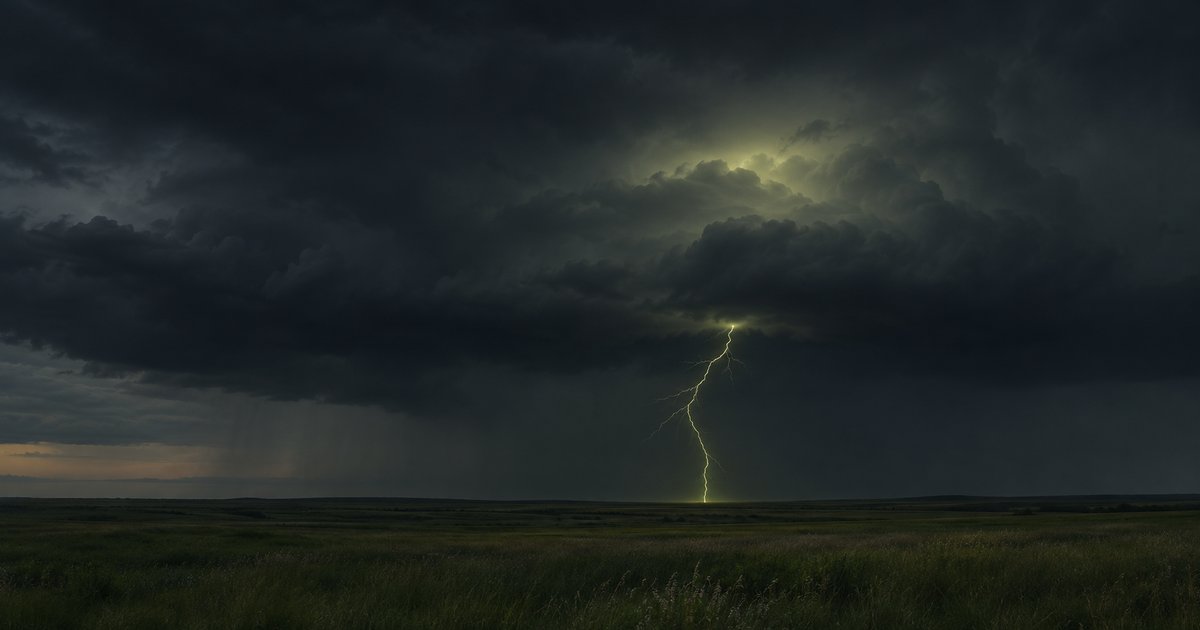
Lightning is an electrical discharge in the atmosphere. NOAA’s National Severe Storms Laboratory calls it “a giant spark of electricity” that occurs when separated charges inside a storm, between clouds, or between cloud and ground overcome the insulating air. The flash can stay aloft or reach the ground; thunder is the sound it makes.
How does lightning work?
NOAA’s National Severe Storms Laboratory (NSSL) explains that collisions between small ice particles and soft hail called graupel help separate electric charge inside a thunderstorm. Lighter particles rise in the storm’s updraft while heavier ones stay lower. When the charge difference becomes strong enough to overcome air’s insulating effect, electricity moves through the air in a flash. The exact way a cloud first builds its charge is still an active research question, NSSL says. The steps inside the storm begin well before the visible flash.
For a ground flash, NSSL describes a channel developing down from the cloud while an upward spark rises from an object near the surface. Their connection lets a bright current race along the channel. A tall tree or building is more likely than nearby low ground to send up that connecting spark, but NSSL cautions that a flash can also hit an open field.
What kinds of lightning are there?
The National Weather Service groups lightning into two main types: discharges within a thundercloud and discharges between a cloud and the ground. NSSL says most storm flashes stay in the cloud; it estimates roughly five to ten cloud flashes for each ground flash, although individual storms vary. Cloud-to-cloud flashes and cloud-to-air channels are other descriptions of where a discharge travels. The names for lightning types also describe polarity, shape, or what an observer sees, so their lists do not all count the same things.
Are there five types of lightning? The NWS does not give a standard list of five; it starts with those two broad groups. A “bolt from the blue” is still a cloud-to-ground flash, NSSL says, even when it lands where the sky overhead is blue. “Heat lightning” is an ordinary distant flash whose thunder cannot be heard. Treat these names as descriptions, not five separate hazards with different rules.
Why does lightning make thunder?
Thunder is the sound of air heated abruptly by a lightning channel. NSSL says the air can reach around 50,000 °F, causing it to expand violently and send out a pressure wave. That figure is the temperature of the thin channel of air, not of the storm around it; how hot lightning gets explains why sources give different numbers. The flash arrives at your eyes before its sound reaches your ears because light travels much faster than sound.
NSSL gives a simple flash-to-bang distance estimate: count the seconds between a flash and its thunder, then divide by five for miles. A 15-second gap is therefore about three miles. The number is an estimate of that flash’s distance, not a countdown to the next one; NWS advice is to seek shelter as soon as thunder is heard.
How often does lightning strike, and where?
Lightning happens far more often than the ground strikes visible from one yard suggest. A 2024 analysis by Vagasky and colleagues in the Bulletin of the American Meteorological Society found an annual average of 23.4 million cloud-to-ground flashes across the contiguous United States in 2017–2022 National Lightning Detection Network data. That counts flashes reaching ground, not their individual strokes, ground contact points, or flashes within clouds. Different units produce different figures in US lightning counts.
For location, NSSL’s undated FAQ describes frequent ground lightning in central Florida, along the Gulf Coast and southeastern Atlantic coast, and in parts of the western mountains. Warm, moist air and Florida sea breezes help build storms there. These are broad patterns, not a prediction for a particular address. The regional and seasonal pattern changes with the measure used.
Why does it matter to people?
A ground flash can reach a person without striking them directly. NSSL explains that current can move through a struck tree and the ground around it, reaching nearby people without a direct strike. A flash can also travel beyond the rain area, NSSL says. The ways lightning reaches people explain why standing away from the obvious bolt is not enough. When someone is struck, NWS says to call 911; the person does not retain an electrical charge and can be touched.
The NWS advises moving into a substantial building or hard-topped vehicle when thunder is heard and waiting 30 minutes after the last lightning or thunder before going outside again. Rain shelters, sheds, and open vehicles do not provide the same protection. Choose a place that protects from lightning before a storm arrives, and restart the 30-minute wait if lightning or thunder occurs again. Lightning Tracker for iPhone shows recently detected strikes on a live map, including the nearest detected strike’s distance, direction, and age.
What do the 30-second rule and standing hair mean?
The old “30-30 rule” said to seek shelter when the flash-to-thunder gap was 30 seconds or less, then wait 30 minutes after the last flash. An older NWS handout states that rule, but the NWS’s general guidance read in November 2026 says to go indoors at any thunder and wait 30 minutes after the last lightning or thunder. A 30-second gap works out to about six miles by NSSL’s distance estimate; it is not a reason to remain outside while the count is longer.
If your hair stands up during a storm, move toward a substantial building or hard-topped vehicle immediately. The NWS warns that waiting for hair to stand on end can give a false impression that a person will get a warning before a strike. The agency stopped recommending the lightning crouch in 2008 because it does not provide significant protection. The signs of a nearby strike can arrive too late to guide a shelter decision.
Is it lightning or lightening?
For the electrical flash, write lightning. Collins English Dictionary defines it as “the very bright flashes of light in the sky that happen during thunderstorms.” Lightening is a form of the verb lighten, which Collins defines as “to make or become less heavy.”
Not a substitute for official weather warnings.
If you hear thunder, seek shelter even if the app shows no nearby strike.
Sources
- Bulletin of the American Meteorological Society, How Much Lightning Actually Strikes the United States?
- NOAA National Severe Storms Laboratory, Lightning Basics
- NOAA National Severe Storms Laboratory, Lightning FAQ
- NOAA National Severe Storms Laboratory, Lightning Types
- National Weather Service, Understanding Lightning: Types of Flashes
- National Weather Service, Overview: Lightning Safety
- National Weather Service, The Lightning Crouch
- National Weather Service, Lightning Safety Facts
- Collins English Dictionary, Lightning
- Collins English Dictionary, Lighten