 Lightning Tracker
App Store
Storm basics
Why lightning hits one spot and not another
November 19, 2026 · 7 min read
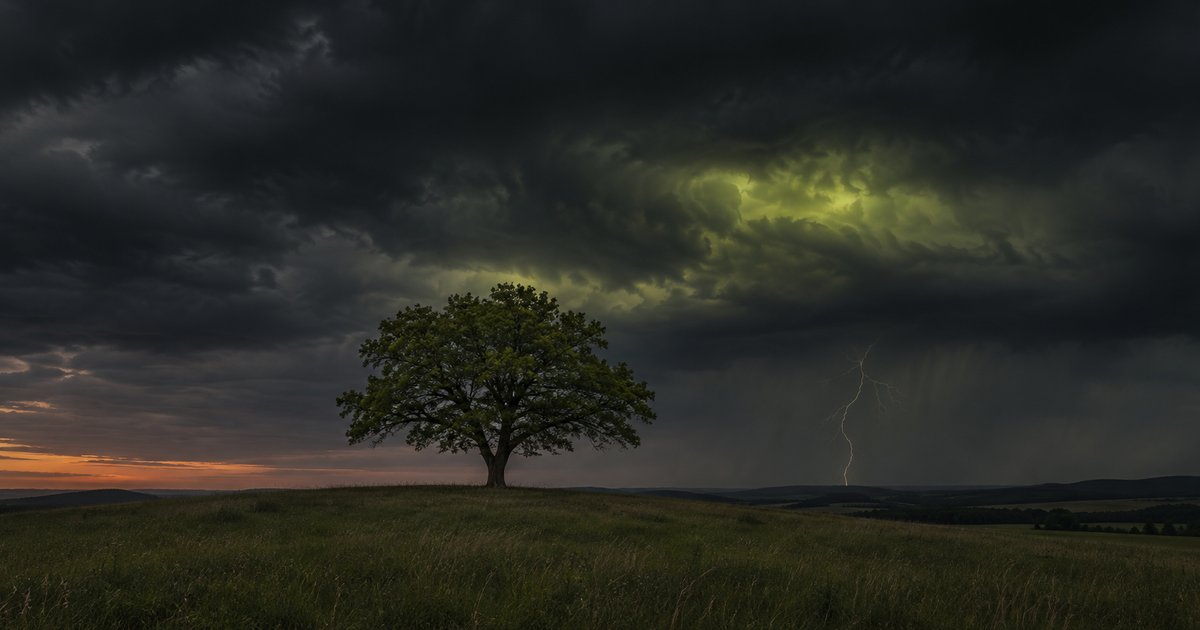
Lightning lands where an upward spark from the ground first connects with the stepped leader coming down from the storm, in the last 100 to 300 feet (30 to 100 meters) of the leader’s path, according to NOAA’s JetStream. Height, a pointed shape and isolation raise an object’s odds of launching that spark, says the National Weather Service (NWS), but none of them decides the outcome: the National Severe Storms Laboratory (NSSL) says lightning can hit open ground beside a tree line, and the NWS names no outdoor spot that protects a person.
The ground answers the stepped leader only in its last few hundred feet
A cloud-to-ground flash begins when a stepped leader, a faint channel of negative charge, leaves the base of the storm and descends in jumps. NOAA’s JetStream Max page (last updated April 6, 2023) describes steps about 160 feet (50 meters) long, with a pause of about 50 microseconds between them. NSSL’s Severe Weather 101 page (undated, as of November 2026) says that when the channel gets within roughly a hundred yards (300 feet) of the ground, objects such as trees, bushes and buildings start sending up sparks to meet it. JetStream Max places the connection of one of those sparks, called a streamer, 100 to 300 feet (30 to 100 meters) above the surface.
Read together, the two NOAA accounts put the competition between objects on the ground in the last 300 feet or so of the leader’s path. JetStream adds, on a page last updated April 5, 2023, that forecasting when and where lightning will strike is not yet possible and most likely never will be.
Several upward leaders can start, and only one of them connects
A high-speed camera study shows more than one upward leader rising from the ground at once. Tran and Rakov of the University of Florida recorded the final approach of four negative strokes at 124,000 or 210,000 frames per second in Gainesville and published the results in Scientific Reports on November 17, 2017. They inferred that the strokes hit treetops. The upward connecting leaders, the ones that joined the descending channel, reached a maximum length of 36 to 82 feet (11 to 25 meters). In one stroke the camera also caught seven upward leaders that never connected, between 23 and 148 feet (7 and 45 meters) from the connecting one in the image.
Because an unconnected upward leader can start before the one that connects, the authors write, starting first does not necessarily make a spot the strike point. The two sides meet in what the paper calls the breakthrough phase, also known as the final jump, and the initial length of the zone where their streamers overlap was estimated at about 98 to 131 feet (30 to 40 meters). The NWS notes that when the main channel discharges, so do all the other streamers in the area, which is one of five ways lightning reaches people.
Treat the numbers as examples, not averages. They come from four strokes at one Florida site, and the authors say their distances, measured in two-dimensional images, are probably underestimates of the real three-dimensional ones by about 30 percent.
Height, a pointed shape and isolation tilt the odds, and metal does not
The NWS Lightning Myths page (undated, as of November 2026) calls height, pointy shape and isolation the dominant factors controlling where a lightning bolt strikes. NSSL explains the height factor: tall objects such as trees and skyscrapers are more likely than the surrounding ground to produce one of the connecting sparks, and mountains make good targets. JetStream adds that mountaintops are closer to the base of the storm cloud, and that air is a good insulator, so the less distance lightning has to burn through, the easier it is to strike.
| Factor | What the sources say | Source |
|---|---|---|
| Height | Tall objects are more likely than the surrounding ground to produce the connecting spark; mountaintops are closer to the cloud base | NSSL; NOAA JetStream |
| Pointed shape | Named as a dominant factor; in rod tests reported in 2000, moderately blunt tips were better strike receptors than sharper ones | NWS; Moore et al., 2000 |
| Isolation | Named as a dominant factor; tall, isolated trees and mountains are struck many times a year | NWS |
| Metal | Makes no difference to where lightning strikes, though it carries current once it is hit | NWS |
The NWS says metal does not attract lightning; it does conduct it, which is why the NWS tells people to stay away from metal fences, railings and bleachers during a storm. The rod tests behind the table were reported by Moore and colleagues in the Journal of Applied Meteorology in May 2000, and their abstract does not extend the result to trees or people.
Tran and Rakov also compared heights. They set their treetop strokes beside three strokes to two 14-story buildings, about 200 feet (60 meters) tall, studied by Saba and colleagues in São Paulo. The downward leader’s tip was higher when the buildings began to connect, 289 feet (88 meters), than for the treetops, with a median of 203 feet (62 meters). That fits the idea that a taller object starts its upward leader sooner, but it rests on seven strokes at two sites and neither paper states it as a rule.
Striking distance means a few hundred feet to researchers and a storm’s reach to the NWS
Striking distance, in Tran and Rakov’s 2017 paper, is the height of the downward leader’s tip at the assumed start of the upward connecting leader. A 2003 paper by Mazur and Ruhnke in the Journal of Geophysical Research says it can be calculated from formulas that relate it to a stroke’s peak current, and offers an alternative based on estimating the leader’s electric potential. A 2017 paper by Saba and colleagues in Geophysical Research Letters says striking distance and connecting-leader speed are widely used in attachment models and in lightning protection standards. Because those formulas depend on peak current, which differs from stroke to stroke, a single fixed distance would not fit every flash.
The NWS uses the same words for something much larger. Its lightning safety overview (undated, as of November 2026) says that if you hear thunder, you are likely within striking distance of the storm, and its myths page says bolts from the blue can strike 10 to 15 miles (16 to 24 kilometers) from the thunderstorm. The first meaning is the air above one spot; the second is the reach of a whole storm.
Tall objects are favored, not certain, and open ground gets struck too
NSSL’s lightning FAQ (undated, as of November 2026) answers the question “Does lightning always strike the tallest object?” with “Never say always!” The same answer says lightning usually strikes the tallest object, because that object is the most likely to produce upward streamers to connect with the downward leader. NSSL’s basics page adds that lightning can strike the ground in an open field even if the tree line is close by, and JetStream says it all depends on where the charges accumulate. Very tall structures can go further: NSSL says natural lightning can trigger upward discharges from tall towers such as broadcast antennas.
A photograph of a strike to flat ground in southern New Mexico shows the contest with no tall object in it. Cummins, Krider, Olbinski and Holle, in Atmospheric Research in April 2018, analyzed a flash photographed on July 10, 2015, whose first stroke started at least 12 unconnected upward leaders, 7 to 26 feet (2 to 8 meters) long, within about 49 feet (15 meters) of where it reached the ground. Attachment came when an upward leader reached an inferred height of about 69 feet (21 meters). None of the leaders could be seen to rise from tall, isolated or pointed objects. The authors say they likely began on small plants, rocks or flat ground.
A person in an open field cannot count on being passed over
The NWS says in its description of the five ways lightning strikes people (undated, as of November 2026) that direct strikes most often happen to victims in open areas. The same page says side flashes generally occur within a foot or two (about 30 to 60 centimeters) of the struck object, and most side-flash victims had sheltered under a tree to avoid rain or hail. Cummins and colleagues add that many upward leaders near one strike point can damage or injure at more than one spot on the ground.
The NWS pages read for this article give no height or distance at which a person is excluded from the contest. They say no place outside protects anyone when thunderstorms are in the area, and that for people caught outside with no shelter nearby, getting off elevated areas such as hills, ridges and peaks, never lying flat on the ground and never sheltering under an isolated tree may reduce the risk. The step the NWS names first is a substantial building or a hard-topped vehicle, reached as soon as thunder is heard.
Read together, the sources point to this: height and isolation change the odds between objects, but they do not tell a person standing outside that the next strike will land somewhere else. Lightning Tracker, an iPhone app, shows recently detected strikes on a live map, with the distance and direction to the nearest one, which says how close the storm is and not where its next strike will land.
Not a substitute for official weather warnings.
If you hear thunder, seek shelter even if the app shows no nearby strike.
Sources
- NOAA National Severe Storms Laboratory, Severe Weather 101: Lightning Basics
- NOAA National Severe Storms Laboratory, Severe Weather 101: Lightning FAQ
- NOAA JetStream, How Lightning is Created
- NOAA JetStream Max, The Lightning Process: Keeping in Step
- National Weather Service, Lightning Myths
- National Weather Service, Lightning Science: Five Ways Lightning Strikes People
- National Weather Service, Lightning Tips: What You Need to Know
- National Weather Service, Overview: Lightning Safety
- M. D. Tran and V. A. Rakov, A study of the ground-attachment process in natural lightning with emphasis on its breakthrough phase, Scientific Reports, November 17, 2017
- M. M. F. Saba et al., Lightning attachment process to common buildings, Geophysical Research Letters, May 14, 2017
- M. Mazur and L. H. Ruhnke, Determining the striking distance of lightning through its relationship to leader potential, Journal of Geophysical Research: Atmospheres, July 18, 2003
- K. L. Cummins, E. P. Krider, M. Olbinski and R. L. Holle, A case study of lightning attachment to flat ground showing multiple unconnected upward leaders, Atmospheric Research, April 2018
- C. B. Moore, W. Rison, J. Mathis and G. Aulich, Lightning Rod Improvement Studies, Journal of Applied Meteorology, May 2000