 Lightning Tracker
App Store
Places and activities
Bristol thunderstorms and lightning: when they happen, warnings and official checks
November 19, 2026 · 5 min read
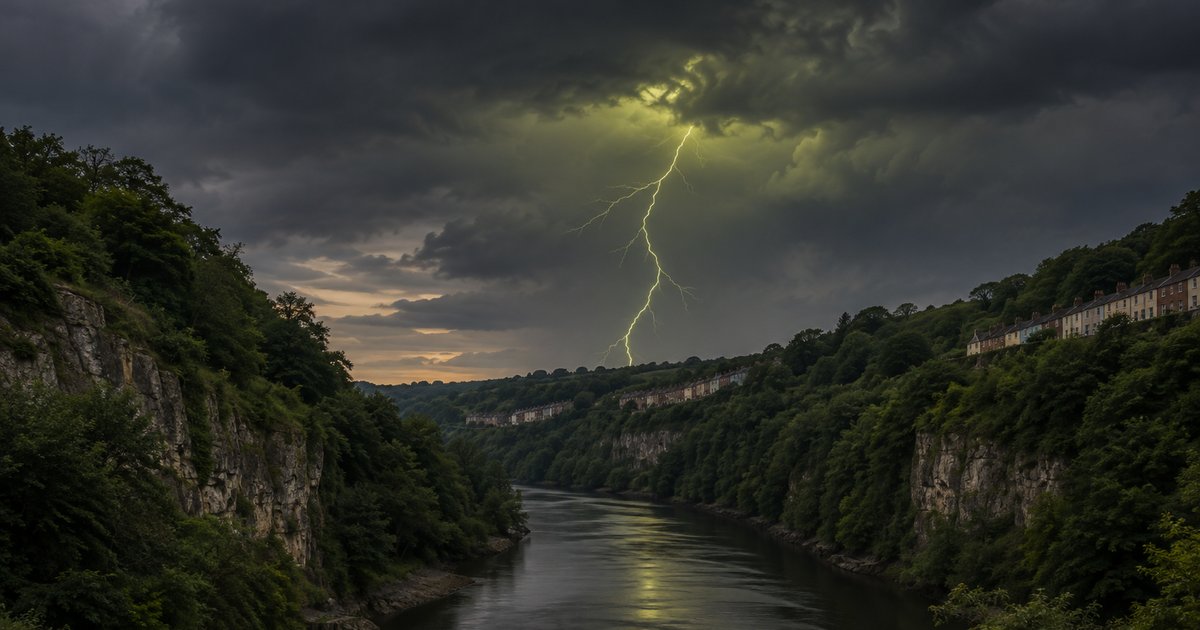
Bristol thunderstorms can occur in any season, but summer is the main season to plan around: the Met Office’s 2023 UK climate factsheet says most places have their highest thunder frequency then. For an actual outing, use the Met Office Bristol forecast and UK warning details; its December 2019 Bristol factsheet identifies Bristol Channel convergence as one local route to heavy showers and thunderstorms.
When does Bristol get thunderstorms?
The Met Office’s 2023 climate factsheet says thunder is possible anywhere in the UK at any time of year, with a summer maximum in most places. Its map shows average annual thunder days for 1971–2000 across broad bands of the country. The map is regional context, not an annual count for a Bristol street or a prediction for a particular date. The Met Office’s South West England climate guide says solar heating can build summer shower clouds and that a large share of the region’s summer rain comes from showers and thunderstorms.
Bristol has a more specific influence than the seasonal UK pattern alone. A Met Office Bristol factsheet from December 2019 says convergence over the Bristol Channel can lead to heavy showers and thunderstorms. The factsheet describes a way storms can form, not a rule that a storm will arrive from the Channel whenever the wind blows a certain way. The Met Office’s thunderstorm advice, opened in November 2026, says rainfall can vary sharply between nearby places.
A June 22, 2026 storm illustrates the practical stakes without measuring Bristol’s typical risk. ITV News West Country reported the next day that a fire in Wadham Grove, Emersons Green, led to household evacuations. Avon Fire and Rescue Service told ITV that the cause was accidental and thought to be a lightning strike. The reported cause was therefore a working assessment, not proof that every fire or power failure during a storm has the same cause. Emersons Green is in the Bristol area, while the fire service lists the incident under South Gloucestershire.
How do Met Office warnings apply to Bristol?
The Met Office’s weather warnings guide, read in November 2026, says it can issue warnings for thunderstorms and lightning up to seven days ahead. A warning forecasts possible impacts in an area and period. Open the UK weather warnings page, choose the relevant day and warning, then read “What to expect,” the local authorities listed in “Further details,” and the impact and likelihood matrix. Check the boundary and validity time for the place you will actually visit. A South West England headline alone does not say whether Bristol is inside the affected area.
The Met Office’s warning guide, opened in November 2026, says yellow, amber and red combine expected impact with the likelihood of that impact. Yellow can mean fairly likely moderate effects or a lower chance of more serious effects. Read the individual warning rather than treating its color as a lightning distance or a forecast of a strike at your address. The agency also notes that thunderstorms can have severe but highly localized impacts, so nearby towns may experience different conditions during the same warning period.
For the city forecast, open the Met Office Bristol location page and inspect its forecast and any warning bar for the times you plan to be outside. The Met Office’s warning guide says that a location warning bar links to the full warning details. Recheck before departure: the guide says warnings can be updated as the forecast changes. A forecast tells you what may happen; it cannot fix the exact time or landing point of a future flash.
Which official checks help during a Bristol storm?
The Met Office provides a separate lightning-strikes page for observations; the Met Office says it “shows where and when lightning has struck in the last 24 hours.” Check the displayed update time and legend before interpreting marks. A forecast warning and a detection display answer different questions: the first concerns possible future impacts; the second concerns electrical activity already detected. Map age, distance and gaps matter when interpreting any provider’s display.
The Met Office’s thunder and lightning guide, opened in November 2026, explains that its location system detects radio pulses from lightning. A detection is an observation, not a precise forecast for the next strike. The radio-sensor detection process also explains why a missing mark cannot establish that lightning is absent. Use the official warning and conditions around you together; do not wait for a dot if you hear thunder.
The Met Office’s thunderstorm advice says hearing thunder places you within range of a possible ground flash, even when a storm center is as far as 16 km (10 miles) away. Leave an exposed spot and seek an enclosed building or a metal-roofed car. A flash-to-bang count estimates distance, but it does not give permission to remain outside after thunder. The same agency warns that low-lying underpasses and basements can flood rapidly during intense rain, so the route to shelter matters too. The choice of lightning shelter is more important than whether a map has a mark over your precise location.
What changes for Bristol parks, events and the airport?
Bristol City Council’s event application page, opened in November 2026, asks organizers using council parks and open spaces for an event-specific risk assessment and management plan. Its Highway Electrical Asset Team’s undated Electrical Safety at Events document specifically lists “Back-up supplies and equipment following a lightning strike” among matters to consider when designing an event electrical scheme. That line applies to event power resilience, not to when visitors may remain in a park.
Bristol Airport has a separate airside procedure, version B of its January 2023 adverse-weather instruction. It describes an electrical-storm alert when activity is observed within about 9 km (five miles) of the airfield and lists ramp activities to suspend. This is an operational rule for airport staff, not a radius for walkers elsewhere in Bristol or an all-clear rule for the public. A trip through the airport calls for its own operational notices as well as the Met Office forecast.
As of November 2026, Lightning Tracker is an iPhone app that works in Bristol and can alert you when it detects a strike inside the radius you set for a place. It does not replace Met Office warnings; its detections are an additional observation for your decision. For an outdoor plan, the wait after the last thunder matters before returning outside.
Not a substitute for official weather warnings.
If you hear thunder, seek shelter even if the app shows no nearby strike.
Sources
- Met Office, Bristol Climate Change: The Science
- Met Office, South West England: climate
- Met Office, Climate of the British Isles
- Met Office, Weather warnings guide
- Met Office, Thunder and lightning advice
- Met Office, Thunder and lightning
- Met Office, Bristol (Bristol) weather
- Met Office, UK weather warnings
- Met Office, Lightning strikes
- ITV News West Country, Lightning strike causes house fire in Bristol’s Emersons Green
- Bristol City Council, Hold an event in a park, open space or street
- Bristol City Council, Electrical Safety at Events
- Avon Fire and Rescue Service, Wadham Grove, Emersons Green
- Bristol Airport, Adverse Weather, version B