 Lightning Tracker
App Store
Places and activities
London thunderstorms and lightning: season, warnings and official checks
November 19, 2026 · 4 min read
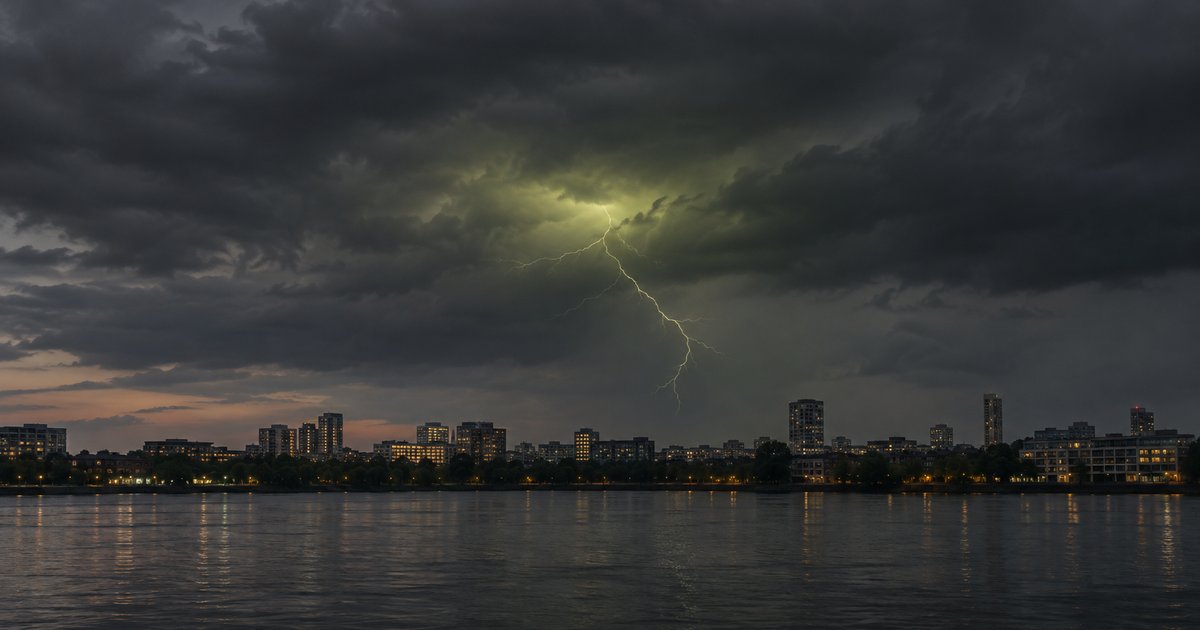
London thunderstorms are most likely in summer, but they can occur in any month; for a storm that may affect your plans, check the Met Office’s London forecast and warning details. The Met Office identifies southeast England as one of the UK’s thundery regions, while its warnings describe expected impacts and the areas they may affect.
When storms are most likely
The Met Office says summer is the UK’s most thundery season, particularly in the East Midlands and southeast England. Meteorological summer runs from June through August. London sits in that southeast region, but the regional pattern is not a forecast for a particular borough or day. The Met Office also says thunderstorms can occur at any time of year; its most severe UK storms usually occur in summer, especially after hot, humid, sunny weather.
The difference between a seasonal pattern and an individual storm matters in London. A summer afternoon can be quiet in one part of the city and stormy in another. The Met Office describes thunderstorm impacts, especially rainfall, as highly localized, with large differences over short distances. A broad London forecast is useful for planning, while a warning’s detailed area list matters more when deciding whether a particular journey or outdoor event may be affected.
What a London warning means
The Met Office issues warnings for both thunderstorms and lightning, as well as rain and other hazards, up to seven days ahead. Its London weather warnings page is the direct check for the city. Open the warning itself, rather than relying on a headline or a screenshot: the warning gives the forecast impacts, their likelihood, a list of affected local authorities and an impact matrix. The Met Office may update warnings as its assessment changes.
The Met Office assigns yellow, amber or red from the combination of likely impact and confidence. Yellow does not mean that every place in the warning area will have only a minor storm. The service says a yellow warning can also reflect potentially significant impacts with lower certainty. The warning’s details explain what is expected and where. A London forecast page can show a warning bar for the hours it is in force, but a warning area is not a promise that lightning will strike every point inside it.
The Met Office’s own thunderstorm advice says a warning may cover severe but very localized effects that affect fewer people. If the warning mentions intense rain, check the route as well as the destination. London Fire Brigade’s June 23, 2026 report illustrates the combination: after intense thunderstorms, the brigade had taken about 400 calls since midnight, mostly for flooding at properties, and attended at least two house fires it suspected were triggered by lightning. That report documents one event; it is not a London annual average.
Is there a London thunderstorm today or tonight?
For a London thunderstorm today or tonight, start with the Met Office Greater London forecast for the planned time and its London warnings for potential impacts. Then read the warning details for the relevant local authority and time window. A forecast describes possible weather ahead; a lightning map shows detected discharges that have already happened. That distinction is useful when comparing a lightning map with weather radar: radar depicts precipitation, while a lightning display depicts electrical activity.
For a recent-strike check, the Met Office site links a lightning map from its weather pages. Check its time label and what its symbols represent. The detection network behind a map can miss a discharge, so an empty display cannot overrule thunder you hear. Lightning Tracker is an iPhone app that works in London and shows recent detected strikes, including the distance and direction to the nearest one.
In a park or on a journey
The Royal Parks asks visitors to check park updates and Met Office advice before traveling when severe weather may affect access. Westminster City Council’s April 2014 emergency booklet also names thunderstorms and lightning, and tells people outdoors to avoid water, trees and metal objects. For a planned walk in Hyde Park, Regent’s Park or another Royal Park, check the park’s severe weather notices as well as the London warning. An open gate or an unchanged booking does not tell you where lightning may strike.
The Met Office says that hearing thunder puts you within range of a possible ground flash. Move toward substantial shelter from lightning; its UK advice also warns against low-lying underpasses and basements that could flood rapidly. If you see a flash, the flash-to-bang count estimates distance, but it is not a reason to remain outdoors after hearing thunder. The wait after the last thunder is relevant before resuming an outdoor plan.
Heavy rain adds a separate travel problem. The London Fire Brigade told drivers after the June 2026 storms not to drive through floodwater and to check their journey before traveling. A lightning warning, a rain warning and park access notice answer different questions; use the official page for each decision.
Not a substitute for official weather warnings.
If you hear thunder, seek shelter even if the app shows no nearby strike.
Sources
- Met Office, Summer: the warmest season
- Met Office, Thunder and lightning
- Met Office, Weather warnings guide
- Met Office, London weather warnings
- Met Office, Thunder and lightning advice
- London Fire Brigade, Weather-related calls - London
- The Royal Parks, Severe weather in the parks
- Westminster City Council, Prepare your household for emergencies