 Lightning Tracker
App Store
Places and activities
Manchester thunderstorms and lightning: when they happen and what to check
November 19, 2026 · 4 min read
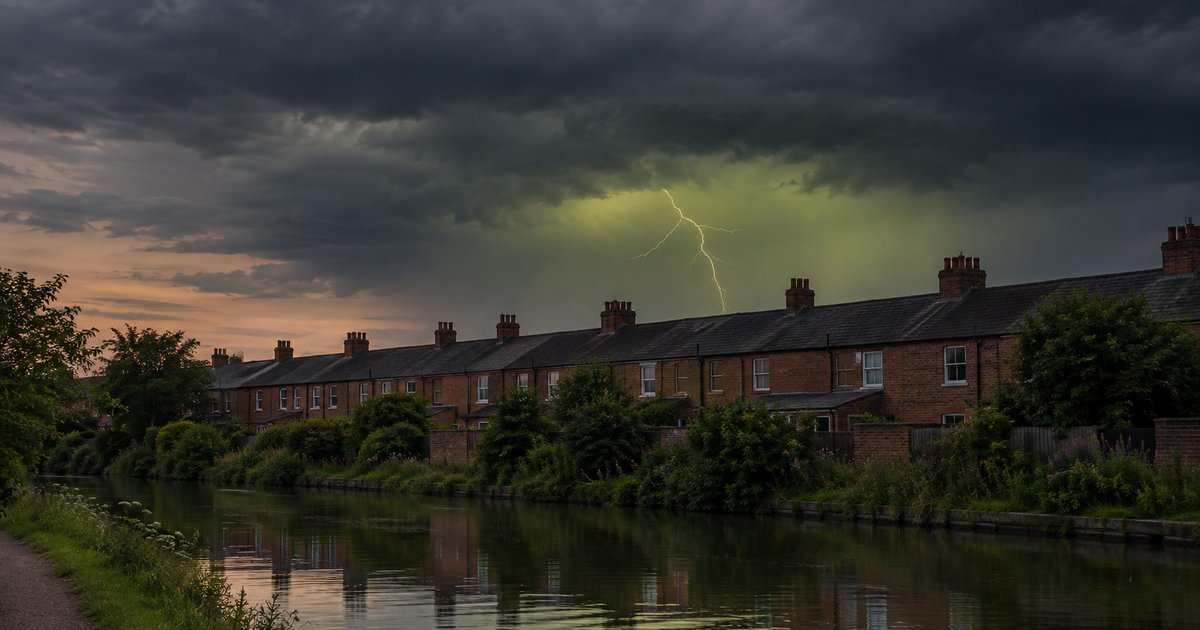
Thunderstorms in the Met Office's North West England climate profile are most likely from May through September, with a July–August peak. The profile reports thunder on 8–12 days a year across the mainland of its wider region, not at a Manchester weather station. For a particular day or outdoor plan, check the Met Office's Manchester forecast and its warning page for the city.
Manchester's regional thunderstorm peak is in July and August
The Met Office climate profile covers Cheshire, Merseyside, Greater Manchester, Lancashire, Cumbria, part of North Yorkshire and the Isle of Man. It says thunderstorms are most likely from May to September and peak in July and August. On the mainland, thunder occurs on an average of 8–12 days per year. That range describes a large region with different terrain; it is useful for seasonal expectations but should not be turned into an exact Manchester count. The same profile records 95.9 mm (3.8 inches) of rain at Manchester-Ringway in 11 hours on 5–6 August 1981 as an example of a heavy fall associated with a summer thunderstorm.
The Met Office's UK thunder and lightning explainer says thunderstorms can occur in any season, while the most severe usually occur in summer after hot, humid weather. It says UK thunderstorms are most common over the East Midlands and southeast. Manchester therefore has a real summer thunderstorm season without sharing the higher-frequency pattern of those parts of England. A seasonal average cannot tell you whether a storm will affect a particular street or event.
Greater Manchester warnings describe possible impacts
The Met Office issues warnings for thunderstorms and lightning, among other hazards, up to seven days ahead, according to its warning guide as read in November 2026. It assigns yellow, amber or red using both the possible impact and the likelihood of that impact. A yellow warning does not always mean a mild event: the guide says yellow can also mark potentially significant impacts with lower certainty. The warning text, rather than its color alone, is where the expected impacts, timing and affected places are set out.
The Met Office's Manchester warning page is the official city-specific check. On the wider UK warnings page, North West England is the region and Greater Manchester appears among its local authorities when relevant. Open a warning's “Further details” for the list of affected areas and the impact-and-likelihood matrix. Warnings can change: the Met Office says it operates around the clock and can issue them at any time. Its October 2026 guide also notes a change to the warning impact matrix, another reason to read the live warning details instead of relying on a remembered color rule.
The Met Office says thunderstorm impacts can be very localized. One part of Greater Manchester can have heavy rain while another gets much less; the agency also names hail, sudden gusts, standing water and lightning as related hazards. A broad warning is a prompt to check your place and plan, not a promise that every address inside its area will see the same conditions.
Manchester's 2023 lightning affected homes and an outdoor event
On 11 June 2023, a lightning strike damaged two houses and several cars on Thornton Road in Rusholme, according to a Greater Manchester Fire and Rescue Service statement reported by ITV News Granada on 12 June. The fire service said three people were injured and several houses were evacuated. The report is a documented Manchester incident, not evidence of the city's annual strike frequency.
On 12 June 2023, Manchester City FC said access to its Oxford Street stage-show site would be delayed because of reported “localised lightning storms.” Its announcement said Manchester City Council made the decision with the club and other local stakeholders after consulting meteorologists and the Met Office. The stage had a planned opening time; the club changed it before the show. For a spectator, an organizer's change to an outdoor event is a reason to follow the event's instructions as well as official weather information.
Is there thunder and lightning in Manchester today?
For thunder and lightning in Manchester today or tonight, the Met Office's Manchester forecast is the place to check the city outlook before travel. The agency says forecasts can identify the likelihood of localized weather but cannot pinpoint exactly where and when every shower will occur. Use its forecast and warning pages together: the forecast gives location context, while an issued warning explains potential disruption and its geographic scope. Neither a regional climate average nor an old lightning report predicts an individual strike.
The Met Office says hearing thunder means you are already within range of where the next ground flash may occur; lightning can reach 16 km (10 miles) from a storm's center. If you are outside, move to an enclosed shelter. Its guidance also warns that rain can differ sharply across short distances, so a dry pavement is no reason to stay outside when thunder is audible. The choice of shelter matters more than trying to estimate a comfortable distance using the flash-to-bang count.
A lightning map and rain radar answer different questions, and lightning detection has limits. Lightning Tracker is an iPhone app that works in Manchester and elsewhere; it can show recent detected strikes near your location and their distance and direction. Keep the Met Office warning as the official source for decisions about severe weather.
Not a substitute for official weather warnings.
If you hear thunder, seek shelter even if the app shows no nearby strike.
Sources
- Met Office, North West England & Isle of Man: climate
- Met Office, Thunder and lightning
- Met Office, Weather warnings guide
- Met Office, Weather warnings for Manchester
- Met Office, Manchester weather
- Met Office, Thunder and lightning guidance
- Met Office, About our forecasts
- Manchester City FC, Trophy Parade update
- ITV News Granada, Lightning strike blows hole in roof of house in Manchester