 Lightning Tracker
App Store
Places and activities
Edinburgh thunderstorms and lightning: when they happen and what to check
November 19, 2026 · 4 min read
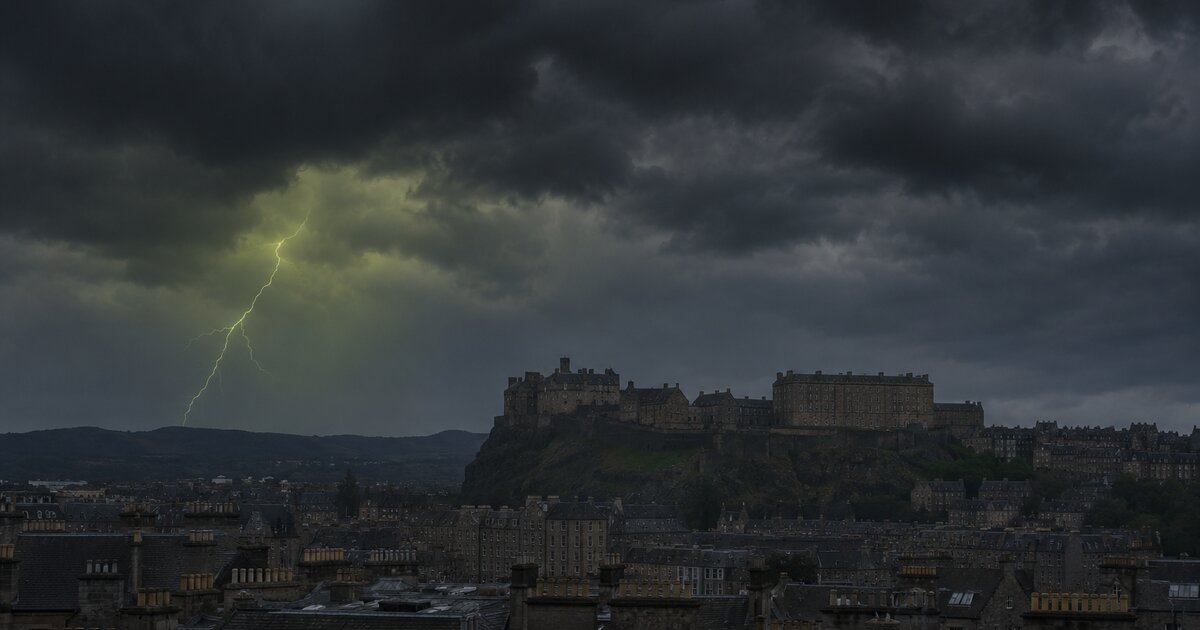
Edinburgh's warmer months bring the strongest thunderstorm chance, but the Met Office's 2023 thunder climatology does not give the city an exact annual thunder-day count. Its UK guidance says storms can occur in any season. For a particular Edinburgh plan, use the Met Office's city forecast and location-specific warning page.
Summer is the likeliest season, but there is no city count here
The Met Office's 2023 Thunderstorms factsheet says summer is the most thundery season away from the UK's western seaboard. It reports fewer than five thunder days a year across most of central and northern Scotland, compared with 15–20 in parts of southeast England. The categories cover broad areas and varying record periods. They do not give an Edinburgh station count, so assigning “fewer than five” to the city would overstate what it measures.
The Met Office's eastern Scotland climate profile explicitly includes Edinburgh, Dundee and Aberdeen, from the Firth of Forth to the Grampians. That is a large, varied region rather than a single city. Its thunder explainer says UK thunderstorms can occur in any month, while the most severe are usually in summer, particularly after hot, humid weather. The practical seasonal answer is to expect the greatest chance of thunder in warmer months while still checking the forecast for a particular day. Regional history cannot predict whether a storm will cross a specific Edinburgh neighborhood.
An Edinburgh warning describes possible impacts
The Met Office's warning guide, checked in November 2026, says it can issue thunderstorm and lightning warnings up to seven days ahead and at any hour. Yellow, amber and red combine likelihood with expected impact; yellow does not always mean a weak storm. Each warning has a headline, expected impacts, advice and further details. The “Further details” section lists affected local authorities and an impact-and-likelihood matrix. Read that detail and the validity times before changing an outdoor plan.
The Met Office warnings archive labels the wider region “SW Scotland, Lothian Borders.” The official weather warnings for Edinburgh page provides the city-specific route. The Edinburgh forecast gives the city's weather outlook, and the Met Office's UK warnings page shows the wider warning area. A warning area may include Edinburgh and surrounding places, but the Met Office says thunderstorm impacts, especially rain, can differ sharply over short distances. An area warning does not promise identical weather on every street.
The Met Office warning guide says the weather type appears on each warning. Check whether a notice concerns thunderstorms, lightning, rain or another hazard instead of treating every colored symbol as a lightning alert. A forecast speaks about weather ahead; a lightning detection records a discharge found by a sensor. Neither a quiet detection display nor the absence of a warning is a reason to ignore thunder you can hear.
A June 2026 storm disrupted flights near Edinburgh
Edinburgh News reported on 26 June 2026 that severe thunderstorms in local and surrounding airspace disrupted Edinburgh Airport. The report quoted the airport saying air traffic flow-rate restrictions had been applied and knock-on delays were likely. It also quoted Nats saying thunder and lightning across parts of the UK were affecting Scottish airspace. Those are documented effects of one storm, not a measure of how often lightning strikes Edinburgh.
The same Edinburgh News report said a Met Office yellow thunderstorm warning covered almost all of Scotland and had been extended into Saturday. Its account illustrates why a warning's area, time and impact text matter. Airport restrictions were an operational decision made during that event; a traveler should check an airline's own notices before travel instead of assuming every thunderstorm causes flight disruption.
Outdoor plans need a place to shelter
The City of Edinburgh Council's Public Space Guidance for Event Organisers, updated April 2026, specifically says, “Lightning – we would expect you to follow this guidance,” pointing organizers to PLASA’s outdoor-event lightning guidance. That applies to people organizing an event in public space, not a blanket claim that every city park closes during thunder. For an outdoor event, follow the organizer's instructions as well as the Met Office warning.
The Met Office's thunder and lightning advice says hearing thunder puts you within range of where the next ground flash may occur; lightning can strike up to 16 km (10 miles) from a storm's center. It advises seeking shelter and avoiding low-lying spaces such as underpasses that might flood rapidly. An enclosed building is a better destination than an open hill, a tree or an exposed path. The choice of shelter matters more than working out an approximate distance with the flash-to-bang count.
Edinburgh thunderstorm today: forecast, warning or strikes?
For an Edinburgh thunderstorm today or tonight, open the Met Office's city forecast first, then its Edinburgh warning page. If a warning appears, open its full details for affected places, times and expected impacts. For a “lightning map Edinburgh” search, the Met Office also offers a lightning strikes page for observations. Detected strikes show where lightning was registered, while a warning addresses potential impacts ahead; lightning and radar depict different phenomena. The Met Office's thunder explainer describes how a sensor network locates lightning, so detection methods are useful context when reading a strike display.
Lightning Tracker is an iPhone app that works in Edinburgh and elsewhere. It can show recent detected lightning near your location, including the distance and direction to the nearest detected strike. Met Office warnings remain the official check for severe-weather decisions.
Not a substitute for official weather warnings.
If you hear thunder, seek shelter even if the app shows no nearby strike.
Sources
- Met Office, Thunderstorms factsheet
- Met Office, Eastern Scotland: climate
- Met Office, Thunder and lightning
- Met Office, Weather warnings guide
- Met Office, National Severe Weather Warnings Archive
- Met Office, Weather warnings for Edinburgh
- Met Office, Edinburgh weather
- Met Office, Thunder and lightning advice
- Met Office, Lightning strikes
- City of Edinburgh Council, Public Space Guidance for Event Organisers
- Edinburgh News, Thunderstorms disrupt Edinburgh Airport flights and flood roads