 Lightning Tracker
App Store
Places and activities
Horses and lightning: who stops a horse show
November 19, 2026 · 7 min read
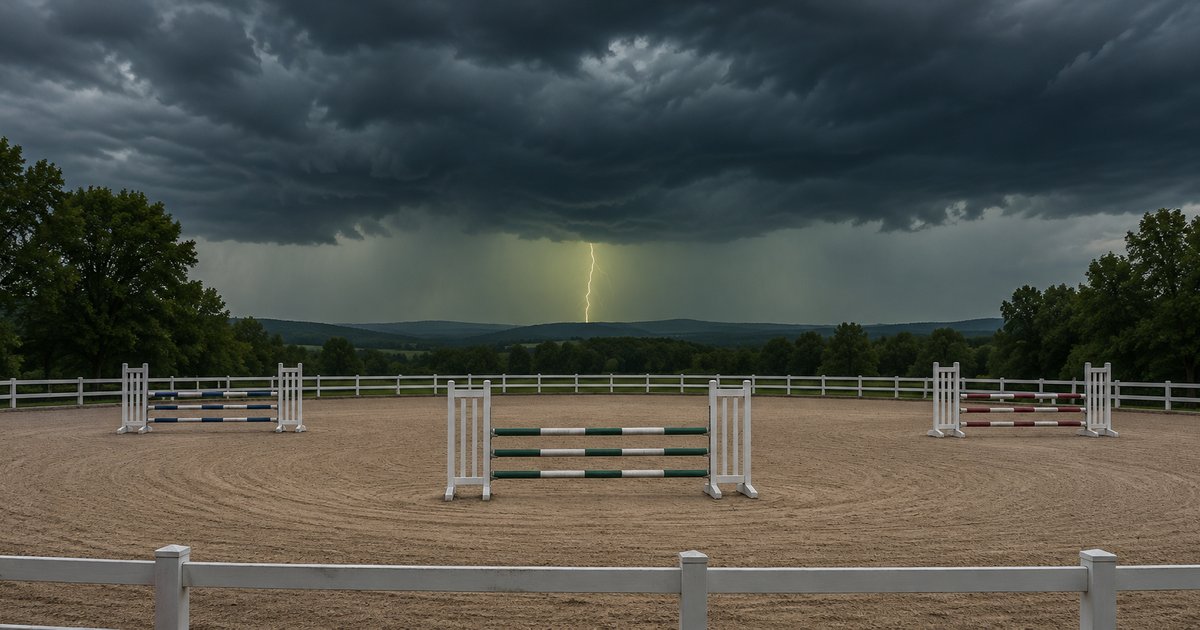
A horse can be struck: the Merck Veterinary Manual says lightning strike is more likely in large animal species, and EQUUS says no one keeps statistics on horses killed by lightning. At a horse show licensed by US Equestrian (USEF), competition management stops the competition when weather appears to threaten horses or exhibitors, and in eventing the Ground Jury decides. The 2026 USEF rule book sets no lightning distance and no waiting time; USEF’s November 2026 guide for organizers recommends stopping when lightning is sighted or thunder heard and waiting until at least 30 minutes have passed without severe weather.
USEF rule GR832 gives the stop to competition management
The 2026 US Equestrian (USEF) rule book, effective December 1, 2025, says in rule GR832.1 that when weather appears to be imminently affecting the safety and welfare of horses or exhibitors, stopping the competition is the responsibility of competition management, with eventing as the stated exception. The same rule says the Show Committee or Competition Management decides whether to re-commence after a storm, accident or other emergency, and that interrupted classes may restart in the same session or a later one. The 2024 edition words GR832.1 the same way. Neither the General Rules chapter nor the Eventing chapter of the 2026 edition uses the word lightning: GR832 speaks of “weather” and “a storm” and sets no distance and no waiting time. Those numbers come from guidance, covered below.
The rule also settles money and points. Unless the prize list says otherwise, the licensee must refund entry fees for cancelled classes on written request within 30 days, and no championship awarded on points can be given in a division unless more than 50% of its scheduled classes were held. Some rules approved at USEF’s 2026 mid-year board meeting take effect on December 1, 2026, so anyone planning a 2027 show should check the edition in force on its dates.
Can a horse be struck? Ground current, and where the sources say horses wait
The Merck Veterinary Manual, in a review dated July 2025, says lightning strike is more likely in large animal species and that step potential, the current spreading through the ground, is the most common mechanism of lightning injury. It explains that larger animals have greater potential differences between their front and hind feet, which increases the current through the body. The NWS makes the same point for large farm animals: because of their body span, ground current from a nearby strike is often fatal to livestock.
On where to put horses, the sources split. EQUUS magazine (July 2015 issue, online March 2017) says the only place to be during a thunderstorm is inside a fully enclosed and grounded building such as a house or a modern barn, and that open-sided run-in sheds are not shelters. For a horse show, it says to put the horses in the trailer, then wait in the truck cab; a National Outdoor Leadership School instructor quoted there describes the trailer as a metal container that wraps around them. That trailer advice rests on one expert’s view: the NWS names substantial buildings and hard-topped vehicles as options for people, and the NWS pages cited here do not address horse trailers. A 2012 Texas A&M veterinary column goes the other way, saying owners often stall horses to protect them from lightning but that letting them travel could keep them safer, with a large pasture and a three-sided shelter as the ideal. EQUUS also advises fencing horses well away from tall, lone trees.
The United States Eventing Association (USEA) safety manual gives one instruction for riders: do not stand out in the open holding or riding a horse. The severe weather paragraph of the USEF Incident Response Guide speaks of participants and does not say where horses wait. The NWS says no place outside is protected when thunderstorms are in the area, and the horse sources above give conflicting advice, so none of them settles where a horse should wait.
No horse-specific distance threshold appears in any of these sources, and none gives a count of horses struck: EQUUS says no one keeps statistics on horses killed by lightning. An NWS interview with a Texas cowboy describes a 2005 strike at his barn under hardly any clouds, with a storm about 10 to 15 miles away. A single account like that cannot show how often horses are struck or set a distance for horses.
Eventing hands the decision to the Ground Jury
Rule EV137 of the 2026 Eventing chapter says the Ground Jury, or the Technical Delegate if the jury is unavailable, must determine whether an event continues when weather or terrain conditions are unfit for competition. The decision to interrupt or cancel a phase is made by the President of the Ground Jury, after consultation with the Technical Delegate if possible. As an exception to GR832, an interrupted event resumes as soon as possible from the point of interruption, with all scores recorded before it standing, and every affected athlete must receive sufficient warning before it restarts.
What happens to a class or ride after a stop depends on the discipline
The 2026 rule book restarts a stopped class differently in each discipline, and the rule number tells you which text applies.
| Discipline | Rule | After the stop |
|---|---|---|
| Hunter and other judged classes | GR832.5 | The judge, steward(s) and management decide whether to hold the class over in its entirety, with no first-session scores counting, or to recommence it where it was interrupted |
| Jumper | GR832.6 | A class that had reached the jump-off stage resumes with only the jump-off competitors |
| Dressage | GR832.7 | The unfinished portion may restart the same or the next day, with the Ground Jury’s consent; earlier scores stand; at least 30 minutes’ notice for a same-day restart |
| Reining | GR832.9 | The unfinished portion may be rescheduled for the same or following days; earlier scores stand |
| Eventing | EV137 | The event resumes as soon as possible from the point of interruption; scores stand |
A dressage rider whose ride moves to a later day must be individually notified at least two hours before the new ride time, according to GR832.7.
USEF’s incident guide recommends a 30-minute wait, as advice
The USEF Incident Response Guide for Competitions, last revised in November 2026, recommends stopping the competition when a severe weather warning is issued, when lightning is sighted or thunder is heard, until at least 30 minutes have passed without severe weather. If a competition stops for lightning, the guide says all participants should take shelter in a large, enclosed structure if possible, or in fully enclosed vehicles, away from metal or conducting surfaces. The guide gives no distance trigger, and its introduction says each competition’s policies are the organizer’s responsibility and that the Recognized Affiliate for a breed or discipline may have its own resources.
The 30 minutes matches the National Weather Service (NWS) overview, which says to wait 30 minutes after the last lightning or thunder before going back outside, and that hearing thunder means you are likely within striking distance of the storm.
Other horse organizations set different triggers for their own events
The published triggers differ by body, and each text governs only the events of the body that wrote it.
| Body and document | Trigger and restart |
|---|---|
| USEF, Incident Response Guide (November 2026) | Lightning sighted or thunder heard; at least 30 minutes without severe weather; a recommendation to organizers |
| US Eventing Association, Safety Coordinator Manual (revised August 2017) | Within 10 miles of a bad storm, prepare to evacuate the cross-country course; riders take cover in barns, spectators return to cars |
| Interscholastic Equestrian Association, weather guidelines (revised November 20, 2023) | Suspend or move events indoors if a storm is less than six miles away, including mounting and warm-up |
| United States Pony Clubs, blog (June 29, 2023) | No specific guidelines; regional and local organizers decide; no “all clear” until the weather has completely passed |
| Racing: ARCI model rules, as endorsed by the Racing Officials Accreditation Program | Delay when lightning is detected within 8 miles of the track; resume 30 minutes after the last strike within 8 miles; the program says the stewards should be the final authority |
The Interscholastic Equestrian Association tells show hosts to estimate distance by counting the seconds between seeing lightning and hearing thunder and dividing by five, and recommends that outdoor events be suspended or moved indoors when a storm is under six miles away. The racing rows are model rules for racetracks, not rules for horse shows. The National Thoroughbred Racing Association’s safety alliance wrote in May 2018 that outdoor sports and industries whose policies specify a safety radius use ranges from 6 to 15 miles. The USEA manual’s cover says it was revised in August 2017, more than eight years before the USEF guide, and its 10-mile figure is a preparation step, not a stop order.
One 2023 show delayed its start by 125 minutes
The Walking Horse Report reported on August 26, 2023 that thunder could be heard through driving rain roughly an hour before the Saturday night performance of the 85th Annual Tennessee Walking Horse National Celebration, and that the start was delayed for 125 minutes. This is one event, not a measure of typical delays; the USEF guide’s recommendation is at least 30 minutes without severe weather.
Lightning Tracker is an iPhone app that shows recently detected strikes on a live map, with the distance to the nearest one and how many minutes ago it was detected; it does not replace the official’s decision, official warnings or the venue’s plan.
Not a substitute for official weather warnings.
If you hear thunder, seek shelter even if the app shows no nearby strike.
Sources
- US Equestrian, 2026 USEF Rule Book, GR General Rules (effective December 1, 2025)
- US Equestrian, 2026 USEF Rule Book, EV Eventing Division
- US Equestrian, 2024 USEF Rule Book, GR General Rules
- US Equestrian, Rules Approved at the 2026 USEF Mid-Year Board Meeting
- US Equestrian, Incident Response Guide for Competitions (revised November 2026)
- United States Eventing Association, Safety Coordinator Manual (revised August 2017)
- Interscholastic Equestrian Association, IEA Weather Safety Guidelines (revised November 20, 2023)
- United States Pony Clubs, Guidelines for Delay, Cancellation, or Disruption of Events Due to Severe Weather or Natural Disaster (June 29, 2023)
- Racing Officials Accreditation Program, Stewards’ Tip of the Month: Lightning & Severe Weather
- NTRA Safety & Integrity Alliance, Lightning Safety Standards in Outdoor Sport and Industry (May 2018)
- Merck Veterinary Manual, Lightning Strike and Electrical Injury in Animals (July 2025)
- National Weather Service, Overview: Lightning Safety
- National Weather Service, Lightning Science: Five Ways Lightning Strikes People
- National Weather Service, Q&A: Lightning Survivor Shares His Story
- Texas A&M College of Veterinary Medicine, Horses and Thunderstorms (March 22, 2012)
- EQUUS, Lightning guidance for horse owners (July 2015 issue; online March 10, 2017)
- The Walking Horse Report, Storm delay has Aged Stallions walking after midnight (August 26, 2023)