 Lightning Tracker
App Store
Storm basics
Flash-to-bang calculator: estimate lightning distance
November 11, 2026 · 4 min read
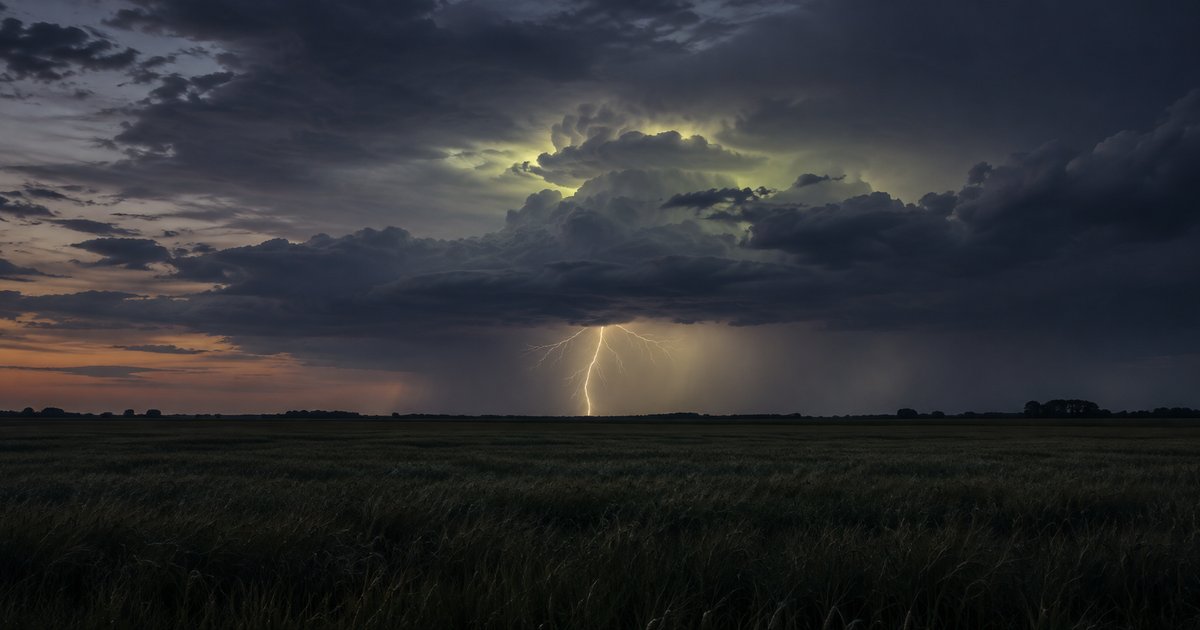
Divide the seconds between a lightning flash and its thunder by 5 to get the distance in miles; the calculator below does it for you, so a 15-second gap means about 3 miles. The result estimates where that one flash struck and is not a distance at which anyone is protected: if you hear thunder, go indoors.
0.0 s
Divide the seconds by 5 for miles, or by 3 for kilometers.
The result estimates where that flash struck. It is not a distance that protects you: if you can hear thunder, go indoors now.
How to time a flash and its thunder
The calculator takes the gap in two ways. Press “Flash: start counting” the moment you see lightning and “Thunder: stop” when the thunder begins, or count the seconds yourself and type the number into the field. Stop at the first sound, not the loudest: the National Weather Service (NWS) says you hear first the thunder made by the part of the lightning channel nearest you, with the sound from farther parts arriving later, and the UK Met Office likewise measures to the start of the thunder. The NWS also says to be in a place that already protects you while you count, because hearing thunder at all means you are probably within striking distance of the storm.
The arithmetic: 5 seconds per mile
The NWS explains that you see lightning immediately while thunder takes about 5 seconds to travel a mile, so the seconds between flash and thunder, divided by 5, give the distance in miles. Its own examples are 5 seconds for 1 mile and 15 seconds for 3 miles, and a count of 0 means the lightning is very close. That is the flash-to-bang method.
The metric form comes from a second weather service. The Met Office gives the same rule and adds that you can divide by three for kilometers. Our arithmetic from the speed of sound the Met Office states, about 1,116 feet per second (340.29 meters per second), shows why both numbers are rounded: sound covers a mile in about 4.7 seconds and a kilometer in about 2.9 seconds. Dividing by 5 therefore returns a distance about 5 percent short of the straight calculation. The two divisors are rounded separately, so the kilometer result runs about 3 percent higher than the mile result converted to kilometers.
| Seconds counted | Miles (divide by 5) | Kilometers (divide by 3) |
|---|---|---|
| 5 | 1 | 1.7 |
| 10 | 2 | 3.3 |
| 15 | 3 | 5 |
| 25 | 5 | 8.3 |
| 50 | 10 | 16.7 |
Why the result is an estimate
A flash-to-bang count depends on a listener’s ears and attention, and four things blur it.
- Matching the thunder to the right flash is hard. A 1999 paper by Holle, López and Zimmermann for the American Meteorological Society warns that the method has severe limitations, in part because it is difficult to associate the proper thunder with its flash.
- Noise hides thunder. The NWS says thunder can usually be heard about 10 miles away when there is no background noise, and that traffic, wind and precipitation may cut that to less than 10 miles.
- Thunder carries a limited distance. The Met Office says thunder is rarely heard beyond about 12 miles (20 km), and that sound can also bend upward and away from the ground. A flash followed by no thunder, such as lightning from a storm too far away to hear, leaves nothing to count.
- The first sound comes from the nearest part of the channel. The NWS says a discharge usually strikes one spot on the ground but travels many miles through the air, so the count reflects the closest part of the flash, which is not necessarily where it reached the ground.
What the count cannot tell you
The count describes one flash that has already happened, and it cannot say where the next one will land. The NWS says lightning often strikes more than 3 miles from the center of the storm, far outside the rain or the thunderstorm cloud, and that “bolts from the blue” can strike 10 to 15 miles from the thunderstorm. A long count to one flash is therefore not a measure of how far the next one will be.
The NWS rule that sits beside every count
The NWS rule does not wait for a number. Its lightning safety overview says that if you hear thunder, you are likely within striking distance of the storm, and sums it up as “When Thunder Roars, Go Indoors!” The same page says no place outside protects you while thunderstorms are in the area, names substantial buildings and hard-topped vehicles as the places to go, and says rain shelters, small sheds and open vehicles do not protect you. A count of 5 seconds and a count of 45 seconds lead to the same step: go indoors, and wait 30 minutes after the last lightning or thunder before going back outside.
An older “30-30 rule” paired that 30-minute wait with a 30-second count, but the 1999 paper that recorded it noted that beyond about 30 seconds lightning does not seem very close even though the next flash may reach the observer; the NWS pages cited here give thunder, not a count, as the signal.
Where Lightning Tracker fits
Lightning Tracker is an iPhone app that shows the distance and direction to the nearest detected strike and how many minutes ago it was detected. It alerts you when a strike is detected inside a radius you set for each place, 10 miles (16 km) by default. That distance comes from detected strike locations rather than from sound, so it is a separate measurement from your count. Detection networks miss some strikes, especially weak ones, and data can arrive late; the app marks a delay or a gap instead of treating it as quiet. It does not replace official warnings or hearing the thunder yourself.
Not a substitute for official weather warnings.
If you hear thunder, seek shelter even if the app shows no nearby strike.
Sources
- National Weather Service, Understanding Lightning: Thunder
- National Weather Service, Overview: Lightning Safety
- National Weather Service, Lightning Myths
- National Weather Service, Lightning Safety and Outdoor Sports Activities
- Met Office, Thunder and lightning
- Holle, López and Zimmermann, Bulletin of the American Meteorological Society, October 1999, Updated Recommendations for Lightning Safety—1998