 Lightning Tracker
App Store
Places and activities
Denver lightning: Front Range timing and official local checks
November 19, 2026 · 5 min read
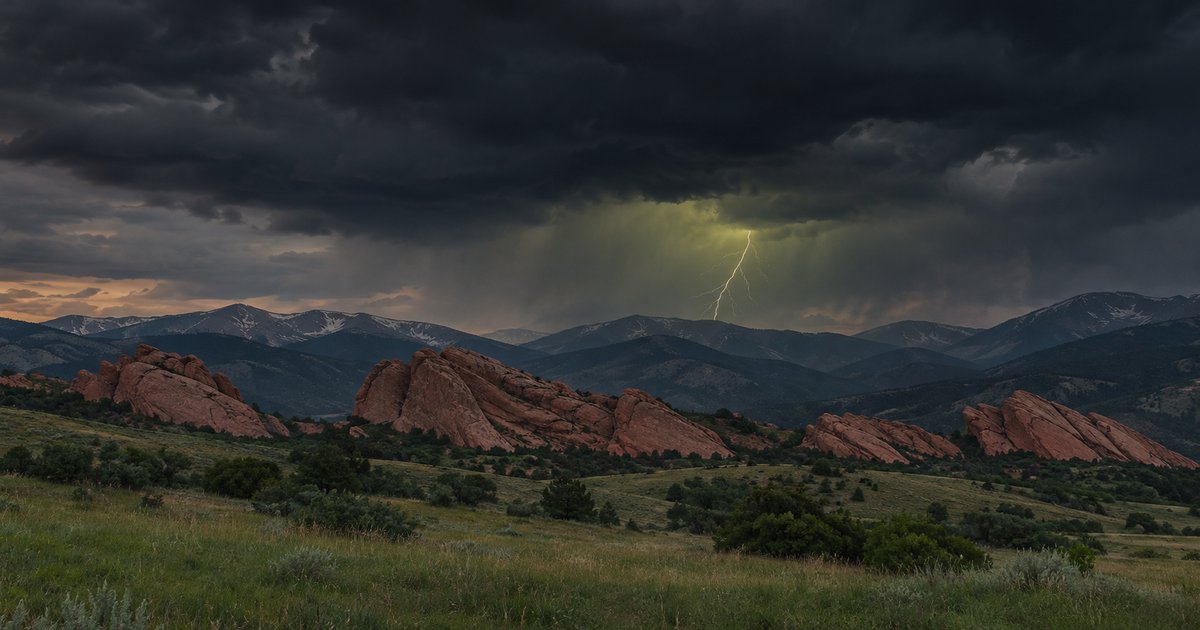
Denver-area lightning often follows a warm-season afternoon pattern, but no clock time predicts an individual storm. A 2019 Colorado study of 1996–2016 cloud-to-ground flashes describes storms developing near the Front Range in late morning or early afternoon and moving east; for a specific outing, the National Weather Service Denver/Boulder forecast, alerts and venue rules matter more than that historical average.
Why an afternoon plan needs room to change
A 2019 Colorado lightning climatology by National Weather Service forecasters and a University of Colorado Colorado Springs researcher analyzed cloud-to-ground flashes from 1996 through 2016. Its discussion of warm-season observations describes storms developing near the mountains and plains interface in late morning or early afternoon, then moving east onto the plains. That pattern helps explain why a walk in the foothills and an afternoon game farther east can face changing conditions on the same day. It does not set an arrival hour for either place. The National Weather Service also explains the general afternoon buildup of thunderstorms: summer sun heats air near the ground, and unstable rising air can form storm clouds and lightning.
The Colorado paper also identifies the Denver convergence/vorticity zone, a terrain-influenced wind circulation over northeastern Colorado that changes where cloud-to-ground flashes cluster. The study says its wind flow can raise flash rates where air converges and lower them where it diverges. That is a regional distribution, not a reliable rule that a particular Denver neighborhood will be missed. Moisture and instability still matter, and storms can form or change in ways a seasonal average cannot resolve.
When the historical lightning season peaks
The same 2019 study found that 99.6% of Colorado cloud-to-ground flashes in its 1996–2016 dataset occurred from April 1 through October 31. Its statewide activity rose as North American monsoon moisture arrived in early July, peaked from late July into early August, and fell sharply in late August. These are statewide historical measurements, not a Denver count or a forecast. The paper says most April-through-June activity lay along the mountains and plains interface and extended east onto the plains. Later in summer, lightning activity increased across the state.
For Denver-area plans, the practical distinction is between a season that deserves extra attention and the weather on the actual day. A July afternoon is not automatically stormy, and a morning or a date outside the peak is not an all-clear. The National Weather Service says thunderstorms can occur at any time of year over most of the United States. People heading farther into exposed high terrain have a different route decision; the hiking above treeline guidance addresses that turnaround problem.
How to read the Denver/Boulder office’s official checks
The National Weather Service Denver/Boulder office’s Denver Metro Decision Support page combines several different products. Its watches, warnings and advisories section is for issued hazards. Its hourly and weekly forecast lets a reader click a spot for a local forecast. Its severe weather section includes an outlook and separate tornado, hail, wind and flash-flood potential displays. Its radar and GLM lightning section shows observations: radar reflectivity and recent Geostationary Lightning Mapper flashes. A flash shown there is a report of something detected, not a prediction of the next flash.
For a park, field or trailhead, start with the spot forecast for that location and the office’s issued alerts, then revisit them close to departure. The office’s outdoor-event planning page tells organizers to use a point forecast for their venue, including daily and hourly views. It also describes a 24-hour weather-impact display in two-hour increments. Those are useful for arranging staff and a shelter route, but an hourly forecast cannot promise a lightning-free hour. The same NWS page warns that rapidly changing weather can arrive without a warning first. The regional thunderstorm outlook categories add context; they do not replace the venue forecast or an alert from the local office.
Check the timestamp and the product name when moving between these displays. A watch describes a general area and time of possible hazardous weather; a warning means hazardous weather is imminent, according to the Denver/Boulder event page. Radar depicts precipitation, while GLM flashes depict observed lightning. A clear-looking radar area is therefore not a reason to wait outside after thunder. The NWS lightning rule is to seek substantial shelter when thunder is heard.
Local rules for fields, trailheads and school sports
At the foothills edge of the metro area, Boulder Open Space and Mountain Parks tells visitors to read posted regulations at each trailhead because they vary by area. Its closures page says some advisories or closures arise suddenly and asks visitors to watch for signs during a visit. That makes a trailhead notice a separate check from the weather forecast. A parking lot, open-sided shelter or trail sign does not provide lightning protection; the University of Colorado Boulder Mountain Research Station advises a substantial building or hard-topped metal vehicle at the first thunder. Where to shelter from lightning explains why common outdoor structures do not protect people.
For school sports, the Colorado High School Activities Association’s policy, posted March 25, 2026, calls for a venue-specific emergency plan, a staff member to monitor weather, and a route to a substantial building or enclosed metal vehicle. It directs outdoor venues to evacuate when a thunderstorm seems imminent, lightning is seen or heard, or a weather app indicates lightning within 10 miles. By the time lightning reaches 10 miles, the policy says people should already have left the athletic site and reached shelter. CHSAA also says to wait at least 30 minutes after the last thunder or visible lightning before resuming, restarting the clock with each new event. The association’s policy applies to its activities; a city park, pool or other organization may have its own operating rule. The 30-minute wait after thunder is the baseline to understand before a game begins.
What to do when thunder interrupts the plan
The Mountain Research Station’s Front Range guidance says hearing thunder means lightning is close enough to strike and calls for moving immediately into a substantial building or hard-topped metal vehicle with the windows up. It specifically rejects picnic shelters, tents and porches as protective places. For a group, that means naming the building or vehicle destination before people spread across a field or trail. If the route to shelter takes time, the first thunder is already a reason to leave the exposed place.
Lightning Tracker is an iPhone app that can alert when it detects a strike within a radius set for a place; it works beyond the United States as well. It does not replace official warnings or local procedures.
Not a substitute for official weather warnings.
If you hear thunder, seek shelter even if the app shows no nearby strike.
Sources
- Hodanish, Vogt and Wolyn, Colorado Lightning Climatology
- National Weather Service, Understanding Lightning: Thunderstorm Development
- National Weather Service Denver/Boulder, Denver Metro Decision Support
- National Weather Service Denver/Boulder, Weather Ready Resources and Planning Tools for Outdoor Special Events
- City of Boulder Open Space and Mountain Parks, OSMP Rules and Regulations
- City of Boulder Open Space and Mountain Parks, OSMP Closures
- Colorado High School Activities Association, Lightning Policy and Procedures
- University of Colorado Boulder Mountain Research Station, Safety