 Lightning Tracker
App Store
Places and activities
Oregon thunderstorms and lightning: fire season and official checks
November 19, 2026 · 6 min read
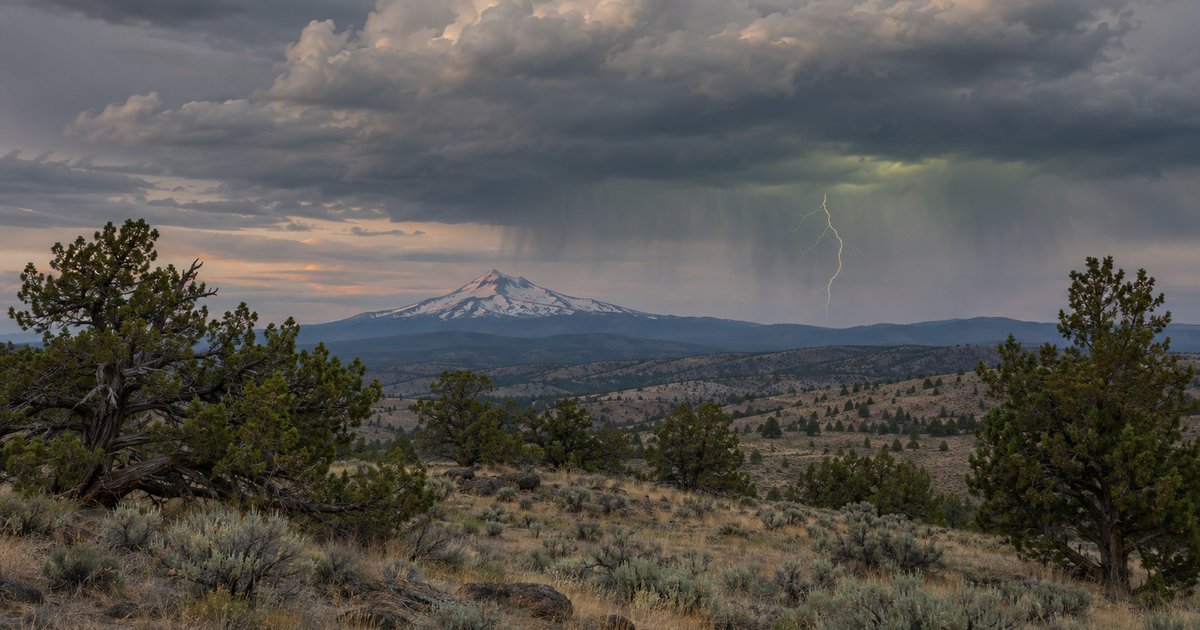
Oregon had 494,797 total lightning events in Vaisala Xweather's 2025 report, and dry-season storms can turn some strikes into fire starts. That statewide, historical count cannot show lightning near a particular trail, school or town. For a place-specific decision, use its serving National Weather Service office and the Oregon fire agencies' information; this article supplies the Oregon context behind those checks.
What Oregon's two lightning figures count
Vaisala Xweather ranked Oregon 39th among the states and Washington, DC, with 494,797 total lightning events in 2025. The report defines an event as an individual in-cloud pulse or cloud-to-ground stroke detected by its network. Several ground strokes can belong to one flash, so the total is not a count of separate ground-hit locations. The difference between events and flashes matters before comparing it with older ground-flash statistics. A state total also pools many regions and days; it cannot describe the conditions at a campsite or stadium.
The National Lightning Safety Council's state table, dated January 2026, lists zero recorded lightning deaths in Oregon for 2016 through 2025. That table counts people who died, not strikes, fire ignitions or injuries. Zero in this ten-year record is no promise about a future storm or an exposed person. The death period and the event-count year also differ, so dividing one figure by the other would not produce a personal risk estimate. The national state rankings likewise answer a different question from whether thunder is near one Oregon location.
Southern Oregon's season and the fire connection
The National Weather Service office in Medford has studied lightning over southern Oregon and northern California since about 2015. Its regional cloud-to-ground flash chart shows a spring spike followed by multiple summer peaks. That is a pattern for the Medford forecast area, not a start and end date for all of Oregon. A July trip east of the Cascades and a spring event in southwest Oregon need their own local forecast and shelter plan, rather than a statewide seasonal rule.
Oregon's fire connection is concrete. NASA Earth Observatory reported on July 28, 2026, that dry thunderstorms formed over the Cascades on July 15 and moved east across Oregon and Washington. NASA said its satellites began detecting numerous wildland fires in central and eastern Oregon by the following day. The satellite account documents that episode; it does not mean every detected lightning event started a fire. The general process behind storms with little rain at the ground matters here because dry vegetation can remain vulnerable when a thunderstorm gives a place little useful rainfall.
The Oregon Department of Forestry says its meteorologists monitor factors affecting wildfire ignition and behavior during fire season. Its public fire statistics page distinguishes tracked large fires from year-to-date lightning-caused and human-caused fires in areas under ODF's primary protection. ODF's long-term fire occurrence statistics cover its protection jurisdiction, about 16 million acres of private and public forestland, rather than every acre in Oregon. A forest-fire tally from that page therefore has a narrower boundary than Xweather's statewide lightning count.
In a July 30, 2026 preparedness release, the Oregon Department of Emergency Management urged residents and visitors to check local fire regulations, prepare for evacuation and follow up-to-date fire information as they travel. The release noted that additional human-caused starts stretched crews already responding to lightning-caused fires. Lightning may be beyond a visitor's control, but the state's separate prevention rules still apply to campfires, vehicles and equipment. Fire restrictions and evacuation notices can change by location, so the relevant agency's current notice matters more than a season label.
Oregon school activities have a specific rule
The Oregon School Activities Association publishes lightning guidelines for people deciding whether to suspend or restart its outdoor practices and contests. Its posted guidelines say to suspend play and move to the designated shelter when thunder is heard or cloud-to-ground lightning is seen. After suspension, the rule calls for at least 30 minutes after the last thunder or visible flash before resuming; each later thunder or flash restarts the count. The association also says detection within 10 miles can help with a suspension decision, but hearing thunder or seeing lightning takes priority over a device. These are school-activity procedures, not a rule for every Oregon park, worksite or private event.
The same OSAA guideline calls for a substantial building with plumbing and wiring, or a fully enclosed metal car or school bus, as the designated place. A coach or organizer has to know where the group will go and how long the move takes before play begins. The broader school lightning plan includes those practical decisions; a low Oregon fatality count does not remove them.
Thunderstorms in Portland, Salem and Central Oregon
A Portland thunderstorm search and a Central Oregon strike search need different local NWS forecasts. NWS point-forecast pages identify Portland as the serving office for Portland and Salem, while the Bend point forecast identifies Pendleton. Those examples locate a forecast office; they do not say a thunderstorm is occurring or expected in either city. The NWS local-forecast search lets a reader enter the exact city or ZIP, then follow the serving-office link above the forecast icons. For a trail outside a city, use the location-specific forecast rather than assuming the nearest city has the same conditions.
Central Oregon's July 2026 fires also show why city wording cannot stand in for a state fire picture. NASA's July 28 account described lightning moving east from the Cascades and subsequent wildland fires in central and eastern Oregon. The Oregon Department of Forestry's fire-information page shows its tracked fires and identifies the jurisdiction covered by its statistics. A Portland reader looking at a forecast, a Bend reader planning an outdoor event and a traveler checking fire restrictions are asking different questions, even when all search for Oregon thunderstorms.
Oregon lightning maps, recent strikes and official quick links
This site has no live Oregon lightning map. Oregon does not have just one National Weather Service office. The Oregon Department of Forestry's fire-weather page names Portland for northwest Oregon, Medford for southwest and south-central Oregon, Pendleton for parts of the northeast and north-central state, and Boise for parts of northeast and southeast Oregon. The NWS says a city-and-state or ZIP search identifies the serving office above the local forecast. That lookup is more precise than choosing an office by its headquarters city. The ways to check nearby lightning have different jobs: radar depicts precipitation, while a lightning detection product depicts detected electrical activity.
For “lightning strikes Oregon today” or “last 24 hours,” NOAA's nowCOAST is an official observation route. NOAA says it displays near-real-time lightning strike density derived from a land-based cloud-to-ground detection network. Density highlights lightning cores rather than plotting each individual strike, so it is not a 24-hour statewide strike total. For “Oregon thunderstorm forecast” or a warning, use the serving NWS office and the Storm Prediction Center outlook instead; an outlook describes possible storms, not observed strikes. The NWS says radar does not give lightning information, even though it can show precipitation near a storm.
- NWS local-office lookup — enter an Oregon city or ZIP to reach the serving forecast and warnings.
- Oregon Department of Forestry fire weather — its Portland, Medford, Pendleton and Boise office routes.
- NOAA nowCOAST — official lightning strike-density observations; check the display time.
- Storm Prediction Center outlooks — official thunderstorm outlooks; read the issue time and area.
- NWS radar — precipitation imagery, not a lightning-strike display.
- Oregon Department of Forestry fire information — fire situation and the scope of ODF statistics.
- OSAA 2026–27 handbook, lightning guidelines — the association's school activity procedure.
Lightning Tracker is an iPhone app that works in Oregon and elsewhere; its free map shows detected lightning from the last 30 minutes and the distance to the nearest detection. It does not replace official warnings or the procedures at a school or venue.
Not a substitute for official weather warnings.
If you hear thunder, seek shelter even if the app shows no nearby strike.
Sources
- Vaisala Xweather, The Annual Lightning Report 2025
- National Lightning Safety Council, Deaths by State from 2016 to 2025
- National Weather Service Medford, Hourly Lightning Climatology for Continental United States
- NASA Earth Observatory, Smoke Blankets Oregon
- Oregon Department of Forestry, Fire Danger & Weather
- Oregon Department of Forestry, Information & Statistics
- Oregon Department of Emergency Management, Oregon State Agencies Remind Everyone to Be Informed and Prepared
- Oregon School Activities Association, 2026–27 Handbook: Lightning Safety Guidelines
- National Weather Service, Contact Your Local NWS Office
- National Weather Service, Basics of Weather Radar
- National Oceanic and Atmospheric Administration, Real-Time Observations
- National Weather Service, Portland Point Forecast
- National Weather Service, Salem Point Forecast
- National Weather Service, Bend Point Forecast
- National Weather Service, SPC Product Reference Sheet