 Lightning Tracker
App Store
Places and activities
Vancouver thunderstorms and lightning
November 19, 2026 · 4 min read
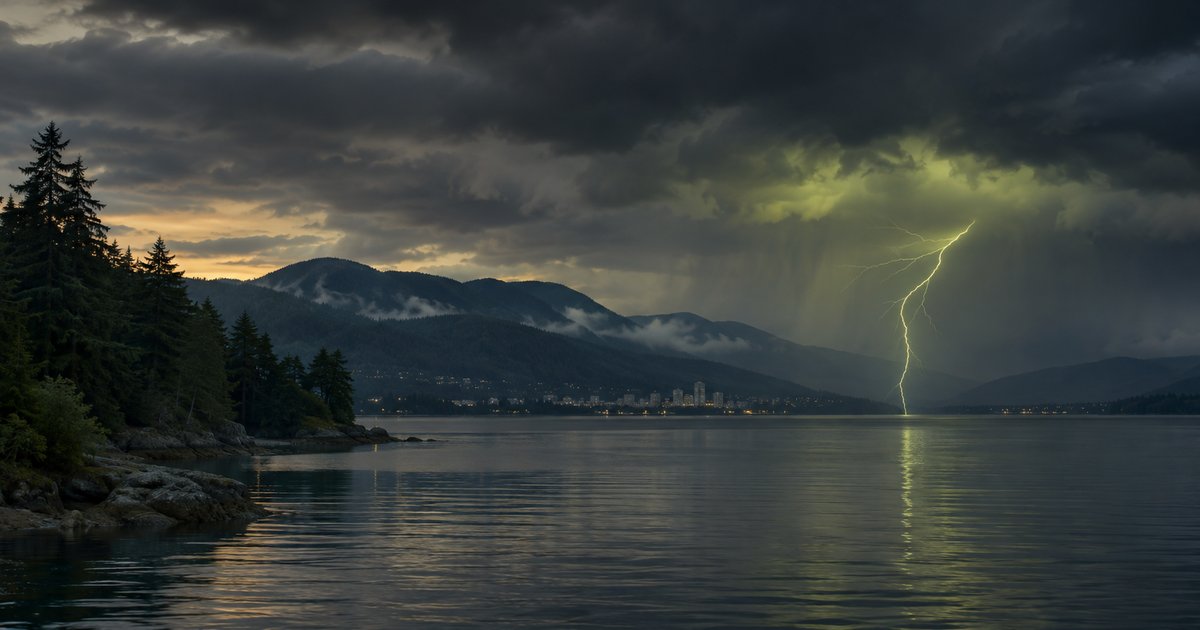
Vancouver thunderstorms are uncommon, but they do happen: Environment and Climate Change Canada counted an average of 12.8 days a year with detected cloud-to-ground lightning within 25 km of the city centre in 1999–2018. When thunder threatens an outdoor plan, check ECCC’s Vancouver alert text and Lightning layer; the August 2026 storm showed that a rare event can still disrupt the region.
How often does lightning reach the Vancouver area?
Environment and Climate Change Canada (ECCC) counted an average of 12.8 days a year with at least one detected cloud-to-ground flash within 25 km of Vancouver’s centre in 1999–2018. Its total for that circle was 1,663 flashes across the 20 years. The measure is for a broad area around the city, not 12.8 thunderstorm days at every address or 1,663 strikes within city limits. ECCC recorded 10.4 lightning days around Richmond and 24.6 around Kelowna by the same method. The difference gives Vancouver’s coastal rarity some scale without suggesting that a storm cannot occur there.
Natural Resources Canada’s 2016 coastal climate assessment describes summer on the Pacific coast as relatively free of storms under a ridge of high pressure. It says most West Coast precipitation is steady rain rather than the showers associated with convection, and that thunderstorms are rare in the region. This describes the regional climate, not a rule for an individual day. ECCC’s 1999–2018 lightning-season analysis says lightning can occur virtually year round in the Pacific coastal region, so “summer storm” is a useful pattern, not a strict season boundary.
The August 2026 storm showed the exception
On the night of August 22–23, 2026, an unusually strong thunderstorm brought lightning and heavy rain to southern B.C. The Canadian Press reported that ECCC issued severe thunderstorm warnings for Metro Vancouver and other South Coast areas. Vancouver International Airport said lightning prevented departures and arriving aircraft from taxiing to gates between 9 p.m. and 3 a.m. CityNews Vancouver reported that the airport issued a red alert, paused airfield operations and cancelled 50 flights. Those accounts describe one event, not a new normal for the city.
The airport interruption illustrates why a rare storm can matter across a large metro area. CityNews quoted an airport official explaining that employees and passengers could not be out on the airfield during the thunder-and-lightning storm. A flash seen from downtown, Richmond or the North Shore need not mean the same thing happened at every point: ECCC’s city statistic counts detections within a 25 km circle. For an individual outdoor decision, the agency’s advice responds to lightning you see or thunder you hear, rather than an annual average.
Where to check Vancouver warnings and lightning
ECCC’s Weather Alerts guide, read in November 2026, defines a watch as a call to get ready when conditions favour severe weather and a warning as a call to act when severe weather is happening or expected. Open Canada.ca/weather or WeatherCAN, choose your Vancouver location, and read the full alert for its area, timing and actions. ECCC’s 2026 severe-thunderstorm guidance says warning polygons can target part of a wider alert zone; a watch can remain over the larger zone while a warning covers a smaller area. That is why the headline alone is less useful than the full alert and its location.
For detected strikes, ECCC directs readers to the Lightning layer of its Weather Information map or to WeatherCAN. Its Lightning Map guide says brown circles mark ground strikes and a larger circle means more detections in an area. The display updates every minute, and its one-hour animation groups earlier detections into six-minute frames. These are observations, not a forecast of the next strike. ECCC says an empty layer can reflect no ground strike in the last hour, a delayed update, in-cloud lightning, or a missed detection. The age and gaps on lightning maps matter when reading any detected-strike display.
ECCC’s webmapping guide places Alerts, Lightning and Radar in separate layer switches. Radar depicts precipitation; a ground-strike circle is a different observation. ECCC notes that lightning can appear without radar rain because a storm produces little precipitation at ground level, the two updates arrive at different times, or radar misses precipitation. That is why lightning and radar layers need their own reading. Neither a dry-looking radar image nor an empty lightning layer overturns thunder heard outdoors.
What to do at a beach, park or field
The City of Vancouver’s former hazards guide described thunderstorms and lightning as rare and gave two direct instructions: “Take shelter inside” and “Stay away from the water.” Those words are from an earlier City page and are quoted as historical guidance. ECCC’s live lightning-safety overview says to take shelter in an enclosed building with wiring and plumbing or an all-metal vehicle when thunder is heard. It says gazebos and picnic shelters do not protect people and directs anyone on or in water to reach shore as quickly as possible. These distinctions matter at beaches, the seawall, playing fields and open parks.
ECCC says to wait at least 30 minutes after the last rumble of thunder before returning outdoors. A new rumble restarts that wait. Counting the interval between a flash and its thunder can estimate distance, but flash-to-bang distance is not a reason to remain outside once thunder is audible. The useful destination is an enclosed building or metal-topped vehicle, as the shelter guidance explains; a tree or open shelter does not provide that protection. The 30-minute wait begins after the last thunder, not when rain stops.
Lightning Tracker is an iPhone app that shows recent detected strikes on a map and their distance and direction from your location. ECCC’s warnings and local instructions remain the official checks for Vancouver.
Not a substitute for official weather warnings.
If you hear thunder, seek shelter even if the app shows no nearby strike.
Sources
- Environment and Climate Change Canada, Lightning activity in Canadian cities
- Environment and Climate Change Canada, Lightning activity: maps and statistics
- Natural Resources Canada, Canada’s Marine Coasts in a Changing Climate
- The Canadian Press, Intense storm brings power outages, travel woes to parts of B.C.
- CityNews Vancouver, Once-in-a-decade thunderstorm grounds flights
- Environment and Climate Change Canada, Weather Alerts
- Environment and Climate Change Canada, Severe thunderstorms and tornadoes
- Environment and Climate Change Canada, Lightning Map
- Environment and Climate Change Canada, Weather: webmapping
- City of Vancouver, Prepare for other disasters (archived January 21, 2024)
- Environment and Climate Change Canada, Lightning safety overview