 Lightning Tracker
App Store
Places and activities
Lightning on the Grand Canyon rim: what the park says
November 19, 2026 · 8 min read
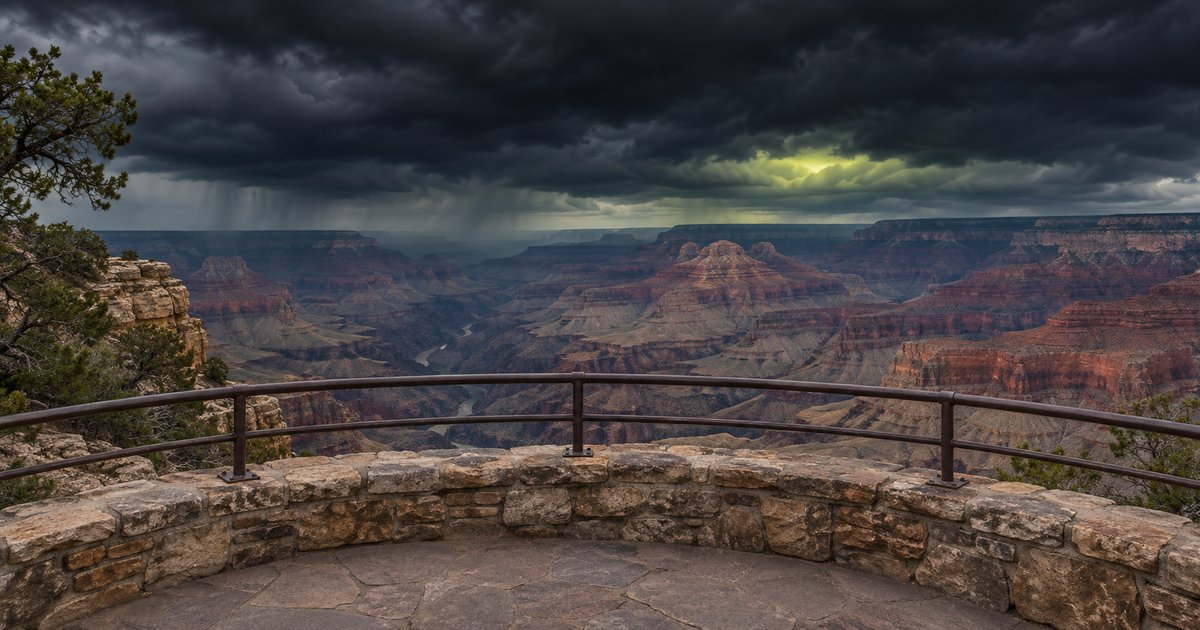
The National Park Service tells Grand Canyon visitors to move away from the canyon edge, railings and rocky outcrops at the first thunder and to get into a building, a vehicle with the windows closed or a shuttle bus. Its weather page says the park’s summer thunderstorms mainly come between 11 a.m. and 6 p.m. in July, August and early September, and its weather-dangers page says lightning can strike 10 miles (16 km) across the canyon, so being below the rim does not put you out of reach.
The Grand Canyon’s thunderstorm season runs from July into early September, mostly between 11 a.m. and 6 p.m.
The National Park Service says summer thunderstorms frequently occur at Grand Canyon during July, August and early September, with torrential rain, frequent lightning and sudden flash floods possible, and that they occur mainly between 11 a.m. and 6 p.m. (park weather page, last updated February 18, 2025). The same page describes how a day builds: it often begins clear, clouds build by mid-morning, and strong ground heating lifts warm air into powerful thunderstorms whenever there is enough moisture. Some rain evaporates before it reaches the ground, and the park says lightning from these dry thunderstorms can ignite forest fires.
The National Weather Service office in Flagstaff gives a wider picture for northern Arizona as a whole: monsoon rain comes most days in the form of afternoon and evening thunderstorms. The park adds that its storms are extremely variable in intensity and location, so neither description is a schedule for a given day. The park’s lightning page also says that lightning strikes Grand Canyon National Park an average of 25,000 times per year. The page does not say which years that average covers, so treat it as the park’s own round figure.
The Park Service tells visitors to leave the canyon edge, railings and rocky outcrops at the first thunder
The Park Service’s Grand Canyon lightning page tells visitors to move away from the canyon edge, leave open areas immediately and avoid rocky outcrops, lone trees, the tallest trees, poles, railings and bodies of water. Its paragraph for visitors with no shelter adds a separate line: “Do not touch metal guard rails.” A park news release dated July 16, 2013 gave the same advice about metal railings when lightning is nearby. The lightning page’s footer reads “Last updated: August 3, 2018”, and the page was still online on November 11, 2026, so check the park’s current notices before you go.
The National Weather Service says height, a pointy shape and isolation are the dominant factors in where a bolt strikes, and says metal objects such as fences and poles do not attract lightning but are excellent conductors. Because the park’s list names the edge and railings together, an overlook can combine an exposed edge with a metal rail. That pairing is this article’s reading of the list, not a park statement.
The park says lightning can strike two points up to 10 miles (16 km) apart at the same time, whether or not blue sky is visible. A 2013 ranger podcast transcript on the same page names the most common visitor mistakes in thunderstorms as not avoiding the rim and neglecting to find proper shelter. The page also treats hair that stands on end as a sign that a strike is looming, while the National Weather Service says that if you hear thunder, lightning is close enough to strike you, and to move to shelter then. For the count, the park says to divide the seconds by 5 for miles, to treat lightning within 6 miles (10 km) as a high-danger zone, and that danger continues for 30 minutes after the last lightning or thunder event.
Park news releases record three lightning incidents at the South Rim between 2011 and 2021
The park’s news releases for three incidents are the documented rim cases found for this page. As of November 11, 2026, their original nps.gov addresses answer “page not found”, so the sources list links the Internet Archive’s copies. No published count of Grand Canyon lightning injuries appears in the sources read here, so the table is a set of examples, not a tally.
| Date and time | Where | What the release says |
|---|---|---|
| August 4, 2011, about 1:45 p.m. | Near Mohave Point on Hermit Road; the Rim Trail about a quarter mile (0.4 km) to the west | Rangers found CPR in progress on a woman who had collapsed after lightning struck very near her party. Five people with her were also injured. Responders could not revive the woman, who was part of a visiting tour group. |
| July 15, 2013, about 1:00 p.m. | Near Mather Point; a group standing near the rim | Several visitors reported injuries. Four people were taken to the South Rim Clinic for evaluation of non-life-threatening injuries. |
| July 20, 2021, about 2:50 p.m. | Bright Angel Trailhead, during a monsoon thunderstorm | Two people were found unresponsive. One regained consciousness without help, and the other’s pulse returned after CPR. Storm activity ruled out air transport, so both went by ground to Flagstaff Medical Center. At least two others went to the Grand Canyon Clinic with lightning splash injuries. |
All three releases remind visitors that if thunder follows a flash in 30 seconds or less, they should take shelter in a building or vehicle or go to the nearest bus stop for a park shuttle. The National Weather Service’s rule uses no count: if you hear thunder, it says, lightning is close enough to strike you. By this article’s reading of the times, all three incidents fell between about 1:00 and 3:00 p.m., inside the park’s 11 a.m. to 6 p.m. window. The 2011 release adds that lightning continued to threaten people outdoors, so rangers took the injured group to the park’s Emergency Operations Center to get them out of the lightning.
On the rim, the Park Service names a building, a closed vehicle and a shuttle bus as shelter
The Park Service’s lightning page tells visitors to get to a shelter, meaning a building, a vehicle with the windows closed or a shuttle bus, as quickly as possible. That matches the National Weather Service’s two options, a substantial building with electricity or plumbing or an enclosed, metal-topped vehicle with the windows up. Once inside, the park adds, do not touch rock walls or any metal on vehicles or structures. Campers are told to wait out the storm in a structure or vehicle, not a tent.
The park’s bus rule is specific: for a shuttle bus, locate a designated bus stop. It also tells visitors to know the nearest structure or vehicle and how long it takes to reach it. On Hermit Road, the park says shuttle service is suspended during summer thunderstorms or other inclement weather between the Village Route Transfer Station and the viewpoints to the west. Drivers will try to carry visitors east to the transfer station or act as standing shelters along the route, and buses with spare capacity will stop wherever stopping is possible without added risk and pick visitors up. A separate park document, the Trip Planner PDF (undated), says buses stop only at designated stops and will not pick visitors up at the roadside during a storm. The two park texts differ on roadside pickup, which is a reason to check the park’s shuttle page before you go. That page, last updated September 11, 2026, says service may be suspended during inclement weather. This article lists no routes or times, because they change by season.
Below the rim, the park says there is little cover and that being below the rim is not a low spot
The Park Service’s weather-dangers page says lightning can strike 10 miles across the canyon, so being below the rim does not put you in a low spot (page last updated March 12, 2025). The 2013 ranger podcast transcript says backcountry travelers in the canyon do not typically have a structure to shelter in. The South Kaibab Trail page, updated October 26, 2026, says the trail’s openness means extreme summer heat and little to no protection from passing storms. It and the Bright Angel Trail page both say that from July to September monsoons can build large, violent lightning storms, and to seek shelter immediately.
For hikers with no shelter, the weather-dangers page says to go to low-lying areas away from cliff edges, lone trees, poles and metal objects, to make sure the area is not subject to flash floods, and not to seek shelter in caves or alcoves. The National Weather Service agrees on the last point: it says never to use a cliff or rocky overhang for shelter and that cave entrances are dangerous during thunderstorms. It also says there is little you can do to substantially reduce your risk outside, and that the only fully protective step is to get into a building or vehicle. The park’s lightning page adds that hikers should learn where emergency phones are located on the trails. Other storm hazards come with the same storms. The park says rushing floodwaters may be the first sign of heavy rain at rim level, and it tells hikers to watch and listen for rockfalls during and after downpours.
Checking a live strike map beside the sky
Lightning Tracker is an iPhone app that shows recently detected strikes on a live map, with the distance and direction to the nearest one and how many minutes ago it was detected. It alerts you when a strike is detected inside the radius you set for each place, 10 miles (16 km) by default. Its 30-minute wait starts after the last strike detected inside that radius and begins again with each new one; when the wait ends, the app reports what it observed and leaves the judgment to you. Detection networks miss some strikes and data can arrive late, which the app marks as a delay or gap and does not treat as calm. It is a check beside the sky and the park’s guidance, not a replacement for either, and it does not replace official warnings or the park’s procedures.
Not a substitute for official weather warnings.
If you hear thunder, seek shelter even if the app shows no nearby strike.
Sources
- National Park Service, Grand Canyon National Park, Lightning Danger
- National Park Service, Grand Canyon National Park, Weather Dangers
- National Park Service, Grand Canyon National Park, Weather and Climate
- National Park Service, South Kaibab Trail
- National Park Service, Bright Angel Trail
- National Park Service, Grand Canyon National Park, Shuttle Buses
- National Park Service, Grand Canyon National Park, Trip Planner (PDF)
- National Park Service news release, August 4, 2011, Lightning Causes One Fatality and Five Injuries at Grand Canyon National Park (Internet Archive copy)
- National Park Service news release, July 16, 2013, Lightning Causes Minor Injuries at Grand Canyon National Park (Internet Archive copy)
- National Park Service news release, July 21, 2021, Lightning Strike Causes Injuries at Grand Canyon National Park (Internet Archive copy)
- National Weather Service Flagstaff, Northern Arizona Monsoon Season
- National Weather Service, Lightning Tips
- National Weather Service, Lightning Safety When You Are Outdoors
- National Weather Service, Lightning Myths